Verify AI Citations Before You Trust Them
Audience: Intermediate readers who use AI for research, writing, study, technical decisions, or evidence-based work.
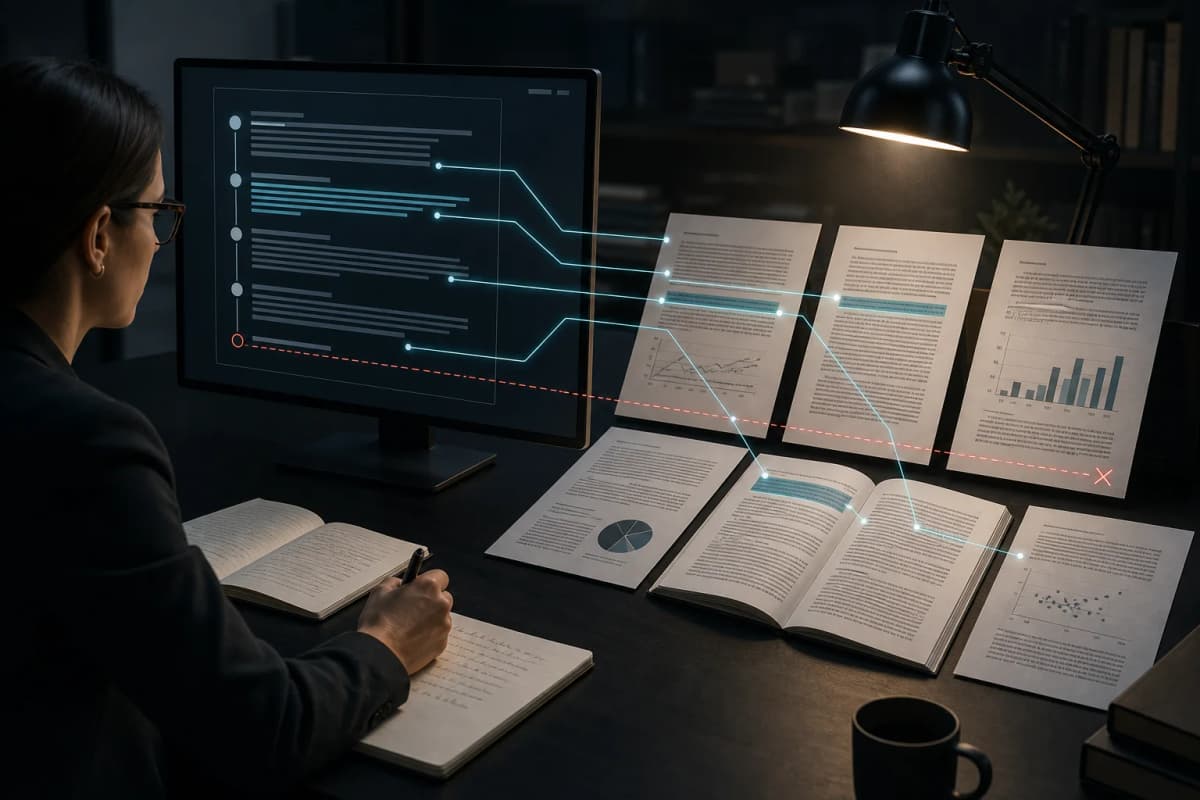
To verify AI citations, confirm two separate facts: the source exists, and the source supports the exact claim. A DOI lookup can settle the first question. Only the relevant passage can settle the second.
The safest workflow has five steps:
This process takes minutes for a short answer. It also catches the two most dangerous failure modes: a plausible reference that never existed, and a real source that says something narrower or different from the AI's prose.
Why a linked source is not enough
Current AI products can search the web and attach citations. Their providers still tell users to check important claims. OpenAI's current accuracy guidance lists fabricated studies, citations, and references among possible errors, then advises readers to visit sources directly.
A source link can fail at four layers:
| Layer | Question | Common failure |
|---|---|---|
| --- | --- | --- |
| Existence | Does the work exist? | Invented title, journal, author, or DOI |
| Identity | Is this the named work? | Wrong year, version, paper, or similarly titled source |
| Support | Does the source support the claim? | The passage is unrelated, contradictory, or much narrower |
| Scope | Can the result carry the conclusion? | Small sample, different population, proxy metric, or missing limitation |
Checking only the URL leaves the last three layers unresolved. Checking only the title still leaves support and scope unresolved.
The same checks apply to more than papers. A link to product docs may exist but describe another version. A benchmark may report a score under different hardware or prompts. A policy page may cover another place or date.
What recent research found about AI citations
Four studies help separate measured failure from practical inference. None proves that every cited AI answer is unreliable. Together, they show why source identity, passage support, and decision risk need separate checks.
Non-existent references have reached real papers
The May 2026 paper LLM hallucinations in the wild audited 111 million references across 2.5 million papers in arXiv, bioRxiv, SSRN, and PubMed Central. The authors estimated 146,932 hallucinated citations in 2025, using a pipeline that matched titles against scholarly indexes and applied additional cleanup and search stages.
That number is a conservative estimate inside the studied repositories. The method can miss obscure works and misclassify records when metadata differs. It detects non-existent references more directly than it detects a real paper used to support the wrong claim. The safe conclusion is narrow: fake citations now appear in real research.
Citations can increase false reliance
A study released on August 1, 2026 tested a source-linked clinical assistant with 46 physicians. In Large language models improve physician accuracy but lead to false reliance, average accuracy rose from 70.8% without the assistant to 82.6% with it. Perceived citation support increased adoption of correct advice from 34% to 76.9%.
The same cue created a risk. When incorrect advice appeared supported, resistance fell from 92% to 34.8% in the observed decisions. The study does not establish that exact effect for other jobs or daily research. Its clinical setup, study order, and small set of harmful decisions limit how far readers can extend the result. The measured gap still warns against treating a cited answer as a trust signal.
Claim-level checks work better than visual inspection
VetScore, released on August 4, divides a long answer into claims, checks each claim against cited excerpts, scores potential harm separately, and then calculates a risk-adjusted result. The authors validated the components against annotations from veterinary experts and reported correlations up to 0.78 for fact verification and 0.76 for harm scoring across tested judge models.
The paper checks cited excerpts, not facts from an outside search. It does not test omissions, human medicine, image inputs, or real-world outcomes. Readers can still use its core method: split the text into claims, check each one, and spend more time where an error could cause harm.
Polished reports can hide weak evidence chains
HiEviDR-Bench represents research as a graph from evidence to intermediate claims and then to a conclusion. Its 2,000 human-validated questions cover text and multimodal evidence. Across 16 tested multimodal models, the authors found a gap between report quality and citation accuracy, claim construction, and answer correctness.
The benchmark uses a test corpus and model judges alongside human review. It does not measure every research tool or live workflow. It does show that polished prose is weak proof. Trace each claim back to its source.
The five-step workflow to verify AI citations
Use a small evidence ledger. A spreadsheet, note, or issue template works. Store one row per material claim with these fields:
claim | citation as given | stable identifier | source passage | status | risk | notesThe ledger keeps each check tied to its claim. It also leaves an audit trail when the text changes.
1. Freeze the exact claim and citation
Copy the sentence that depends on evidence. Preserve qualifiers, dates, numbers, comparison groups, and causal language. Then copy the citation exactly as the AI presented it.
Avoid checking an entire paragraph as one unit. Split it when the sentence contains separate factual propositions. For example:
This sentence contains at least two claims: a measured drop and a claim about all industries. One source might support the first and provide no proof for the second.
Mark statements that need no external evidence, such as a clearly labeled opinion or recommendation. Spend verification time on factual claims that change a decision.
2. Confirm the source identity
Search for a stable ID first: DOI, PubMed ID, arXiv ID, standards number, case number, or official docs URL. Match the title, authors or agency, date, journal, and version.
Crossref's REST API documentation describes records deposited by publishing members and supplemented by trusted sources. Its API can confirm bibliographic metadata and expose corrections or post-publication updates when present. OpenAlex provides an open catalog of scholarly works and their connections to authors, sources, institutions, and topics.
These tools help answer, “Is this the named work?” They do not answer, “Does this work support the sentence?” Their records can be incomplete or stale. If records disagree, prefer the publisher, conference, court, regulator, or authors' current version and note the conflict.
Stop and reject the citation when you cannot find the work after checking multiple stable fields. Do not replace it with the nearest plausible paper and pretend the original was correct.
3. Open the primary source
Follow the identifier to the paper, standard, dataset, release note, statute, or official documentation. Use a secondary article only to locate or contextualize the primary source.
Check the version and date before reading the result. A preprint can change after peer review. Product documentation can describe the current release while the AI answer discusses an older one. A retraction, correction, or updated benchmark can reverse the safe interpretation.
Paywalls can block full verification. Label the claim unverified when you can access only an abstract and the claim depends on methods, subgroup results, or limitations outside it. An abstract is evidence for what the authors chose to summarize, not a substitute for the full study.
4. Match the claim to a passage and its scope
Find the exact table, figure, paragraph, or section that should support the claim. Record enough context to find it again: page, section, table, figure, or paragraph heading.
Classify the relationship:
Read around the matching sentence. Check the population, sample size, baseline, comparison, uncertainty, outcome definition, and time period. Separate correlation from causation. Confirm whether the number is absolute or relative and whether it came from a preregistered primary outcome, exploratory subgroup, model simulation, or vendor benchmark.
For technical claims, record the model version, prompt, data split, hardware, quantization, latency percentile, and cost. Use the same checks when you benchmark AI models for real work→.
5. Decide according to risk
Verification effort should rise with the cost of being wrong. A low-risk background fact may need one authoritative source. A medical, legal, financial, security, or safety claim needs expert review, current jurisdiction or version checks, and independent corroboration.
Use four actions:
| Finding | Action |
|---|---|
| --- | --- |
| Source exists and directly supports the scoped claim | Accept and cite the primary source |
| Source supports a narrower statement | Rewrite with the missing condition and mark qualified |
| Source is missing, mismatched, or contradictory | Remove or reject the claim |
| Evidence remains unclear and the decision is high-risk | Ask a subject-matter expert |
Do not average a supported low-risk claim with an unsupported high-risk claim. The risk-weighting idea in VetScore is useful here even when you verify manually: prioritize dosage, legal duty, security control, financial exposure, and other claims that can cause material harm.
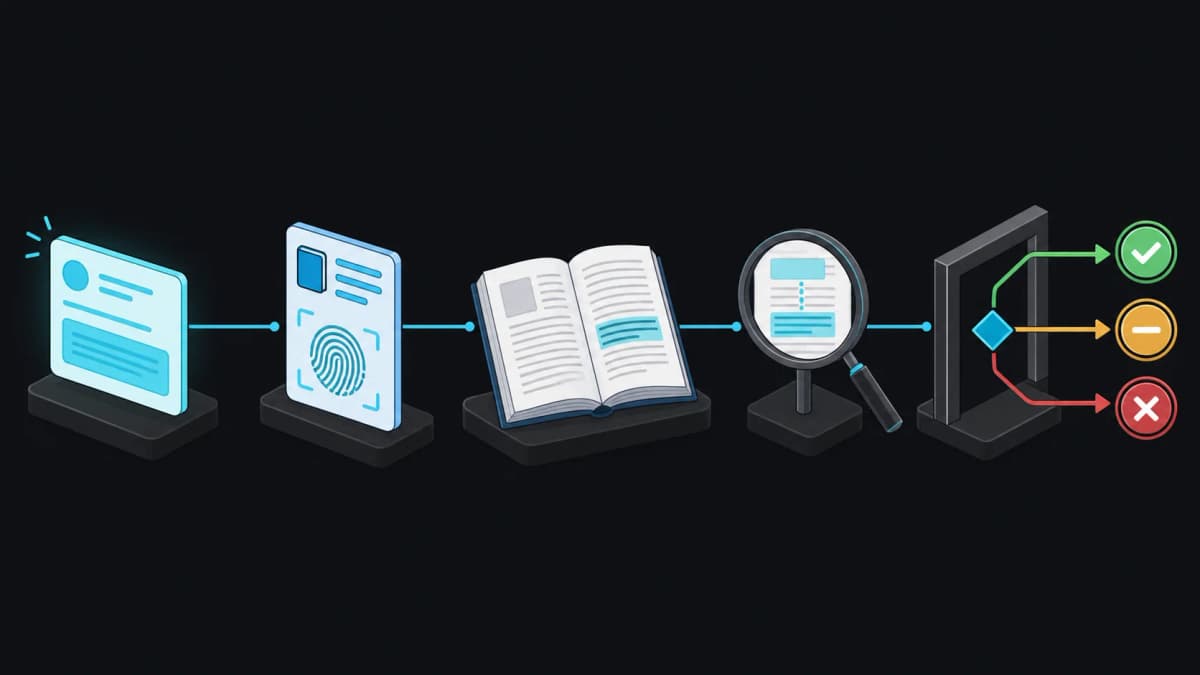
*Capture the claim, confirm the source identity, open the primary source, match the passage, and route the result by risk.*
A reproducible worked example
Take this claim from the earlier research section:
Run the five checks:
2605.07723 names the paper, authors, May 8, 2026 submission date, and version.The final wording carries the evidence boundary instead of copying the most dramatic number.
What automated citation checkers can and cannot do
Automation is strong at repetitive identity checks. It can normalize titles, match authors and years, resolve identifiers, flag missing works, detect duplicate references, and produce a queue for review.
The open-source RefChecker repository documents checks against Semantic Scholar, OpenAlex, Crossref, DBLP, and ACL Anthology. It combines deterministic prefilters with optional LLM-based extraction and deeper searches. The project was active when checked on August 5, 2026, with releases and commits on the previous day. That activity shows ongoing engineering work, not independent proof of accuracy.
Keep a human in the support step. Title matching cannot decide whether a study's result applies to another population. An LLM judge can repeat the same overreach found in the answer. Full-text extraction can lose tables, footnotes, or negation. A checker should return evidence and uncertainty, not a green badge that ends review.
Teams that build source-linked systems can reuse the stages in a RAG evaluation workflow→. Test retrieval, citation fit, claim support, and answer quality on their own. Calibrate any score against labeled examples from the real field. The guide to LLM confidence calibration→ explains why a raw model score is not a probability.
A reusable AI citation verification checklist
Before quoting, publishing, or acting on an AI-generated source, confirm each item:
The workflow cannot guarantee truth. It creates a traceable reason for trusting, narrowing, or discarding each claim. That is a stronger standard than trusting a fluent answer because it arrived with links.
Claim checks
| Claim | Status | Evidence boundary |
|---|---|---|
| --- | --- | --- |
| AI systems can fabricate studies, citations, and references. | Verified | OpenAI documents the limitation; the wild-citations study measures non-existent references in a defined scholarly corpus. |
| A DOI or metadata match proves claim support. | Rejected | It establishes source identity. The relevant passage and scope must still be checked. |
| The wild-citations study found exactly 146,932 fake references across all scholarship in 2025. | Rejected | The paper reports a conservative estimate for its studied repositories and detection method. |
| Citations always make AI-assisted decisions safer. | Rejected | CORA improved average physician accuracy but also measured lower resistance to apparently supported incorrect advice. |
| CORA proves the same effect in every domain. | Rejected | The study involved 46 physicians in a structured clinical setting. |
| Claim decomposition and excerpt verification form a tested pattern. | Qualified | VetScore validates the pattern in veterinary long-form QA; external fact-checking and other domains need separate validation. |
| Professional report quality proves grounded evidence aggregation. | Rejected | HiEviDR-Bench found a gap between report quality and citation, claim, and answer results in its tested systems. |
| Automated reference matching can replace passage review. | Rejected | It can reduce identity-check work but cannot establish every claim's scope and interpretation. |