
Benchmark AI models on the work you plan to ship, not on a leaderboard built for someone else's task. A public benchmark can identify a strong candidate. It cannot tell you whether that model will complete your workflow reliably.
Audience: Intermediate — developers, product teams, and technical buyers choosing a model for a real application.
To benchmark AI models for real work, give every candidate the same representative tasks, grade the resulting state rather than the wording, repeat each task, record latency and cost, and set a rollout gate around the failures you cannot accept. The winning model is the cheapest option that clears those gates consistently. It is not necessarily the model with the highest average score.
What should an AI model benchmark answer?
A useful benchmark should answer one operational question:
That sentence forces six details into the open:
Public benchmarks usually hold a different combination of these variables. Model cards and release notes still help: they narrow the candidate list and reveal supported modalities, context limits, pricing, and known safety behavior. July 2026 releases illustrate the distinction. OpenAI published broad capability and safety results for GPT-5.6, while Google documented lower token use and price for Gemini 3.6 Flash relative to its previous Flash model. Those are useful priors, not measurements of your prompt, tools, data, or error budget. (OpenAI, Google)
The NVIDIA NIM free AI API case study→ shows how a translation workflow can turn model choice into measurable throughput and consistency. For coding candidates, start with the focused free AI coding agents comparison→. Then move the decision into your own test set.
Why one average score hides production risk
Three recent benchmarks expose the same problem from different domains.
Partial credit can hide end-to-end failure
APEX-Accounting evaluates models on 160 accounting tasks across ten synthetic companies, using spreadsheets, PDFs, and other files. Accounting experts wrote the tasks and success criteria. The researchers ran nine frontier models eight times per task, producing 11,520 trajectories.
The strongest model reached 56.4% on the paper's partial-credit metric, Mean Criteria@3. Yet no model exceeded 2.6% on Pass^8, which asks whether all eight attempts at a task succeeded. The best Pass@8, which asks whether at least one of eight attempts succeeded, was 21.5%. Ninety-three of the 160 tasks were never completed perfectly by any tested model in any run. (APEX-Accounting)
The authors measured close-cycle accounting tasks in a controlled synthetic environment. They did not cover tax, audit, consolidation, multi-entity or multi-currency work, or external reporting. The task set was also filtered for difficulty using three frontier models, which may depress scores or favor some model families. The practical conclusion is narrower than “AI cannot do accounting”: a model can satisfy many individual checks while remaining too inconsistent for an unattended, multi-step workflow.
A valid output can still miss the user's constraint
TREK tests travel-planning agents on 800 tasks against a synthetic knowledge base with 212,530 records. Its evaluator checks rules and final state deterministically rather than asking another language model to judge the plan.
The strongest tested agent completed 46.2% of feasible tasks perfectly. It was hallucination-free on 94.9% and executable on 86.3%, but satisfied all user constraints on only 50.7%. The system could produce plausible, bookable plans while missing an implicit preference or cross-step requirement. (TREK)
TREK uses a synthetic travel world, excludes live prices and availability, and reports one run per agent. Its reasoning comparison is a single-pair, cross-version observation rather than a matched controlled ablation. It still demonstrates a durable evaluation rule: check the final state and every binding constraint. Fluency is not task completion.
The benchmark itself may be broken
An OpenAI audit of the 731-task public split of SWE-Bench Pro found a second source of false confidence: faulty evaluation data. An automated pipeline flagged 27.4% of tasks as broken, while a five-engineer annotation process marked 34.1%. The issues included underspecified prompts, overly strict tests, and tests that allowed incomplete solutions to pass. OpenAI estimated that roughly 30% of the benchmark was broken and retracted its earlier recommendation to use it. (OpenAI benchmark audit)
A hard test is useful only when a known-good reference result passes it and a wrong result fails it for the right reason.
How to benchmark AI models in seven steps
1. Define the decision before the test
Write the production decision in one line:
Change the numbers for your product. Keep the structure. A benchmark without a decision rule invites cherry-picking after the results arrive.
Separate hard gates from optimization metrics:
A model that violates a hard gate loses even when its average score is higher.
2. Build tasks from the work, not from a demo
Start with real, de-identified examples when you are allowed to use them. Add synthetic cases to cover rare failures, but do not let synthetic prompts replace the distribution users create.
A practical first suite can contain 30 to 50 tasks:
Those percentages are a starting template, not a statistical standard. High-impact systems need broader coverage and domain review. Keep a separate holdout set so prompt tuning does not quietly overfit the benchmark.
Tag every task by language, input type, risk, difficulty, and expected behavior. Aggregate scores can improve while one important slice gets worse.
3. Specify observable outcomes
Grade the artifact or system state whenever possible:
Anthropic's evaluation guidance makes the same distinction between the transcript and the outcome: an agent may say a flight was booked, but the relevant check is whether the reservation exists in the database. It recommends deterministic graders where possible, model-based graders where necessary, and human review for calibration. (Anthropic)
Use partial credit to diagnose a failure, not to approve deployment. A task-perfect rate tells you how often the whole job finished. Criteria coverage tells you which requirement usually breaks.
4. Freeze the test conditions
Record the complete configuration for every run:
Do not compare one model with a tuned prompt and another with a generic prompt unless the question is specifically “which complete system should we deploy?” A model benchmark and a system benchmark answer different questions.
Provider APIs change. For example, Google's current model guide says Gemini 3.6 Flash ignores deprecated sampling parameters and will reject them in future generations. A reproducible record prevents a silent configuration change from looking like model drift. (Google model guide)
5. Run paired, repeated trials
Run every candidate on the same task IDs. Paired comparisons reduce noise from differences in test difficulty.
One run measures an anecdote. Repeated runs expose variance:
Three repeats per task provide an inexpensive first view of instability. Five to eight repeats give a clearer picture for high-variance or high-risk workflows. These are pragmatic starting points, not universal sample-size rules. Increase repetitions when candidate scores are close or the deployment consequence is large.
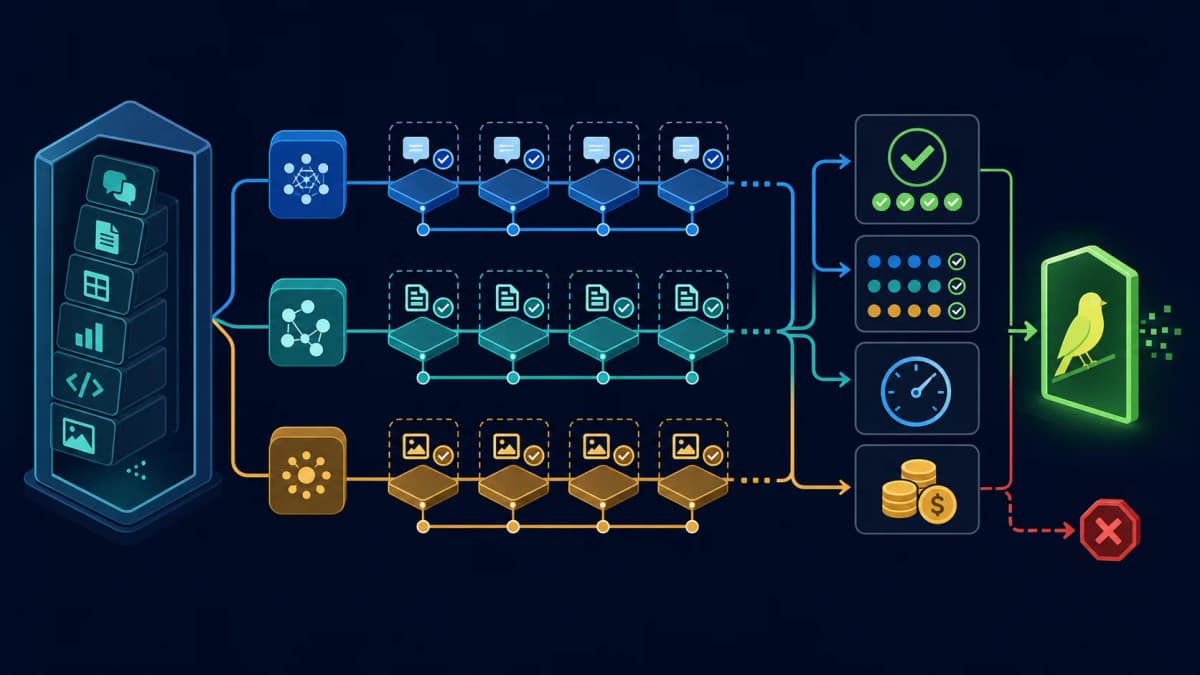
*Run every candidate through the same tasks and repeated trials. Compare outcomes, consistency, latency, and cost before a guarded rollout.*
6. Inspect failures, not only totals
For every failed trial, store:
Useful failure labels include missing constraint, wrong tool, invalid argument, retrieval miss, fabricated fact, premature completion, unsafe action, timeout, and grader defect.
Read a sample of passes too. A loose grader can reward a shortcut that will fail later. A strict grader can reject a valid alternative. If failures do not look fair, repair the task before comparing models.
This is also where a narrow evaluation can help. If retrieval is the weak stage, test it separately with a RAG evaluation workflow→. If a confidence signal controls escalation, calibrate the LLM confidence score→ against labeled outcomes instead of treating it as truth.
7. Apply a rollout gate
Choose the model only after it clears the prewritten rule. Then send a small, reversible share of traffic through the selected configuration.
Monitor the same outcome metrics in production. Add newly observed failures to a regression suite. Keep capability tests, which should remain challenging, separate from regression tests, which should stay close to 100% for behavior the system already supports.
A local benchmark reduces uncertainty. It does not remove distribution shift, provider changes, novel user behavior, or evaluator mistakes.
A scorecard that reflects real work
| Metric | Calculation | Why it matters |
|---|---|---|
| --- | --- | --- |
| Task-perfect rate | Tasks where every required check passed / all tasks | Measures end-to-end completion |
| Criteria coverage | Passed checks / all checks | Locates partial failures |
| First-attempt success | Tasks passed on trial one / all tasks | Captures the user experience without retries |
| Pass@k | Tasks with at least one success in k trials / all tasks | Fits search or generation where alternatives are allowed |
| Pass^k | Tasks where all k trials succeed / all tasks | Exposes consistency risk |
| Cost per successful task | Total model and tool cost / completed tasks | Prevents a cheap but failure-prone model from looking efficient |
| p50 and p95 latency | Median and tail completion time | Shows both normal speed and slow-user pain |
| Hard-gate violations | Count by safety or policy rule | Blocks unacceptable behavior |
Do not collapse every metric into one weighted number too early. A single score can hide a safety failure behind lower cost or better style.
A reproducible starter format
Store tasks in a versioned JSONL file. Keep private or personal data out of the repository.
{"id":"refund-001","input":{"request":"Refund duplicate €42 charge","account_state":"two matching settled charges"},"expected":{"action":"refund","amount_cents":4200,"count":1},"tags":["billing","happy-path"]}
{"id":"refund-002","input":{"request":"Refund my last charge","account_state":"no settled charge"},"expected":{"action":"clarify","must_not":["create_refund"]},"tags":["billing","abstain"]}
{"id":"refund-003","input":{"request":"Refund both charges","account_state":"one settled charge, one pending"},"expected":{"action":"clarify","must_not":["refund_pending"]},"tags":["billing","edge-case","high-risk"]}
The grader should inspect the result, not search for persuasive wording:
type Expected = {
  action: "refund" | "clarify";
  amount_cents?: number;
  count?: number;
  must_not?: string[];
};

type ToolState = {
  action: "refund" | "clarify";
  refunded_cents?: number;
  refund_count?: number;
  actions: string[];
};

function grade(result: ToolState, expected: Expected) {
  const checks = {
    correctAction: result.action === expected.action,
    correctAmount:
      expected.amount_cents === undefined ||
      result.refunded_cents === expected.amount_cents,
    correctCount:
      expected.count === undefined ||
      result.refund_count === expected.count,
    forbiddenActionAbsent:
      (expected.must_not ?? []).every(
        (action) => !result.actions.includes(action),
      ),
  };

  return {
    passed: Object.values(checks).every(Boolean),
    checks,
  };
}
Before trusting the task, run a reference solution and a deliberately wrong solution through the grader. The reference must pass. The wrong result must fail for the expected reason.
When should you use an LLM judge?
Use deterministic checks for state, schema, calculations, citations, required fields, and prohibited actions. They are cheap, reproducible, and easy to debug.
Use a rubric-based human or LLM grader when quality cannot be reduced to exact checks: tone, completeness, argument quality, or whether a summary preserves the important nuance. Keep the rubric specific. Include examples of acceptable alternatives and disqualifying errors.
Calibrate an LLM judge against expert labels before using it at scale. APEX-Accounting did this explicitly: its judge was checked against 1,687 human labels and reached an F1 score of 0.970 in that study. That validates the judge for the paper's criteria and data; it does not make the same judge universally reliable. (APEX-Accounting)
When a canonical benchmark is expensive, adaptive sampling can reduce evaluation cost. BayesAME selects items using historical reference-model performance and reports better accuracy-cost trade-offs than several baselines across multiple academic benchmarks. Its current method assumes scalar scores and useful historical item signals. For a small, bespoke suite where a full run is affordable, running every task remains simpler and easier to audit. (BayesAME)
Open-source tools can provide the harness without defining your product requirements. Inspect AI supports task execution, scoring, logs, and retries. LM Evaluation Harness provides a broad collection of academic tasks and model backends. Use them when they fit. A versioned JSONL file plus product-specific graders is often enough for the first useful benchmark.
Common benchmarking mistakes
Testing only the happy path
A model can learn to act but never learn when to stop. Include matched cases where it should act and where it should clarify, abstain, or refuse.
Grading the explanation instead of the outcome
Confident prose can describe an action that never happened. Inspect the database, file, API response, or test result.
Changing several variables at once
If you change the model, prompt, retrieval system, and tools together, you can compare complete systems but cannot attribute the difference to the model.
Tuning on the test set
Move failed examples into a development set while iterating. Confirm the change on untouched holdout tasks before rollout.
Ignoring cost created by failure
Price per token does not include retries, human review, tool calls, or recovery from a bad action. Measure cost per successful task.
Treating a fresh benchmark as permanent truth
Task contamination, saturation, broken graders, and capability shifts can erase signal. Record the benchmark version and revisit whether its failures still look fair.
Claim checks
| Important claim | Evidence | Boundary or uncertainty |
|---|---|---|
| --- | --- | --- |
| Partial-credit scores can coexist with poor end-to-end consistency | APEX-Accounting: 56.4% Mean Criteria@3 for the top model; no model above 2.6% Pass^8 | Synthetic close-cycle accounting tasks; difficult-task filtering may affect scores |
| Valid-looking plans can miss binding constraints | TREK: strongest agent 46.2% task-perfect and 50.7% satisfaction despite higher executability and hallucination-free rates | Synthetic travel world; one trial per agent |
| Benchmark defects can materially distort capability estimates | OpenAI audit: automated review flagged 27.4% and human review 34.1% of SWE-Bench Pro's public tasks as broken | One coding benchmark and one audit methodology |
| Deterministic outcome checks should be preferred when available | Anthropic's evaluation guidance and the deterministic TREK evaluator | Subjective quality still requires calibrated human or model judgment |
| Adaptive item selection can reduce large-benchmark cost | BayesAME reports a stronger estimation-cost trade-off across several academic benchmarks | Depends on historical reference signals and scalar scores |
Frequently asked questions
How many examples do you need to benchmark an AI model?
Thirty to fifty well-chosen tasks can expose obvious differences and failure modes. That is a pilot, not proof. Expand the suite when decisions are expensive, slices are diverse, or candidate scores are close. Report uncertainty and keep a holdout set.
What is the difference between pass@k and pass^k?
Pass@k asks whether at least one of k attempts succeeds. It fits workflows where multiple tries are acceptable. Pass^k asks whether all k attempts succeed. It fits customer-facing or side-effecting workflows where consistency matters.
Should you use an LLM to grade another LLM?
Only when deterministic checks cannot express the quality criterion. Write a specific rubric, compare the judge with expert labels, inspect disagreements, and keep deterministic hard gates outside the judge.
Should cost or quality decide the winning model?
Apply quality and safety gates first. Among the models that pass, compare cost per successful task and tail latency. A low token price does not compensate for retries or recovery work.
The decision rule
Benchmark the workflow you will ship. Grade the state you care about. Repeat the task enough to expose variance. Inspect the failures. Then choose the least expensive model that clears every hard gate and the required reliability threshold.
Leaderboards help you decide what to test. Your task suite decides what earns production traffic.