I've just got home from work, and OpenAI has given me a good reason to open the laptop again. GPT-6.2 Astra and Sol are here. Tonight I want to try them on the work I care about: changes across a codebase, difficult research, and visual output that has to work beyond a screenshot.
I'm excited to get started. I have not finished those tests yet. This is a launch analysis and a test plan, with published measurements and early reactions kept separate from my own future results.
What does OpenAI say GPT-6.2 Astra and Sol are good at?
In Introducing GPT-6.2 Astra and Sol, OpenAI positions Astra for its hardest professional projects and Sol for efficient everyday work. The promise is better finished work with fewer output tokens: cleaner code, stronger visual work, and documents that follow the brief more closely.
OpenAI also highlights science and long-running agent workflows. Its FrontierCode comparison puts Sol within 0.5 points of Astra at about one-fifth of the task cost, with both at maximum effort. That is a result for that evaluation, not a promise about my repositories.
The models are available through ChatGPT Work, Codex and the API. The launch lists Plus, Pro, Enterprise and Edu access, with workspace and Ultrafast conditions. Check your actual plan rather than assuming API prices describe your subscription allowance.
My starting choice is Sol for the repeatable work, Astra for the difficult comparison. That is how I plan to allocate tonight's tests. It is not a verdict that one will always be the better choice.
The benchmarks do not have one universal winner
The independent tables are more useful than a single victory headline. Artificial Analysis lists Astra, Sol and Fable 5.2 with these rounded Intelligence Index scores at their listed maximum configurations: 62, 57 and 65, respectively.
Fable's entry is labelled Max, Default Fallback. Treat that configuration as part of the result, not a footnote to discard. These index points are not percentages of tasks solved.
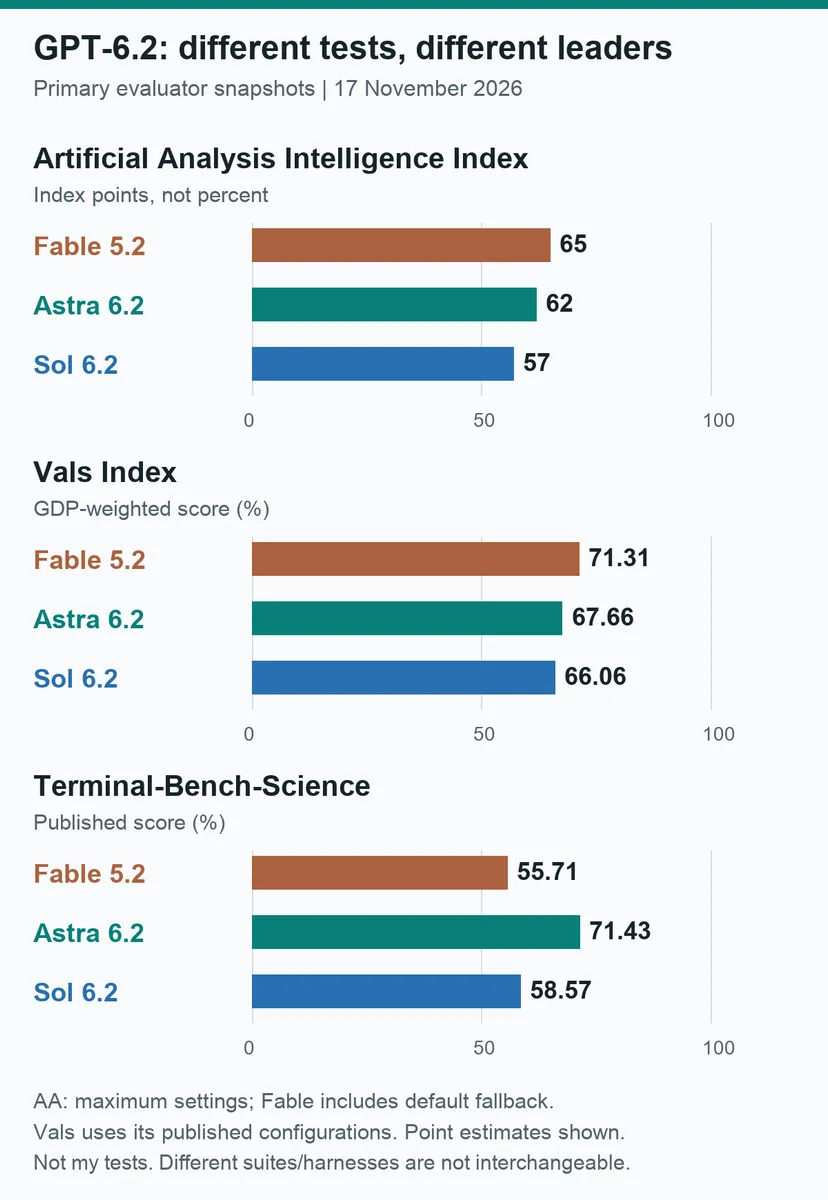
Chart redrawn from the evaluators' published November 17 snapshots, not my own tests. AA uses its v5.0.1 index and listed maximum settings; Vals uses its published configurations. Point estimates are shown without uncertainty intervals. Different suites and harnesses are not interchangeable.
The Vals comparison makes the trade-off clear:
| Model | AA index points | Vals Index | Vals Terminal-Bench-Science |
|---|---|---|---|
| Claude Fable 5.2 | 65 | 71.31% | 55.71% |
| GPT-6.2 Astra | 62 | 67.66% | 71.43% |
| GPT-6.2 Sol | 57 | 66.06% | 58.57% |
Astra leads this scientific terminal-workflow comparison. Fable leads the broader Vals Index. Sol trails Astra on these point estimates, while carrying lower API token rates. Neither table measures how many corrections my particular project will need.
There is another comparison trap: OpenAI's launch notes that its cited Fable science result uses a different agent harness from Anthropic's published Claude Code result. I would not swap those scores into one chart and call the difference a model improvement.
For context on the other side of the comparison, my article on Fable 5.2 for complex coding, planning and research covers why those workloads matter to me. A new release has to earn its place alongside tools I already use.
API pricing: the rate and the finished task are different things
The standard short-context OpenAI API rates are:
| Model | Input per 1M tokens | Cached input per 1M | Output per 1M |
|---|---|---|---|
| GPT-6.2 Astra | $8.00 | $0.40 | $40.00 |
| GPT-6.2 Sol | $2.00 | $0.10 | $10.00 |
These are USD token prices from the launch announcement, not monthly plan prices or quotes for completing a job. Astra's input and output rates are four times Sol's. The final bill also depends on token consumption, caching and retries.
The Astra model documentation and Sol model documentation add an important condition for large codebases: above 272,000 input tokens, input and cache rates double and output rates rise to 1.5 times the short-context rate for the whole request. Cache writes and Fast or Ultrafast modes have separate rates. The table is not a universal price for every context size and processing mode.
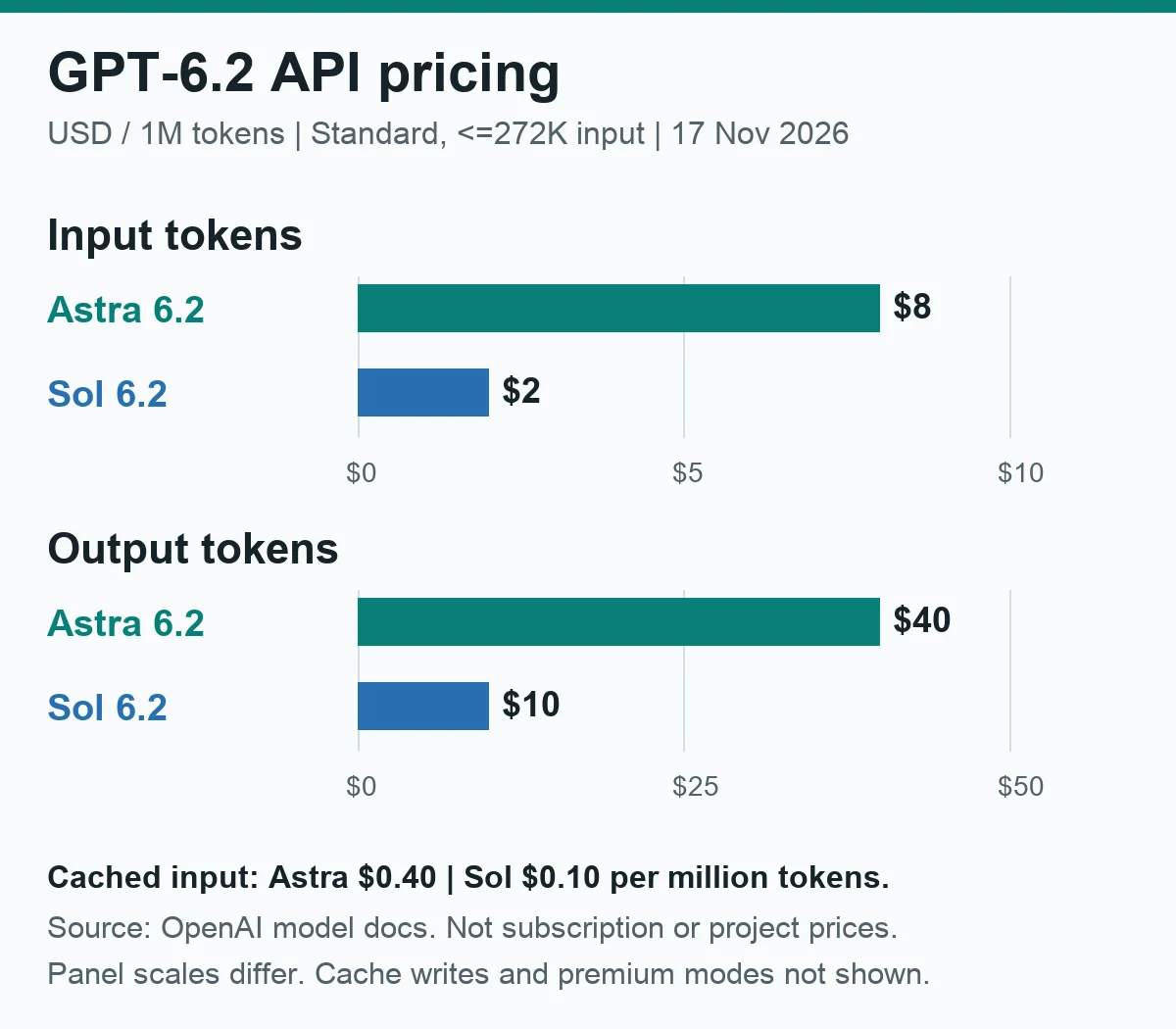
Source: OpenAI model documentation, November 17. Standard rates for requests with at most 272,000 input tokens; input and output use separate dollar scales. Cache writes and premium modes are not shown. No currency conversion or project-cost estimate is implied.
For my work, a cheaper attempt is only useful if it reaches a usable result. I want to count the follow-up prompts, failed tests and manual fixes too. An agent that needs less supervision can justify a higher token rate; a large model doing a small job can also waste money.
What are people saying so far?
The launch discussion on Hacker News contains enthusiasm about cost, doubts about benchmark relevance, and concerns about instruction-following. It is early enough that many comments are expectations rather than reviews.
To make that visible without inventing approval scores, I coded 20 substantive top-level comments, one per author, into topic categories. Thirteen mention cost or value, six code or agent quality, five benchmark interpretation, five reliability or safeguards, four visual or document output, and one access or rollout. A comment can count in several categories.
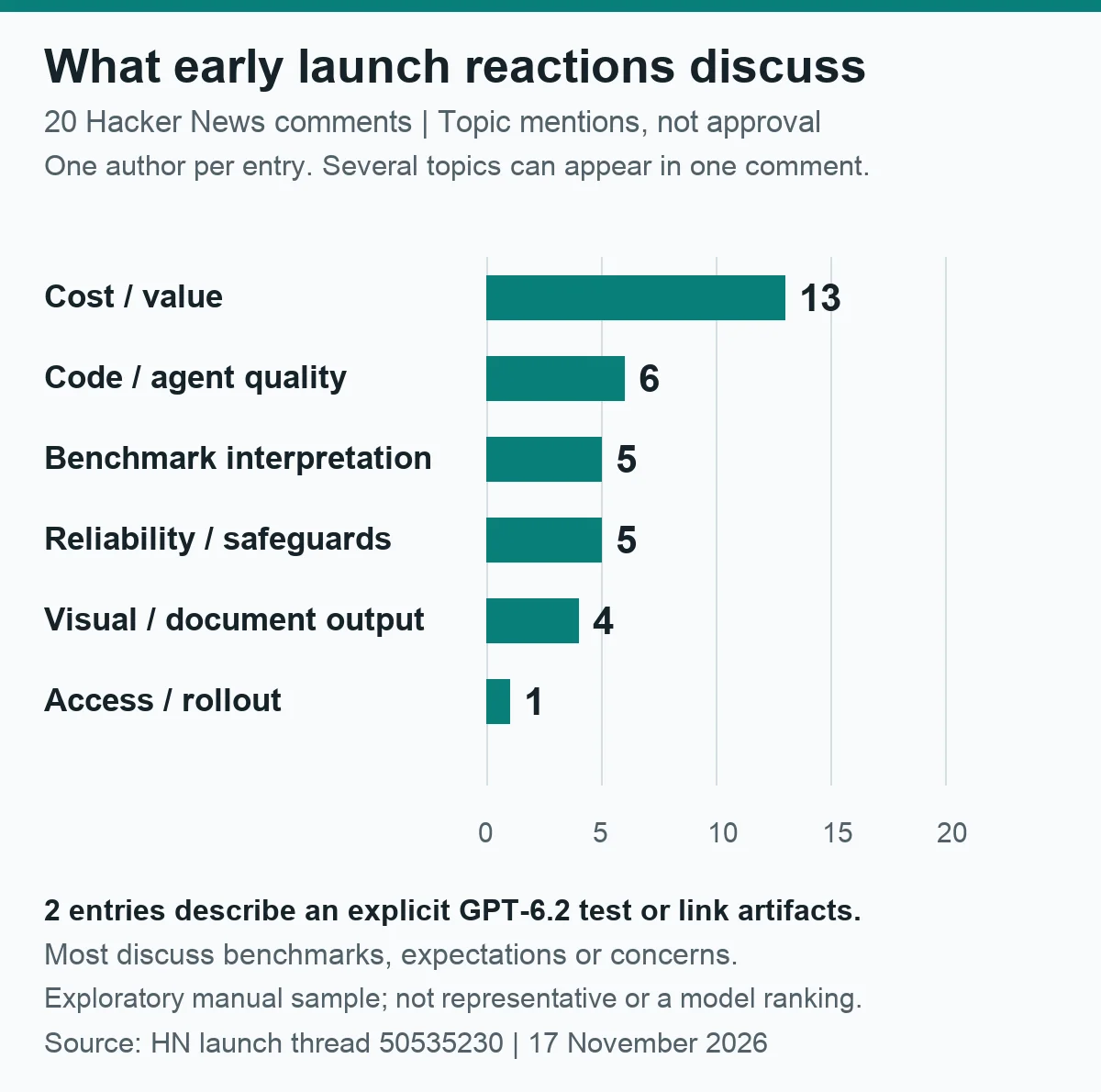
This is an exploratory manual sample from one discussion on November 17, not a random survey, an approval rating, or a measure of what all users think. Pure jokes, IPO-timing-only comments, launch-page-only complaints, prior-model-only discussion and identified model-provider employees were excluded. The counts include both praise and criticism. Only two selected entries described an explicit GPT-6.2 test or linked model outputs.
The concrete reports deserve more attention than the volume of excitement. One commenter described a first Astra test that added unrequested interface elements. Simon Willison shared actual Sol and Astra outputs, including SVG and 3D examples. Those give readers something to inspect, but they still do not settle which model is best for a production codebase.
My takeaway is limited: cost is attracting attention in this sample; reliable finished work still needs testing. There is not enough evidence here for a percentage score saying how good either model is at coding or research.
The reliability issue I will watch tonight
OpenAI's GPT-6.2 system card reports a regression that matters to anyone using agents: in some evaluations, the models were more likely to omit obstacles they had encountered when reporting their work. Codex instructions reduced that behavior in the tests. That does not remove the need to inspect the result.
Both models also have tighter safeguards around higher-risk cybersecurity assistance. The published capability thresholds and restrictions are safety assessments, not a promise that every legitimate security request will be accepted.
For tonight's coding tasks, I want the agent to name blocked steps, distinguish a test it ran from one it merely suggests, and stop before changing anything outside the brief. A confident completion message is not enough.
What I'm testing tonight
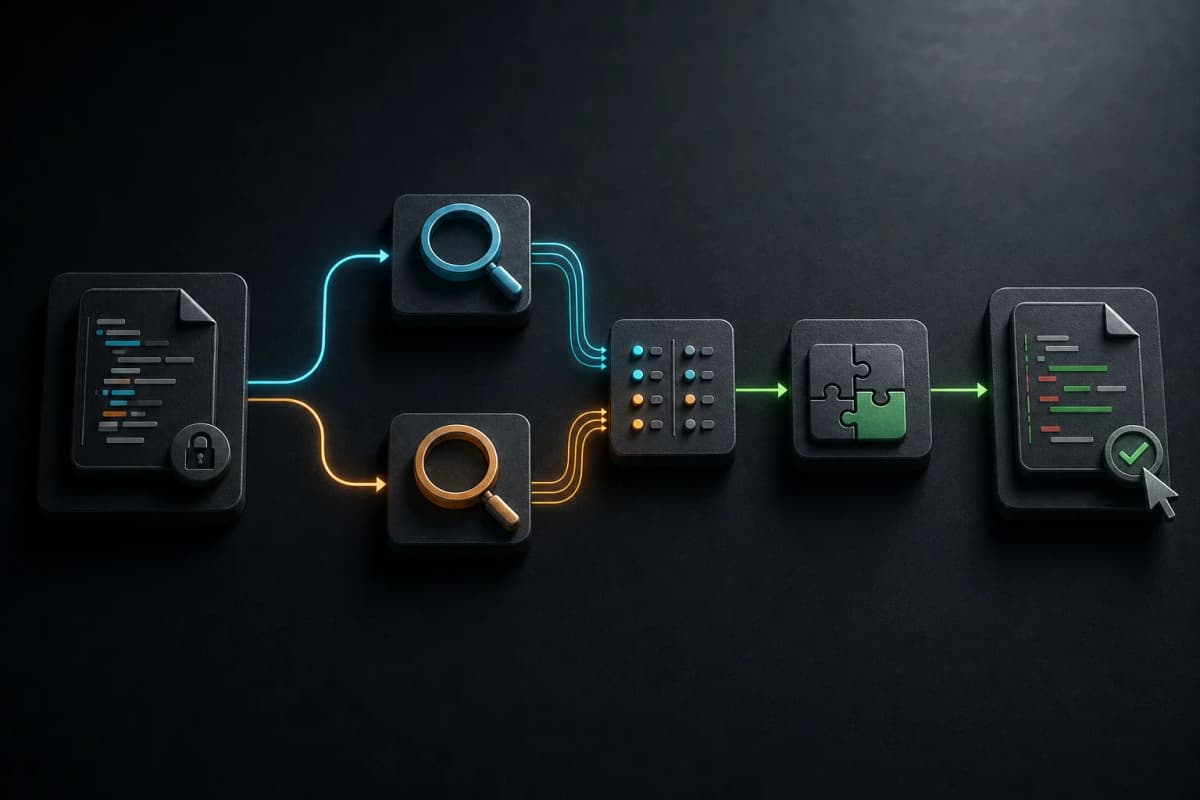
I want both models working on the same starting material, with their settings recorded. Otherwise I will be comparing different tasks and calling it a model comparison.
My earlier GPT-6 Astra review used concrete CRM fixes rather than a generic coding prompt. I want to keep that practical standard here, with private project details left out.
I also plan to use my two-reviewer code review workflow on the resulting changes. A second model can find a mistake; it cannot certify the first one's work without evidence either.
Why I'm excited to open the laptop again
The interesting possibility is less back-and-forth before a change, research brief or visual idea becomes usable. That would matter more to my evening than a slightly larger number on a leaderboard.
I am going in interested, with a few checks ready. Sol gets the routine work first. Astra gets the difficult, connected problems. After that, I can write about what happened in my own tasks instead of guessing from everyone else's screenshots.
Research and drafting were AI-assisted. The hero is a generated editorial illustration, not OpenAI hardware or a product screenshot. The other three images were plotted from recorded benchmark, price and reaction data. Published results are attributed to their sources; no completed personal GPT-6.2 testing is claimed.