Claude Fable 5.2 interests me because I already use Fable for work that is hard to split into small, isolated questions. I use it to build complex plans, bounce ideas around, research a problem and work through codebases where one feature touches several parts of the system.
A small function is rarely the difficult part. The difficult part is understanding what else must change, and what must keep working.
Anthropic released Fable 5.2 on November 9, 2026. The early results look promising for that kind of work. They also show why I would not send every task to it at maximum effort. This is a launch analysis built around my existing Fable workflow, not a claim that I have independently benchmarked 5.2.
Research checked November 10, 2026. The hero is an AI-generated editorial illustration, not an Anthropic interface. The charts below use recorded evaluation data, not generated numbers.
What is new in Claude Fable 5.2?
Fable 5.2 is Anthropic's new model for demanding reasoning and long-running technical work. Its specifications list a one-million-token context window, up to 128,000 output tokens, and support for text and image input with text output. A large context window means it can accept substantial material; it does not guarantee that it will use every detail correctly. Claude Fable 5.2 specifications
Anthropic says output generation is up to 30% faster than Fable 5.1. That is a claim about generating tokens, not a promise that an entire project will finish 30% sooner.
Fable and Mythos 5.2 share the underlying model, but differ in safeguards and access. Mythos is for verified organisations in areas such as cybersecurity and life sciences. A Mythos-only result should not be presented as something every Fable user can reproduce. Anthropic: Fable 5.2 and Mythos 5.2 launch
Why I use Fable when a feature spans the codebase
Imagine adding an approval step to a document-upload workflow. The button is easy to describe. A reliable implementation needs more thought.
The API must check who can approve. The database must store the decision. A background job must avoid sending the same notification twice. The interface needs pending, approved and failed states. Tests must cover two people acting at the same time.
I want the model to understand those connections before it starts editing. Fixing each file separately can leave a feature that works in one screen but fails elsewhere.
Planning and challenging an idea
This is where I like using Fable as a discussion partner. I can describe the outcome, explore different approaches and ask it to challenge the assumptions. I want a plan that identifies dependencies and failure cases, rather than a long task list that sounds organised.
For example, the model should explain whether approval belongs in the existing workflow or needs a separate service. It should also be able to tell me that the smaller change is enough.
Research that informs an implementation
Research is useful when it changes a decision. I want the model to compare documentation, explain trade-offs and separate a confirmed limitation from a guess.
The standard I care about is practical: can I follow the source, check the claim and understand what remains uncertain? A confident summary without that evidence is not enough, regardless of the model.
What do the coding benchmarks show?
Anthropic's launch table reports 49.1% on FrontierCode 2.0, against 32.4% for Fable 5.1 and 45.5% for Opus 5.5. The two Fable results use xhigh effort; Opus uses max. These are selected best-effort results, not an equal-cost comparison.
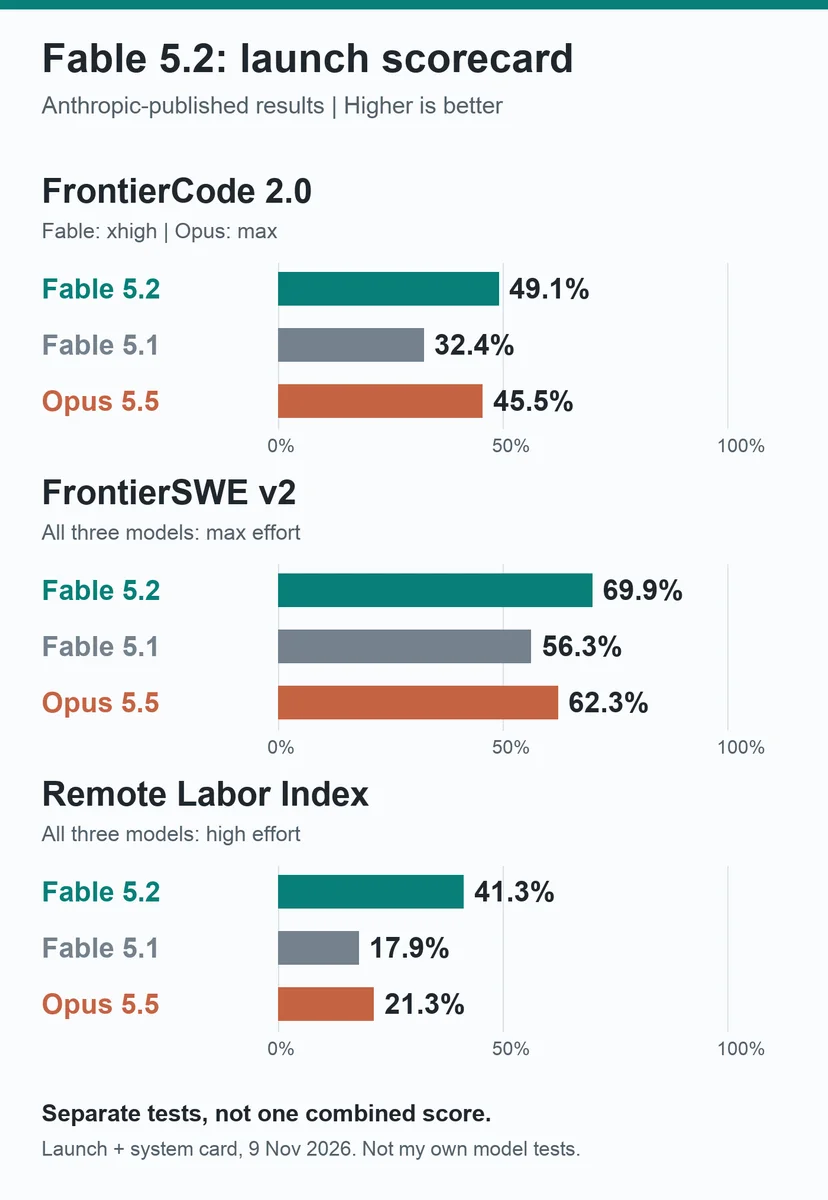
Each panel measures a different task. Do not average the percentages. FrontierSWE v2 uses max effort; the Remote Labor Index Claude runs use high effort, a 200,000-token context and a 32,000-token response limit, according to the system card. Anthropic system card, capabilities section
FrontierSWE is particularly relevant to my interests. Its authors describe 34 long engineering and research tasks, with a 20-hour budget per task. That is closer to sustained problem-solving than completing one short function. It is still a specific test environment, not a forecast for my repositories. FrontierSWE v2 methodology
The Remote Labor Index result is also easy to overstate. A 41.3% score on those projects does not mean Fable can replace 41.3% of jobs. It is a result on a defined set of deliverables.
What are independent testers finding?
The first public tests point to strong capability with important limits. They do not yet amount to a broad consensus about production codebases.
Artificial Analysis lists Fable 5.2 at a rounded Intelligence Index score of 65 at max effort in the snapshot I checked. Its high-effort result is 62. The cost difference is substantial, as the next chart shows. This is a separate evaluation suite from Anthropic's launch table. Artificial Analysis: model results
Spring Prompt ran its own business tests on November 10. Fable led its survey-analysis and simulated advertising-budget tests, but GPT-6.1 Sol was slightly more reliable on factual product listings and much cheaper per listing. Most of those tests ran once; the product-listing tests used three repeats. The team explicitly says it did not benchmark coding agents. I read this as an early reason to test analysis-heavy work, not proof of better software migrations. Spring Prompt: Fable 5.2 review and test limits
Simon Willison found a useful warning in a small SVG-generation experiment. Xhigh produced a result, while max spent its 128,000-token limit thinking and returned no image. That is one reported experiment, not a general failure rate. It is enough to challenge the assumption that the highest setting always produces the best answer. Simon Willison: first Fable 5.2 experiments
How much does it cost, and which effort level makes sense?
Standard API pricing is $8 per million input tokens and $40 per million output tokens. That is 20% below Fable 5.1's $10/$50. Opus 5.5 costs $4/$20. Cache reads for Fable 5.2 are $0.20 per million tokens; cache writes have separate charges. These are API prices, not subscription allowances. Anthropic pricing
Optional fast mode costs $16/$80 per million input/output tokens. Anthropic claims up to 2.5 times faster token generation in that mode. Faster output and a lower price per token are separate things from the final cost of completing a task.
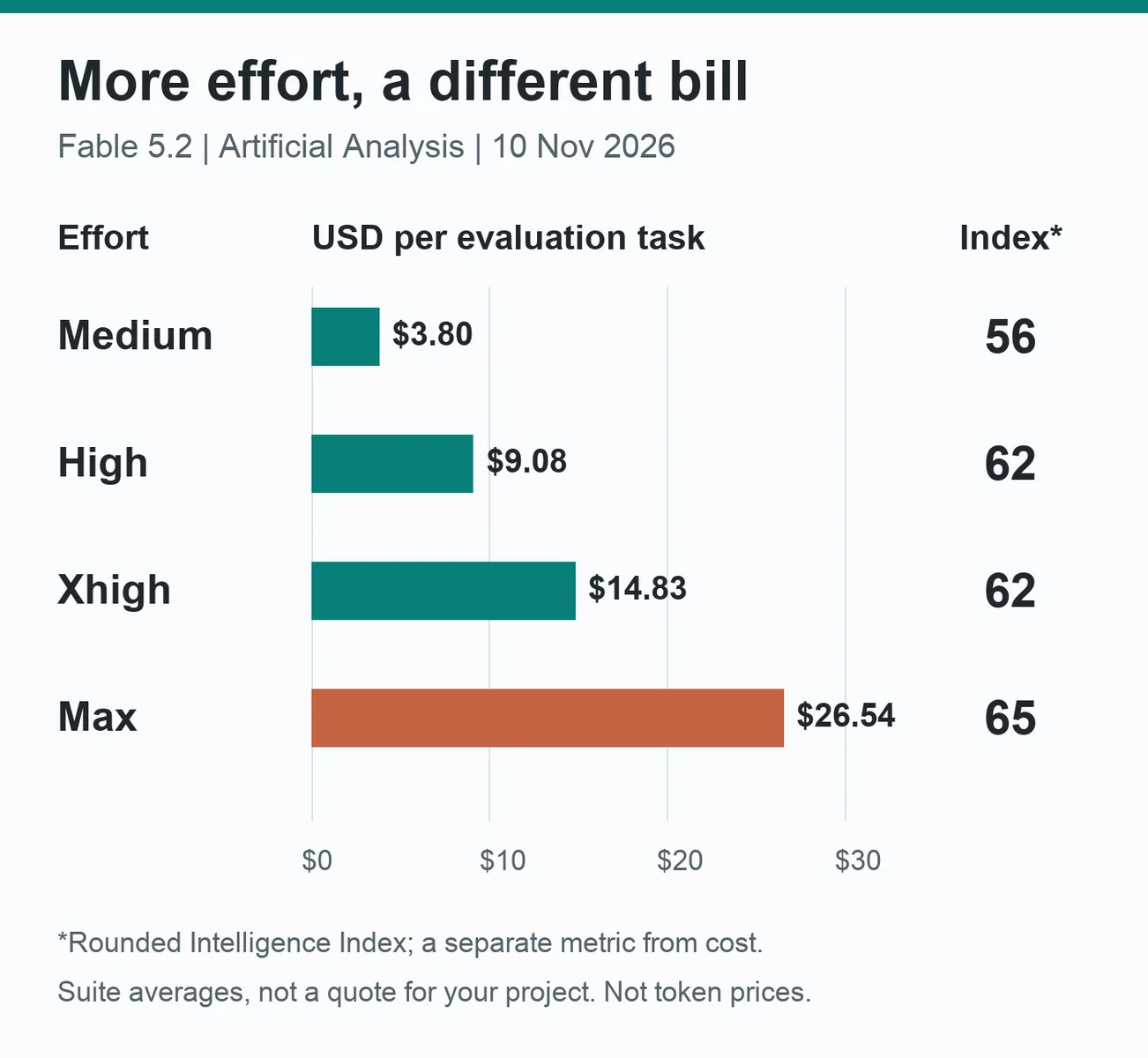
Artificial Analysis snapshot, November 10: medium $3.80, high $9.08, xhigh $14.83, max $26.54 per Intelligence Index task. These are evaluation-suite averages, not quotes for a feature or research project. The rounded index scores are 56, 62, 62 and 65 respectively. Artificial Analysis: effort and cost comparison
Higher effort needs a reason
Anthropic's API defaults to high for Fable 5.2, while its launch page says Claude apps and Claude Code default to medium. Thinking is always on. The effort setting controls how much work the model puts into its response; it is not simply a switch for longer answers.
Anthropic's effort guide recommends high as an API starting point and reserves max for rare tasks where time and tokens matter less. I would compare settings on representative work, then pay more only when the result justifies it. Claude effort guidance
How I would structure a complex coding session
My starting point would be a clear outcome and a request to inspect the existing system. I would want four things from the session:
A starting prompt could be:
Before editing, trace this feature through the existing codebase.
Map its dependencies and explain the main failure cases.
Propose the smallest complete change and the tests that would catch a broken implementation.
Preserve unrelated work. Ask before migrations, publication or deployment.
Afterwards, report what changed, what you verified and what remains unverified.
I would not copy prompts that give the model unrestricted ownership of a client codebase. Anthropic's prompting guide warns that ownership wording can encourage extra changes, even when other instructions limit scope. That is a reason to make the boundaries explicit and inspect the diff. Prompting Claude Fable 5.2
A cheaper model can also handle routine steps while Fable helps with difficult decisions. Claude Code's advisor tool supports that arrangement, with access and billing conditions. Advice still consumes tokens; delegation is not free. Claude Code advisor documentation
My take: use it where understanding the system matters
I am interested in Fable 5.2 because planning, research and cross-codebase changes are already the reasons I reach for Fable. I want help connecting the parts and challenging an approach before I spend time implementing it.
That does not make it my automatic choice for every edit. Anthropic still recommends starting most coding and knowledge work with Opus 5.5. My Opus 5.5 overview and earlier Fable 5.1 review provide context for that choice.
For the difficult work, I want a clear plan, a coherent implementation and evidence that it works. I would keep the independent checks described in my multi-agent code review workflow, rather than treating a stronger model as its own final reviewer.
Fable 5.2 looks worth testing on those harder tasks. The useful question is whether it leaves me with less missing work and a result I can verify.