I have spent much less time with Google's models than with the other AI tools in my workflow. Gemini 4 Argon gives me a reason to change that. The business automation results look useful, and the announced introductory price sits alongside GPT-6.1 Sol rather than a premium-only model.
I want to test it when access opens. For now, this is a look at published evidence, pricing and early reactions, not a hands-on Argon review.
Source check: October 1, 2026. The cover is AI-generated editorial artwork. The charts below redraw cited numerical results; they are not screenshots of my own tests.
What is Gemini 4 Argon, and can I use it yet?
Google announced Argon on September 30, 2026, initially for trusted cyber defenders through Fairwind. Wider access will start with paid API customers and Google AI Ultra subscribers; the announcement gives no firm public release date. See Google's Gemini 4 Argon announcement.
I would wait for actual account access before buying a subscription specifically for Argon. An announced rollout is different from a model I can select today, and Google has not promised a Swedish availability date in that announcement.
The strongest reason for me to pay attention is the possibility of finishing longer tasks with less intervention. My useful test will involve existing code, awkward business rules and evidence that the final result works. A polished answer alone will not settle it.
Gemini 4 Argon pricing: the introductory rate has a catch
Google announces $2 input and $10 output per million tokens. Its pricing footnote sets the later rate at $4/$20, without naming the introductory period's end date. Cached input receives a 95% discount, giving an introductory $0.10 rate by calculation.
| Model or pricing period | Input / 1M tokens | Output / 1M tokens |
|---|---|---|
| Gemini 4 Argon, introductory | $2 | $10 |
| Gemini 4 Argon, after introduction | $4 | $20 |
| GPT-6.1 Sol, Standard | $2 | $10 |
| Claude Opus 5.5, Standard | $4 | $20 |
| GPT-6 Astra, Standard | $10 | $50 |
Sources: Google's announcement and expanded pricing footnote, GPT-6.1 Sol model pricing, GPT-6 Astra model pricing, and Claude Platform pricing.
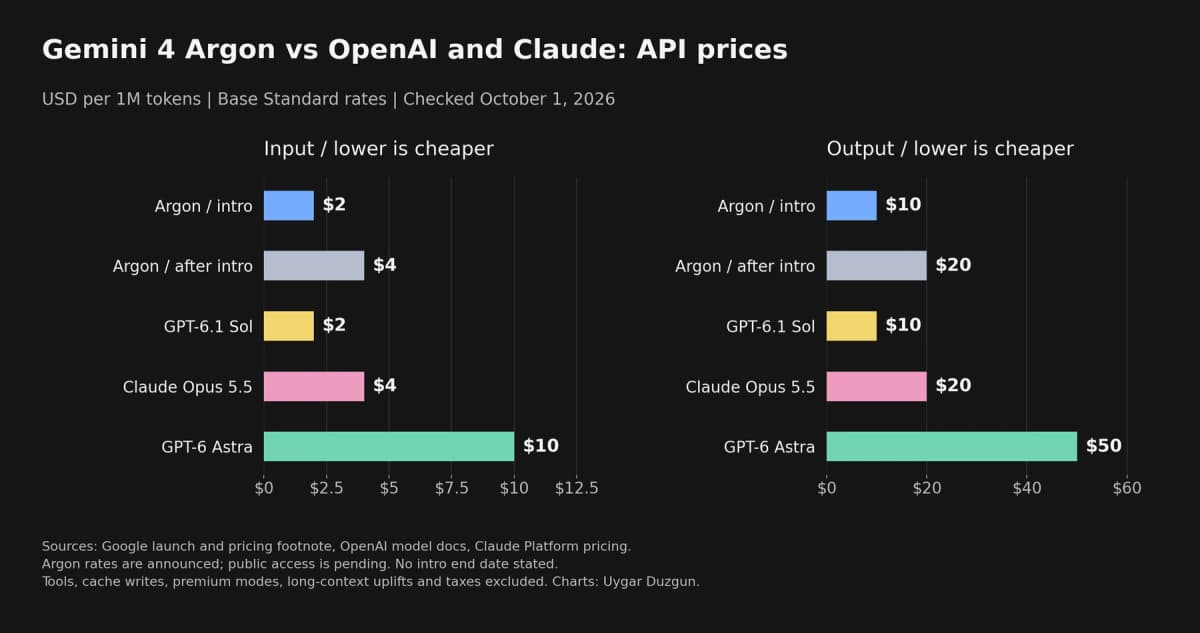
Base USD rates checked October 1. Argon's prices are announced rates, not proof of general API access. The comparison excludes tools, cache writes, premium modes, regional charges and taxes.
For a simple budget example, one million uncached input tokens plus 100,000 output tokens across multiple short-context requests would cost $3 at Argon's introductory rates, $6 afterward, $3 with Sol, $6 with Opus and $15 with Astra. That is arithmetic using a fixed token mix, not a measured workload. The same task can consume different token counts across models.
OpenAI also increases full-request prices above 272,000 input tokens in one prompt; Anthropic lists standard pricing across Opus 5.5's context window. A base-price table therefore cannot tell you the bill for a huge repository session. My GPT-6.1 Sol vs Opus 5.5 comparison covers those tradeoffs.
I would budget an integration using Argon's later rate, then treat the promotion as temporary savings. That avoids building a business case around a discount whose expiry I cannot yet schedule.
Gemini 4 Argon benchmarks: strong automation, mixed coding
Business automation is the result I care about most
Zapier's AutomationBench 1.0.6 tests end-to-end work across 47 tools in six business functions. It checks the resulting environment with deterministic assertions rather than grading an agent's persuasive final message.
The selected configurations below retain their effort settings and fallback behavior.
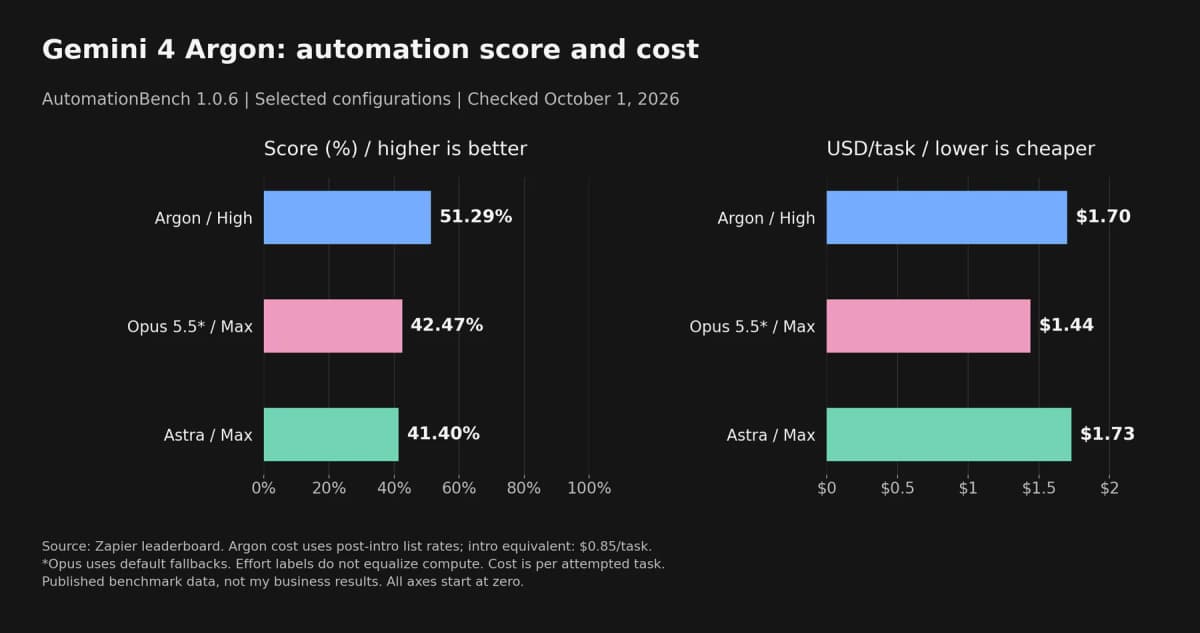
Zapier reports Argon High at 51.29% and $1.70 per attempted task using later list prices; its introductory equivalent is $0.85. Opus 5.5 Max with default fallbacks scores 42.47% at $1.44, and Astra Max scores 41.40% at $1.73. Effort labels do not match compute budgets between providers.
Argon has the higher score in this comparison, but its ordinary task cost is not the lowest. Nor does a roughly 51% benchmark score justify unattended production access. I still want approval around consequential actions, logs I can inspect and a way to recover from partial completion.
That distinction matters for business automation. I care about the right record being updated and the right recipient receiving a message. An agent telling me it finished cannot substitute for those checks.
Coding results depend on the task
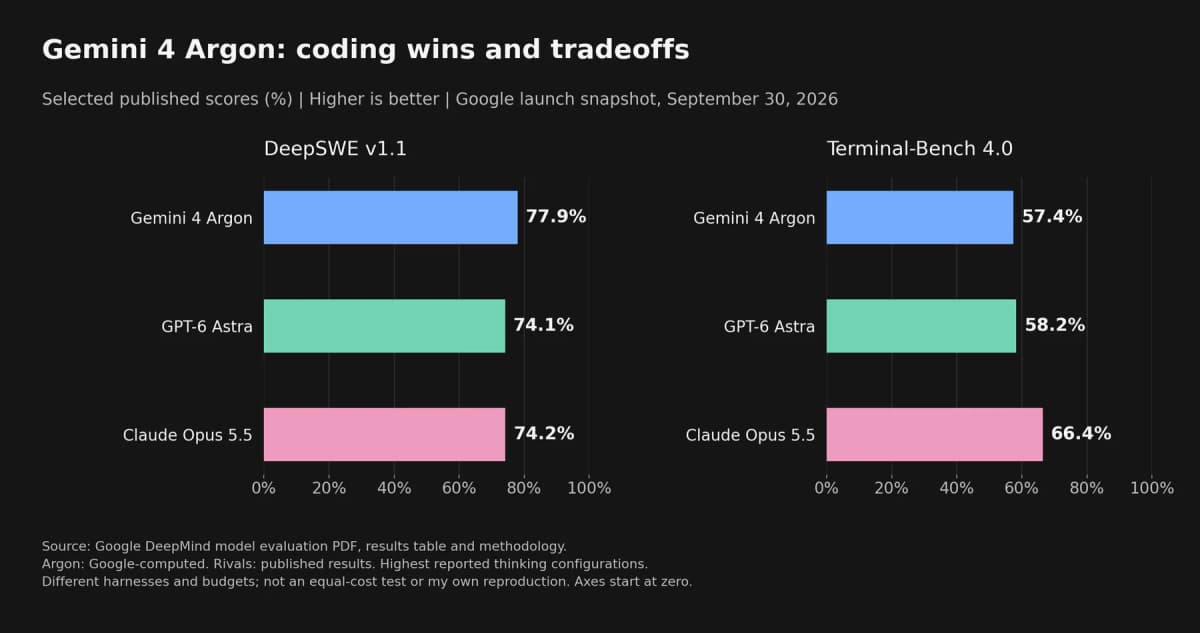
Selected scores from Google DeepMind's model evaluation report. This combines Google-computed Argon results with published rival results, not a uniform independent head-to-head run.
Argon reaches 77.9% on DeepSWE v1.1, against Astra's 74.1% and Opus's 74.2%. On Terminal-Bench 4.0, Opus leads this trio at 66.4%, followed by Astra at 58.2% and Argon at 57.4%. The report also puts Astra ahead on FrontierSWE v2: 65.5% against Argon's 55.0%.
Google generally reports its highest thinking settings and maximum or best available rival results. Harnesses and budgets matter. A lead on one repository benchmark does not guarantee a better fix in my codebase, especially when the difference is only a few percentage points.
I would test a bounded regression repair and a multi-file change separately. Both need behavioral checks and a review of the diff. A model could pass the test while adding an abstraction I do not want to maintain.
Independent knowledge-work evidence adds context
Vals Index 2.1, updated September 30, lists Argon at 68.90%, Opus 5.5 at 66.97%, Astra at 63.13% and Sol 6.1 at 61.15%. Vals combines finance, coding, legal and tax tasks with sector weights based on US GDP.
Its cost column complicates the ranking: $15.68 per test for Argon at $4/$20 token rates, versus $3.24 for Sol. Those are benchmark-specific costs, not quotes for my work. They show why I would keep a cheaper model in the evaluation even if another model tops the score column.
I would route tasks after measuring them. Easy recurring work and expensive failures should not automatically use the same model.
What are other people saying about Argon?
The early Gemini 4 Argon release discussion contains excitement, frustration about restricted access and reminders about the later price. These are launch reactions from individual users, not a representative survey or evidence that they have all tried Argon. Comments predicting weeks or months of waiting are speculation.
The more useful debate for me appears in the Rust community discussion of Google's codebase migrations. One commenter, nicoburns, argues that translation between languages can work better because the original design already exists. Others describe maintainability problems and the effort they spend correcting generated code.
That discussion concerns agent-assisted engineering broadly. It does not establish Argon's real-world reliability. I take the practical lesson seriously: compare behavior against the original, keep changes reviewable and measure the human work left afterward.
How I plan to test Gemini 4 Argon
I am curious enough to give Google a proper chance. I will start with tasks I can verify, rather than asking the model to take over everything at once.
I want to record elapsed time, token cost, retries, correctness and review effort. The question is whether Argon reduces my total work, including checking and repairing the result.
Google's announcement also raises the output limit to one million tokens. That is a ceiling, not a target. I would still set budgets and stopping conditions; more available reasoning should earn its cost. My article on AI reasoning tokens and compute costs explains why I care about that tradeoff.
Gemini 4 Argon looks worth testing. I have not used Google enough to give it a fair place in my workflow yet. These results make me want to change that when I can access the model, while keeping Sol, Opus and Astra as real alternatives until my own tests tell me more.