GPT-6.1 Sol has my attention because I want to run more useful agent work without treating every task as a premium-model expense. The interesting question is how much correct, reviewable work I can get for the budget.
My first take: Sol deserves a place in the daily-driver conversation. Claude Opus 5.5 still deserves a serious comparison, especially when quality matters more than the first response time. I will test both on real work. For now, I am separating published benchmarks, early user reports and my own expectations.
*Source check: September 29, 2026. The hero is an AI-generated editorial illustration. I drew the data charts from the cited published values; they are not screenshots of my own tests.*
What is GPT-6.1 Sol good for?
OpenAI positions GPT-6.1 Sol around complex coding, computer use and professional work, aiming closer to Astra at a lower price. Its API model ID is gpt-6.1-sol, with a 1,050,000-token context window and up to 128,000 output tokens. See the official GPT-6.1 Sol model documentation.
For my work, that suggests three useful places to start:
Those are evaluation candidates, not promises that the model will handle them unattended. I would still keep production writes behind approval and require the agent to show its evidence.
This follows the same practical question as my GPT-6 Astra review: does the model help finish the work once it meets an existing system?
GPT-6.1 Sol pricing vs Claude Opus 5.5
The standard API comparison is straightforward. These are USD prices per million tokens, before tools, cache writes, speed premiums or regional modifiers.
| Token type | GPT-6.1 Sol | Claude Opus 5.5 |
|---|---|---|
| --- | ---: | ---: |
| Input | $2.00 | $4.00 |
| Cached input | $0.10 | $0.20 |
| Output | $10.00 | $20.00 |
Sources: OpenAI API pricing and Claude Platform pricing.
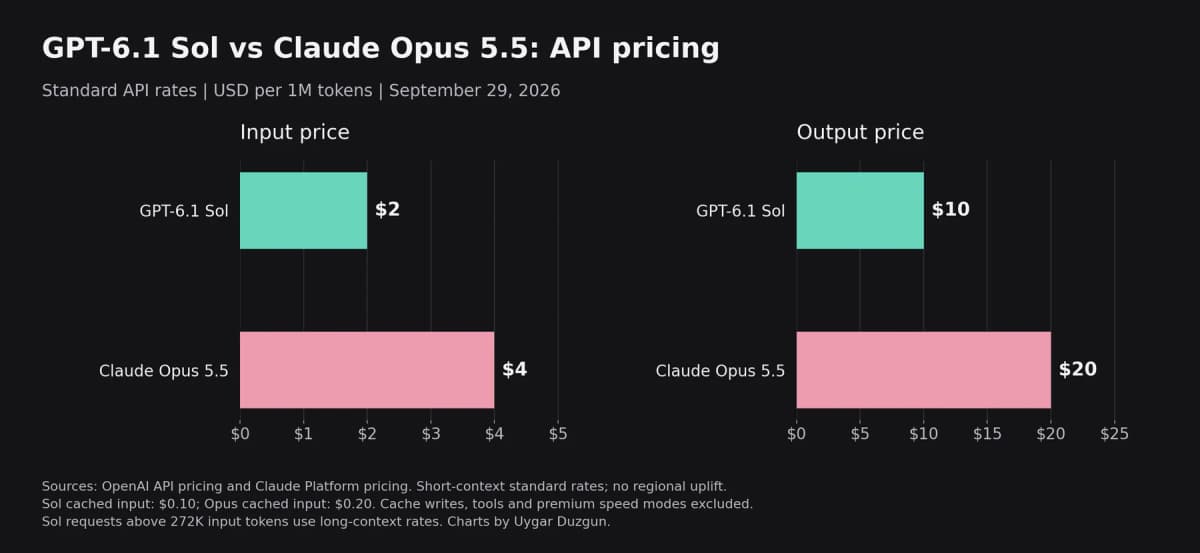
*Standard short-context rates. The table includes cached reads; the chart shows ordinary input and output prices.*
Sol costs half as much per token in these categories. That does not mean every completed job costs half as much. Models can use different amounts of reasoning, call different tools and need different numbers of retries.
Long context also changes the comparison. Sol applies higher rates to the full request above 272,000 input tokens in one prompt: twice the input and cached-input rate, and 1.5 times the output rate. Anthropic lists standard pricing across Opus 5.5's full context window. A long-running session's aggregate token counter is not the same thing as one prompt crossing that threshold.
For background on the earlier release, my GPT-6 Sol and Luna overview covers the preceding lineup.
GPT-6.1 Sol benchmarks: score and cost together
AutomationBench: Sol is cheaper; Opus reaches higher at max
AutomationBench 1.0.6 tests end-to-end business workflows across 47 tools. Zapier scores the resulting state with deterministic checks, rather than asking another language model to judge the answer.
| Configuration | Score | USD per attempted task |
|---|---|---|
| --- | ---: | ---: |
| Sol 6.1, medium | 31.7% | $0.19 |
| Opus 5.5, medium, default fallbacks | 29.5% | $0.65 |
| Sol 6.1, max | 36.1% | $0.30 |
| Opus 5.5, max, default fallbacks | 42.5% | $1.44 |
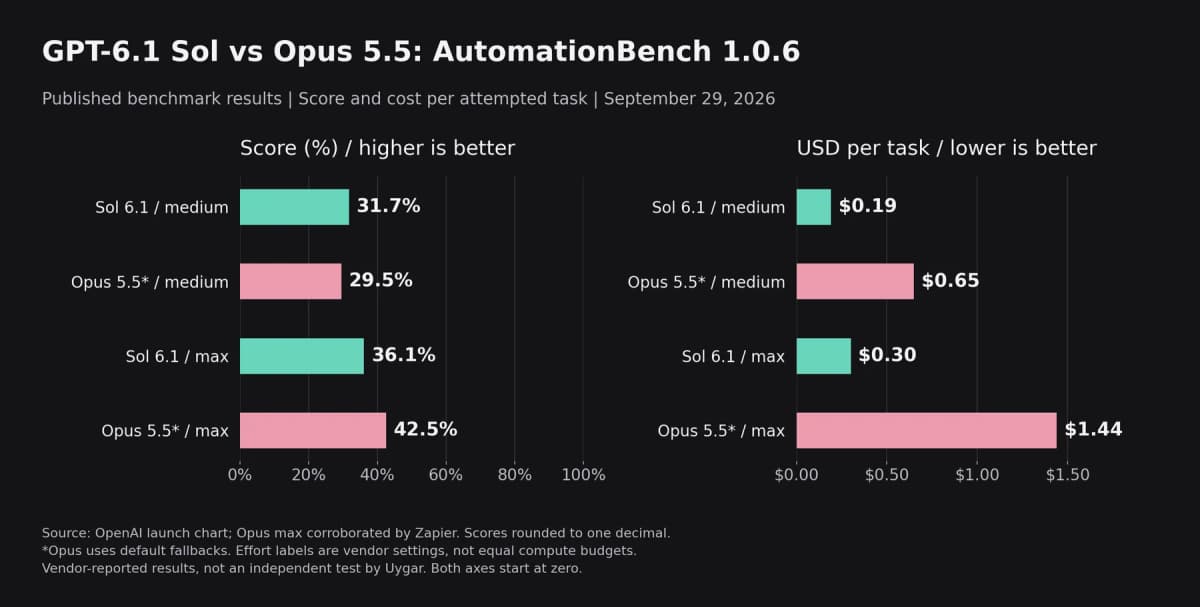
*Values from OpenAI's launch charts, with scores rounded to one decimal. Zapier corroborates the Opus max result. The Opus configuration includes default fallbacks; vendor effort labels do not represent equal compute budgets.*
At medium, Sol offers a modest score lead and lower reported task cost. At max, Opus has the higher score. I would choose between those trade-offs using the failure cost of the workflow, including the time someone spends checking it.
These costs cover attempted tasks, including failures. They are not prices for a guaranteed successful business outcome.
DeepSWE: a useful upgrade over the previous Sol
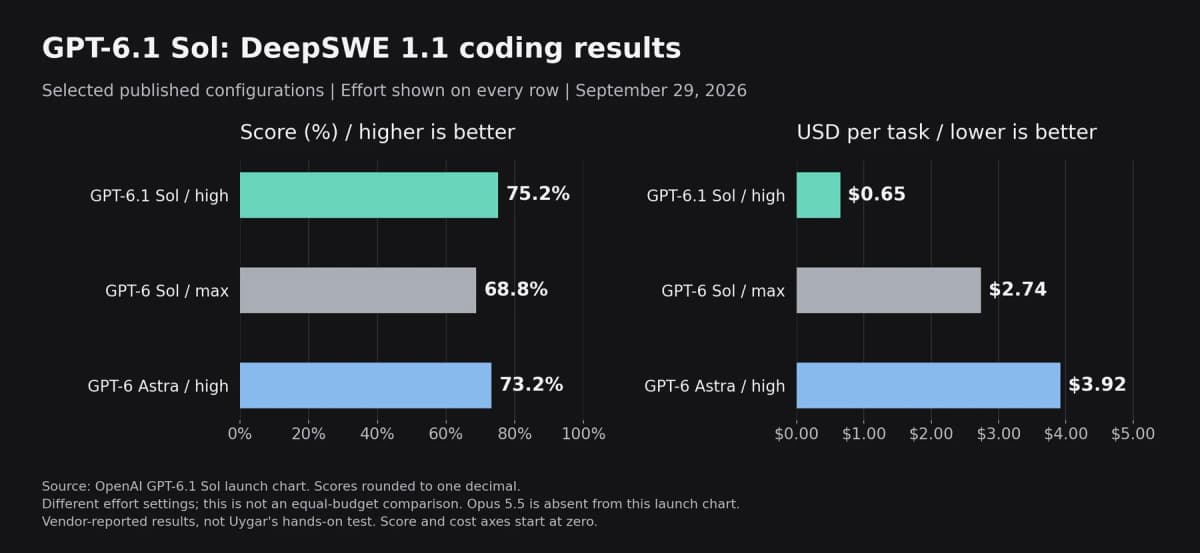
*Selected DeepSWE 1.1 values from the same OpenAI launch charts: Sol 6.1 high, 75.2% at $0.65; previous Sol max, 68.8% at $2.74; Astra high, 73.2% at $3.92 per task. Different effort settings are explicit.*
The DeepSWE benchmark uses long-horizon repository tasks and behavioral verifiers. OpenAI does not include Opus 5.5 in this launch chart. I will not put an unrelated FrontierCode score beside it and pretend they measure the same thing.
OpenAI combines its own evaluations with publicly reported competitor results. Treat this as published evidence, not an independent head-to-head run by me.
Where Claude Opus 5.5 still matters
Anthropic positions Opus 5.5 for long-running coding and knowledge work. Its launch report gives a 54.6% FrontierCode v1.1 Main score at default medium effort and describes gains in multi-file coding. Those results use a different benchmark from DeepSWE. Anthropic also includes early partner feedback about fewer steps and tokens, which remains attributed feedback rather than a controlled comparison with Sol 6.1. See the Opus 5.5 announcement.
I would keep Opus in the comparison for difficult changes, review and visual work where another pass might improve the final result. I would test that hypothesis, rather than assigning the model a permanent specialist role based on launch week.
My Claude Opus 5.5 benchmarks and reactions cover its release in more detail.
What are other users saying?
Early reactions are mixed. In a launch discussion on Reddit, some users welcomed cheaper cache reads; others questioned how close the model would feel to Astra and preferred Claude. These are individual reactions, not a representative survey.
One more concrete three-model test from digitalml used the same cinematic Three.js scene prompt at medium effort. The reported times were 8 minutes 42 seconds for Sol 6.1, 9 minutes 37 seconds for Astra and 38 minutes 54 seconds for Opus 5.5. The author preferred Opus's cinematic result and reported camera and sound problems in Sol's version.
That single example captures a trade-off worth investigating: finishing first can matter, but so can polish and behavior after the page loads. It does not establish a general speed or quality ranking.
How I will test GPT-6.1 Sol
I will give Sol and Opus the same task, starting files, tool access and acceptance checks. I want to record correctness, elapsed time, retries, token cost and the review work I still need to do. A quick answer that leaves me fixing regressions is not a cheap result.
For API integrations, Sol requires the Responses API for tool calling; Chat Completions supports it without tools. It supports low, medium, high, xhigh and max reasoning effort, with medium as the default. The model documentation above defines those constraints.
My practical starting point is medium, a scoped brief and runnable checks. I will raise effort when a task needs it, then compare the result. More reasoning should earn its extra time and cost.
I am excited to try GPT-6.1 Sol because the published price-performance looks useful for repeated agent work. Opus 5.5 remains a strong alternative. I will decide where each belongs after I have evidence from the tasks I need to finish.