
To understand the market effect of AI-generated books, stop asking whether the average one is good.
The stronger question is whether supply is growing faster than reader attention and revenue. A July 2026 working paper reports exactly that pattern in a sample of 14,419 self-published genre-fiction ebooks: compared with 2023 Q1, the number of titles selling in a quarter grew 19.2 times by 2026 Q1, while unit sales grew 7.3 times and revenue 8.9 times. Books with substantial detected AI text sold worse on average, yet they gained sales and top-rank share as their numbers rose.
That is evidence of a supply shock. It is not proof that AI caused every decline, that every flagged book used AI, or that low-cost fiction leaves readers worse off. A second economics paper reaches an important counterpoint: more AI-containing books may add modest consumer value by serving niche demand, even while average usage per title falls.
The market can dilute author revenue and expand reader choice at the same time.
Reader level: Advanced. This article separates measured results, model-based estimates, legal interpretation, and practical decisions for authors, publishers, and platforms.
Contents
What the newest AI book study measured
Generative AI floods and dilutes the market for books, posted July 22 and revised July 26, studies self-published genre fiction released from January 2023 through March 2026. The researchers matched full book text to daily Amazon sales through June 29.
The analysis uses a proprietary panel maintained by a major publisher. The paper says the broader panel covers about 500,000 Amazon ebook identifiers representing at least 95% of daily ebook unit volume. Its study sample includes 14,419 titles across eight genre clusters after market-rank, genre, and text-availability filters.
The researchers split each book into chapters, removed front and back matter, and ran the text through Pangram 3.3. They placed titles into three bands:
These labels describe detector output. They do not reveal which model was used, whether the author disclosed it, how much editing occurred, or whether a human wrote the text. The paper tests alternate thresholds, but no detector turns authorship into an observed fact.
The study then compares sales, gross consumer revenue, rank positions, author output, Kindle Unlimited exposure, and distinctive phrase overlap. Its 90-day launch window makes older and newer release cohorts more comparable.
This design is unusually useful because it combines full text with transaction records. It is still observational. The safest reading is: the study measures a market pattern consistent with dilution and rules out several simple explanations; it does not identify a clean causal effect of AI adoption.
AI-generated books sell below their catalog share—and still matter
Books with substantial detected AI text were 20.0% of the sample but received 12.1% of launch-window unit sales and 11.3% of revenue. Books with no detected AI text were 62.9% of titles, 71.7% of sales, and 72.5% of revenue.
| Detected-text band | Share of books | Share of sales | Share of revenue |
|---|---|---|---|
| --- | ---: | ---: | ---: |
| No detected AI text | 62.9% | 71.7% | 72.5% |
| Light detected AI text | 17.1% | 16.2% | 16.2% |
| Substantial detected AI text | 20.0% | 12.1% | 11.3% |
The average substantial-AI title underperformed. The category did not remain commercially irrelevant.
By 2026 Q1, titles with any detected AI text held 36.6% of observed sales and 38.5% of constructed Top-25 rank slots. The substantial-AI band alone held 17.5% of sales and 18.7% of those slots. The paper also documents a small set of high earners: its 15 highest-revenue substantial-AI titles each generated at least $220,000 in gross consumer revenue during the measured period.
Those figures do not establish author profit. Gross revenue precedes platform commissions, advertising, production costs, taxes, refunds, and other deductions. They do establish that “readers will ignore all of it” is not a defensible market assumption.
Average quality and aggregate impact are different variables. A low-cost producer does not need every release to succeed. It can publish many attempts, learn which covers and niches convert, and keep the small share that reaches scale. The relevant unit shifts from one book to a portfolio.
Supply grew faster than sales and revenue
The clearest result is the gap between title growth and market growth.
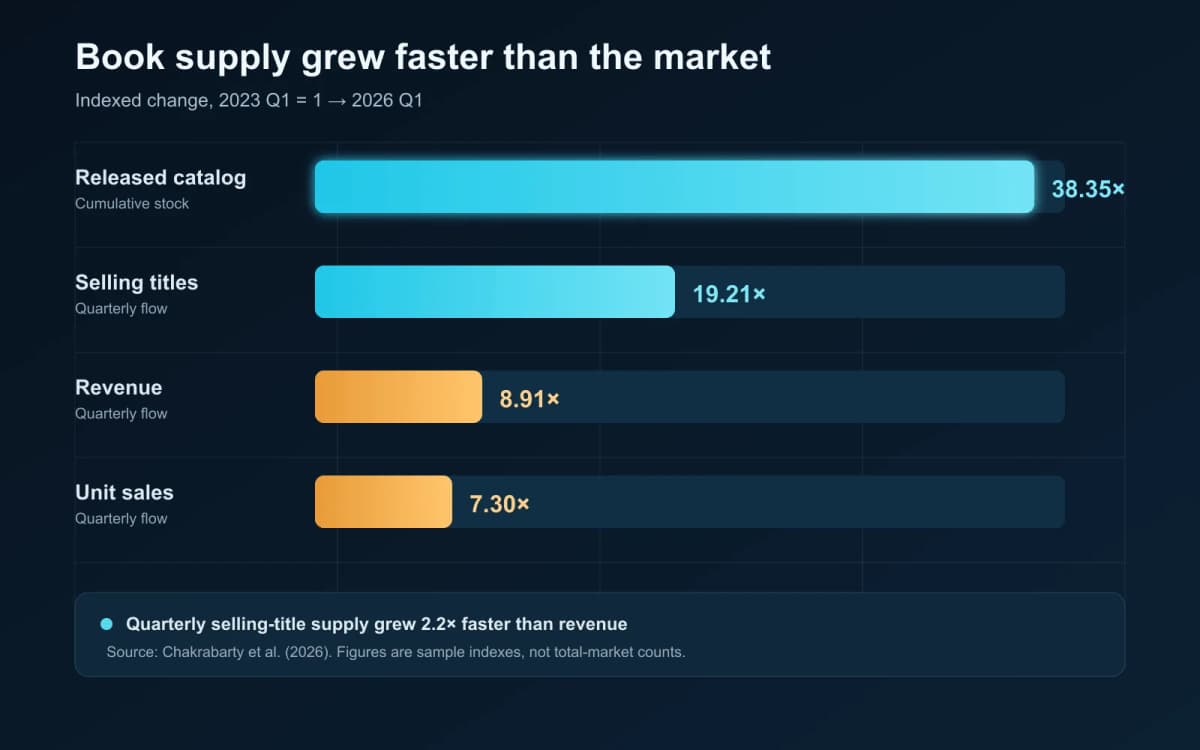
*Caption: Indexed change from 2023 Q1 to 2026 Q1 in the study sample. Released catalog is cumulative; selling titles, unit sales, and revenue are quarterly flows. Source: Chakrabarty et al. (2026).*
By 2026 Q1:
The cumulative catalog and quarterly flows are not identical measures, so the 38.35 figure should not be compared as if every released book competed equally in that quarter. The like-for-like quarterly comparison still shows the core imbalance: selling titles grew more than twice as fast as revenue and more than 2.6 times as fast as unit sales.
The paper then uses a fixed launch window to compare release cohorts. Mean launch-window revenue per selling title fell from $20,134 in 2023 to $17,312 in 2025, a 14% decline. For books with no detected AI text, it fell from $23,877 to $19,739, a 17.3% decline. Revenue per selling title fell in six of eight genre clusters across all books and in seven of eight clusters for the no-AI group.
This matters because it addresses a composition objection. The market average could fall simply because a flood of low-selling AI books entered the denominator. The no-AI cohort decline shows that the change reached books outside the substantial-AI band too.
Exposure patterns point in the same direction. The no-AI share of constructed Top-25 positions was 87.8% in low-exposure genre-months and 62.8% in high-exposure ones. In Kindle Unlimited-heavy genres, the no-AI lead over substantial-AI titles was 8.5 percentage points smaller for sales and 8.4 points smaller for revenue.
Amazon says Kindle Unlimited royalties come from a monthly global fund and depend on each title's share of normalized pages read. That creates an explicit shared pool. The study's stronger dilution pattern in KU-heavy genres fits the mechanism, but it does not prove that Kindle Unlimited caused the difference.
Why weak average quality does not prevent dilution
Creative markets allocate more than money. They allocate search visibility, recommendation slots, review attention, audience time, and editorial screening.
A new title can impose small discovery costs even when it sells nothing:
The effect accumulates across thousands of releases. This is why production scale matters independently of average product quality.
The study finds that 287 of 385 observed byline identities that continued publishing substantial-AI titles increased their monthly output after adoption. That 74.5% is conditional on authors who kept publishing in the category. It is not an adoption effect for all writers: only 311 of 824 identities in the broader event-time panel sat above the output-growth diagonal.
The cost side helps explain the asymmetry. AI can compress drafting time, but it does not make generation free. More output still consumes inference energy, review time, asset work, platform capacity, and reader attention. The broader cost structure is covered in the resource cost behind additional AI output→. A producer may rationally accept mediocre average performance when the cost of each additional attempt is low enough.
Quality remains hard to define. Sales reward fit, packaging, timing, price, promotion, and existing audience as well as prose. A separate analysis of open and closed models shows why creative quality depends on the evaluation target→. A market study can measure what readers buy; it cannot reduce literary value to revenue.
The reader-value counterargument
Market dilution does not imply that consumers receive no value.
The May 2026 revision of the NBER working paper AI and the Quantity and Quality of Creative Products examines a much broader Amazon ebook market. It uses a stratified sample of more than 330,000 releases representing about 10 million ebooks from 2020 through 2025, plus a 479,000-book census across eight subcategories.
Its main quality proxy is usage: the age-adjusted number of reader ratings, validated against estimated sales and supplemented with sales-rank and star-rating checks. That is a demand measure, not a judgment of literary merit.
The paper reports three findings that complicate a simple collapse narrative:
The authors calibrate a nested-logit demand model and estimate that AI books raised consumer surplus by about 7% in 2025. That estimate depends on the model's substitution structure and the assumption that observed usage captures consumer utility. It is not a direct survey result and does not measure author welfare, search cost, cultural value, or long-term market quality.
The two book-market papers can both be right. More niche products can improve the chance that a reader finds a specific trope or combination. The same expansion can lower revenue per title and make discovery more expensive for creators.
| Perspective | Potential gain | Potential loss |
|---|---|---|
| --- | --- | --- |
| Reader | More combinations, faster supply, underserved niches | Higher search cost, uncertain provenance, repetitive catalogs |
| Author | Lower production cost, more experiments | Lower revenue per title, harder discovery, imitation pressure |
| Platform | More inventory and engagement | Moderation, ranking, disclosure, and trust costs |
| Publisher | Faster testing and assisted workflows | Brand risk, rights uncertainty, weaker scarcity |
The distribution decides who benefits. A positive estimate for aggregate consumer surplus does not compensate a particular author whose expected income falls.
What private AI fiction reveals—and what it does not
Published ebooks are only one route for AI fiction. AI Fiction in the Wild, revised June 23, studies 573,453 English-language conversations from the WildChat dataset, collected from April 2023 through May 2024 through free GPT-3.5 and GPT-4 interfaces.
The authors used a lexicon and an o4-mini classifier, then manually checked a random sample of 300 conversations. The fiction classifier reached 97% precision and 94% recall against the authors' consensus labels. It classified 195,271 conversations—34%—as involving fiction. Fanfiction appeared in 49% of the fiction subset, and a small group of power users produced much of the activity.
This supports a demand signal for immediate, customized, repetitive, and niche fiction inside a private chat. It does not measure published-book demand.
WildChat users opted into a public research interface without requiring an OpenAI account. The sample can overrepresent technical users, power users, boundary testing, and people seeking a free service. The researchers cannot observe whether generated stories were shared, purchased, revised into books, or read beyond the conversation.
The economic distinction is important:
AI can satisfy the first use case without creating a sale in the second. That helps explain how AI fiction demand can be real while average revenue per published title declines.
The paper provides its classification materials and data references openly. Its companion repository is useful for auditing definitions and reproducing the analysis. Repository availability strengthens process transparency; it does not make the underlying WildChat population representative.
Copyright and detection complicate the market story
The July market study adds a provocative textual result. Among top-50 sellers, books with substantial detected AI text had 45.0% coverage by rare five-or-more-word expressions found in a small number of existing books but absent from a 4.7-trillion-token web snapshot. The corresponding no-AI group measured 37.7%.
Within the substantial-AI top-200, rare-expression coverage rose 7.6 percentage points for each tenfold increase in revenue. The slope was statistically significant at *p* = .001, but the interaction comparing that slope with the no-AI group was marginal at *p* = .063.
This does not prove that a particular passage was copied from a particular book. Aggregate phrase overlap can reflect training data, genre conventions, quotation, common source material, detector selection, or other pathways. The paper itself says the analysis cannot establish infringement.
A separate preregistered study, Readers Prefer Outputs of AI Trained on Copyrighted Books over Expert Human Writers, shows why the quality ceiling may change. Twenty-eight MFA-trained readers and 516 college-educated general readers completed 10,920 blind pairwise evaluations of human and AI excerpts written in the styles of 50 award-winning authors.
With ordinary in-context prompting, MFA readers strongly preferred human excerpts. After author-specific fine-tuning on complete oeuvres, the tested ChatGPT outputs reversed that preference on average for both writing quality and stylistic fidelity. Fine-tuned output also evaded the two tested AI detectors far more often.
The study covers excerpts of up to 450 words, not complete novels. Its reported generation costs exclude human steering, editing, long-form coherence work, and publishing. It tests imitation under unusually rich author-specific training, not ordinary consumer prompting. The result is evidence that detector accuracy and perceived quality can change with training and editing—not a forecast that AI novels will replace authors.
That distinction matches a practical rule from the AI-music detection workflow→: detector output is evidence, not ground truth.
Amazon KDP's current content guidelines require a publisher to inform Amazon about AI-generated text, images, or translations. They do not require disclosure for AI-assisted work, and the publisher remains responsible for intellectual-property and quality compliance. The public guideline describes disclosure to Amazon; it does not promise a reader-facing label.
The U.S. Copyright Office's generative AI training report treats market substitution, market dilution, licensing, and public benefit as separate considerations. It also says fair-use analysis remains fact-specific. A sales correlation, detector score, or phrase-overlap statistic cannot settle that legal test.
What the evidence does not prove
The current evidence supports a narrower conclusion than the headline of the July paper.
It does not prove causality
The book-market study observes exposure, sales, and cohort changes. Genre demand, pandemic-era behavior, advertising costs, pricing, subscription dynamics, platform ranking changes, and author entry can move at the same time. The exposure gradients and no-AI cohort decline strengthen the dilution interpretation, but no random assignment identifies the AI effect.
It does not observe author income
The revenue figures are gross consumer spending. Kindle Unlimited page reads are not separated from purchases in the proprietary panel. Pen names can split one producer into multiple bylines. Neither study gives a clean distribution of net author profit.
It does not validate disclosure
The researchers say none of the sampled books disclosed AI use in the data available to them. KDP's disclosure rule concerns information supplied to Amazon. A missing public label is not evidence that an author failed to notify the platform.
It does not turn detection into authorship
Pangram's reported validation results are not a labeled ground-truth test on this full book corpus. Edited, translated, formulaic, or model-specific writing may behave differently. Robustness across thresholds reduces sensitivity to one cutoff; it cannot eliminate systematic detector error.
It does not measure the whole book market
The July study focuses on self-published genre-fiction ebooks primarily sold through Amazon. Traditional publishing, nonfiction, print, audiobooks, libraries, direct sales, and other platforms may have different economics.
A decision framework for authors, publishers, and platforms
Do not reduce the decision to “use AI” or “ban AI.” Measure the variable that each party can control.
For authors: optimize reader retention, not release count
Track each release cohort for at least:
Set a stop rule before scaling. If output rises while retained readers, profit per editing hour, or series continuation falls, more releases are magnifying weak fit.
Use AI assistance where it preserves differentiated judgment: research organization, consistency checks, accessibility review, or controlled ideation. Keep provenance records for source material, model use, edits, and rights decisions. Those records will not resolve every legal question, but they make disclosure and correction possible.
The operating principle is the same as using AI without erasing the author's own judgment→: define the decisions the human must still own, then test whether the workflow preserves them.
For publishers: separate throughput from portfolio value
Evaluate AI-assisted projects against a human-authored baseline at the same genre, price, author stage, and marketing level. Report medians and distributions, not only total releases.
Require:
A faster manuscript pipeline has little value if acquisition, editing, positioning, and discovery remain the bottlenecks.
For platforms: test discovery quality under supply shocks
Volume limits and disclosure fields address only part of the problem. Ranking systems should be stress-tested as catalog supply grows faster than reader sessions.
Useful platform measures include:
Keep “unknown provenance” separate from “human-created.” Missing or stripped metadata is not evidence of human authorship. Preserve the source disclosure, transformation history, and confidence level through ingestion, moderation, and recommendation systems.
Conclusion
AI-generated books do not need to beat human books on average to reshape publishing.
The newest market evidence shows a supply shock: far more titles competing for sales, revenue, and rank positions that grew more slowly. The decline in revenue per selling title extends to books with no detected AI text, and high-exposure genres show the strongest losses. Those patterns are consistent with dilution.
They are not a causal verdict. Broader market data also suggests that a larger catalog can create modest reader value, especially for niche demand. Private fiction generation shows that some readers want combinations no publisher would efficiently supply.
The practical test is distributional: who gains from the extra variety, who pays the discovery and quality costs, and which metrics reveal the trade before the catalog scales?
Frequently asked questions
Are AI-generated books allowed on Amazon KDP?
Yes. Amazon KDP requires publishers to inform Amazon when a book contains AI-generated text, images, or translations. It does not require disclosure for AI-assisted work. Publishers remain responsible for intellectual-property and quality compliance.
Are AI-generated books profitable?
Some are. In the 14,419-book study, substantial-AI titles earned a smaller share of revenue than their catalog share, but a small group reached meaningful commercial scale. Gross revenue is not author profit, and the average result does not predict a specific book.
Can an AI detector prove that a book was AI-written?
No. It estimates whether text matches learned patterns. A detector can support an investigation or a market-level analysis, but it cannot establish authorship, disclosure, copying, or infringement on its own.
Claim checks
| Claim | Evidence status | Qualification |
|---|---|---|
| --- | --- | --- |
| Selling titles grew 19.21× while quarterly unit sales grew 7.30× and revenue 8.91× | Supported by the July market paper | Indexed within the study sample; observational; released catalog is cumulative |
| Substantial-AI titles were 20.0% of the sample but 11.3% of revenue | Supported by the July market paper | “Substantial AI” means more than 25% of text windows flagged by Pangram |
| Revenue per selling title fell 14% from the 2023 to 2025 launch cohorts | Supported by the July market paper | Gross consumer revenue over a fixed 90-day launch window, not author earnings |
| AI books raised consumer surplus by about 7% in 2025 | Model-based estimate in the NBER paper | Depends on a nested-logit calibration and usage as a utility proxy |
| Thirty-four percent of WildChat's English conversations involved fiction | Supported by the WildChat paper | Opt-in public interface sample; not representative of all readers or book purchases |
| Fine-tuned AI excerpts outperformed human excerpts in the tested preference study | Supported in that experimental setting | Short excerpts, author-specific complete-oeuvre fine-tuning, and blind preference—not full novels or sales |
| KDP requires disclosure of AI-generated but not AI-assisted content | Supported by current Amazon documentation | Disclosure is to Amazon; the public page does not promise a reader-facing label |
| The evidence proves AI caused market dilution | Not supported | Current market designs are observational and cannot isolate every competing cause |