Qwen Code vs Kimi Code: The Free AI Coding Agent Wave Is Here
July 2026 is not just another model month.
Moonshot AI put Kimi K3 on the table on July 16, 2026. Z.ai pushed GLM-5.2 with a 1 million token context window in June. Alibaba used WAIC 2026 to preview Qwen 3.8-Max-Preview and said open weights for Qwen 3.8-Max are coming. Those launches matter, but the bigger shift is one layer above the model.
The new fight is not only model against model. It is agent stack against agent stack.
That is why Qwen Code, Kimi Code, OmniRoute, and OfficeCLI matter more than another benchmark screenshot. They turn open or low-cost AI into something you can actually ship with.
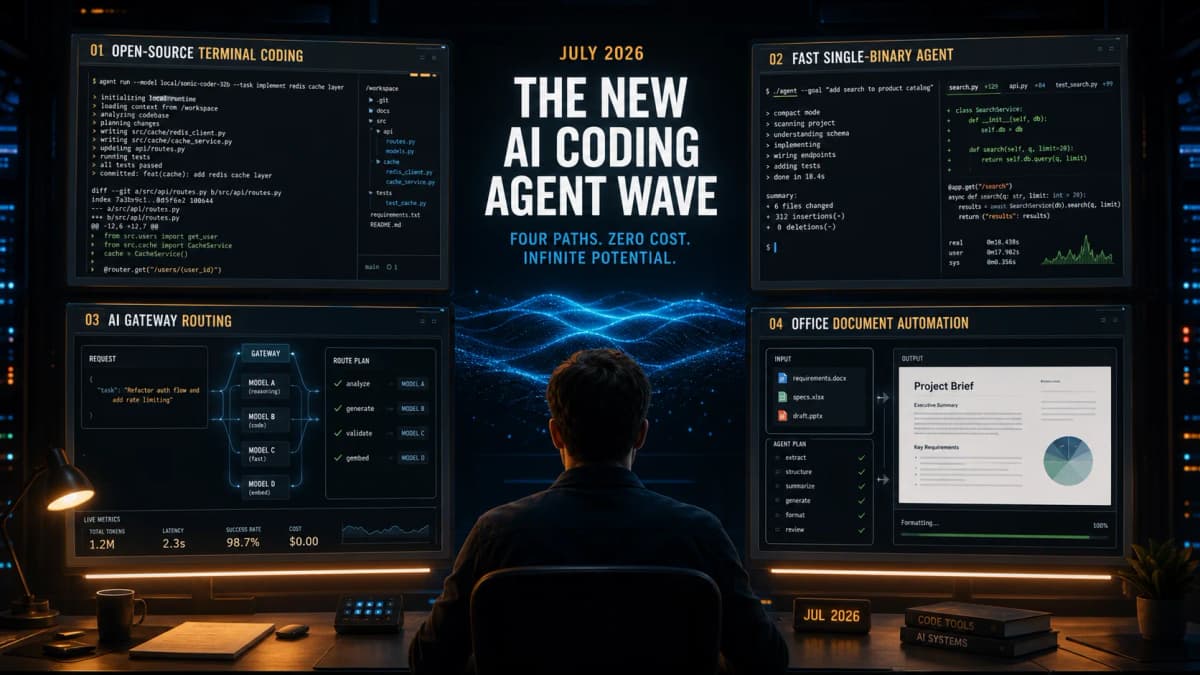
If you only want the short answer, here is mine as of July 25, 2026:
That combination makes this one of the most important AI traffic angles right now. Searchers do not only want “the smartest model.” They want the cheapest stack that still works.
Why July 2026 changed the conversation
The open-model side finally looks connected to the agent-tool side.
That was not always true. For a long time, open releases looked impressive in isolation and messy in practice. You could admire the benchmark chart, then go back to a paid workflow because the surrounding tools were worse.
That gap is shrinking.
Here is what changed:
That last point matters most.
Models create headlines. Tooling creates habits.
Once developers start installing the agent, wiring the MCP servers, adding fallbacks, and building files they can hand to a coworker, the market stops being a pure intelligence race. It becomes a workflow race.
Qwen Code vs Kimi Code
This is the real front door for the topic.
If someone searches qwen code vs kimi code, they are not asking which landing page looks cooler. They are asking which terminal agent deserves time in a real repo.
My answer is simple: Qwen Code is broader; Kimi Code is tighter.
Where Qwen Code wins
Qwen Code describes itself as an open-source AI coding agent that lives in your terminal. Its current GitHub repo highlights the parts that matter most for serious use:
That makes Qwen Code the more ambitious platform.
If you want one agent that can grow with you, Qwen Code is the better bet. It is not only a CLI. It is building into a larger product surface with skills, memory, tools, MCP, and integrations. That matters if you want your workflow to survive model churn instead of getting rebuilt every two weeks.
Where Kimi Code wins
Kimi Code takes a different angle.
Its GitHub repo and docs frame it as a fast terminal agent with a single-binary install, no Node.js required, and a strong out-of-the-box experience. The feature list is also sharper than many people expect:
Kimi Code feels less like a framework pitch and more like a product pitch.
That is a good thing.
A lot of developers do not want to “design their own agent system” on day one. They want something that installs fast, opens quickly, and starts doing work in the repo. Kimi Code is closer to that promise right now.
My practical verdict
If I had to split them by buyer intent:
Neither one eliminates the need for evaluation. Both reduce the cost of getting serious enough to evaluate in the first place.
That is why the wave matters.
Why OmniRoute matters more than most people think
The easiest way to misunderstand this market is to compare agents without comparing the layer underneath them.
That layer is routing.
OmniRoute matters because it attacks the real budget problem. Its repo promises one endpoint across 290+ providers, 90+ free providers, and 500+ models, with quota-aware fallback and token compression. Even if you discount the marketing tone, the direction is right.
Developers do not only need a good agent. They need a way to avoid getting stranded when:
OmniRoute is useful because it treats provider instability as a normal condition, not an exception.
That makes it more than a “free API trick.” It is a hedge against lock-in and churn.
For this article angle, OmniRoute is also what widens the traffic surface. Someone may arrive for Qwen Code vs Kimi Code and stay for free AI gateway, free Claude alternative, MCP routing, or best budget agent stack.
Why OfficeCLI belongs in the same article
This is where most AI coding roundups stay too narrow.
A lot of real agent work does not stop at code output. It ends in:
OfficeCLI is built for exactly that gap.
Its repo says it is purpose-built for AI agents to read, edit, and automate Word, Excel, and PowerPoint files, with a single binary and no Office installation. The strongest detail is not the file support. It is the render loop. OfficeCLI turns Office documents into something an agent can inspect visually and fix, not just write blindly.
That is important because many “AI coding” workflows fail at the final handoff layer. They can generate code or text, but they still break when the deliverable must live in a business file format.
OfficeCLI closes that gap.
So if I were building a real low-cost stack today, I would not only ask which code agent I want. I would ask which stack can go from repo to deliverable without forcing me back into manual cleanup.
The stack I would actually use right now
This is the stack I would test first on July 25, 2026:
That stack is not ideological. It is operational.
I am not trying to prove that open tools are morally superior. I am trying to reduce cost while keeping enough quality to move fast.
The risk this wave still has not solved
Free and open does not mean frictionless.
The current agent wave makes it much easier to start work. It does not automatically make the work reliable. GitHub’s own community discussions already show maintainers dealing with low-quality AI-generated contributions at scale. That is the dark side of better agent tooling: more people can generate output, including output they did not verify.
That is why I still think the system matters more than the model.
The winning setup is not “the smartest free agent.” It is:
Without that, the cheap stack becomes an expensive cleanup problem.
I wrote earlier about this in Code Agents After 21.54 Billion Tokens: What’s Missing?→. The conclusion still holds. The model is the engine, not the car.
Final verdict
The free AI coding agent wave is real now.
That does not mean the premium tools lost. It means the old “free tools are only toys” take is out of date.
My current verdict is:
If you want the practical route, start there, then keep your premium tools for the work that genuinely deserves them.
That is a better strategy than pretending one winner will solve everything.
FAQ
Is Qwen Code better than Kimi Code?
Qwen Code is the better choice if you want a broader ecosystem, deeper extensibility, and stronger multi-provider flexibility. Kimi Code is the better choice if you want a faster install, a tighter product feel, and a terminal agent that starts working with less setup.
Is there a free AI coding agent good enough for production work?
Yes, but only for part of the workflow. Free agents are now strong enough for repo exploration, implementation, document generation, and lower-risk automation. High-stakes production changes still benefit from stricter verification and sometimes a premium model.
Why add OmniRoute if Qwen Code or Kimi Code already work?
Because the model layer changes faster than the workflow layer. OmniRoute gives you routing, fallback, and budget control underneath the agent, which makes the whole stack more resilient when providers, limits, or pricing move.