Kimi K3 vs GPT-5.6 Sol is close enough to make me rerun my routing tests. Moonshot's model still does not replace OpenAI or Anthropic in my stack.
That conclusion is less dramatic than the launch headlines, but the numbers support it. Moonshot AI's new flagship ranks third on an independent intelligence index, leads a blind frontend coding arena, and beats GPT-5.6 Sol on one long-horizon knowledge-work test. It also remains behind Claude Fable 5 and Sol on the broadest measures, and its downloadable weights are still promised for a future date.
As of July 18, 2026, I see Kimi K3 as a serious evaluation candidate rather than a reason to migrate production work. I have not put K3 through my own production benchmark yet, so I separate third-party results from my routing decision below.
The short verdict
The result is a three-model race with different winners by task. A single leaderboard cannot tell you which model will finish your work with the fewest retries.
What is Kimi K3?
Moonshot AI introduced Kimi K3 on July 16 as a 2.8-trillion-parameter Mixture-of-Experts model. Its router selects 16 of 896 experts for each token. K3 also has native image input, a one-million-token context window, and text output.
Moonshot attributes the jump from K2 to two architectural changes: Kimi Delta Attention and Attention Residuals. The company reports roughly 2.5 times better scaling efficiency than K2, but a technical report has not yet been published. That number remains a vendor claim.
The API is live now. Moonshot says the full weights will arrive by July 27. Until those files arrive, K3 is an announced open-weight model, not a model you can already download and verify on your own infrastructure.
Kimi K3 vs GPT-5.6 Sol vs Claude Fable 5
The cleanest comparison combines independent tests with official product specifications. The first four rows below come from Artificial Analysis and Arena; context and pricing come from each provider's documentation.
| Measure | Kimi K3 | GPT-5.6 Sol | Claude Fable 5 |
|---|---|---|---|
| --- | ---: | ---: | ---: |
| Artificial Analysis Intelligence Index | 57 | 59 | 60 |
| GDPval-AA v2 | 1,668 Elo | 1,748 Elo | 1,760 Elo |
| AA-Briefcase knowledge work | 1,547 Elo | 1,495 Elo | 1,583 Elo |
| Frontend Code Arena | 1,679 Elo | 1,618 Elo | 1,631 Elo |
| Context window | 1M tokens | 1.05M tokens | 1M tokens |
| API input/output per 1M tokens | $3 / $15 | $5 / $30 | $10 / $50 |
| Weights | Promised July 27 | Closed | Closed |
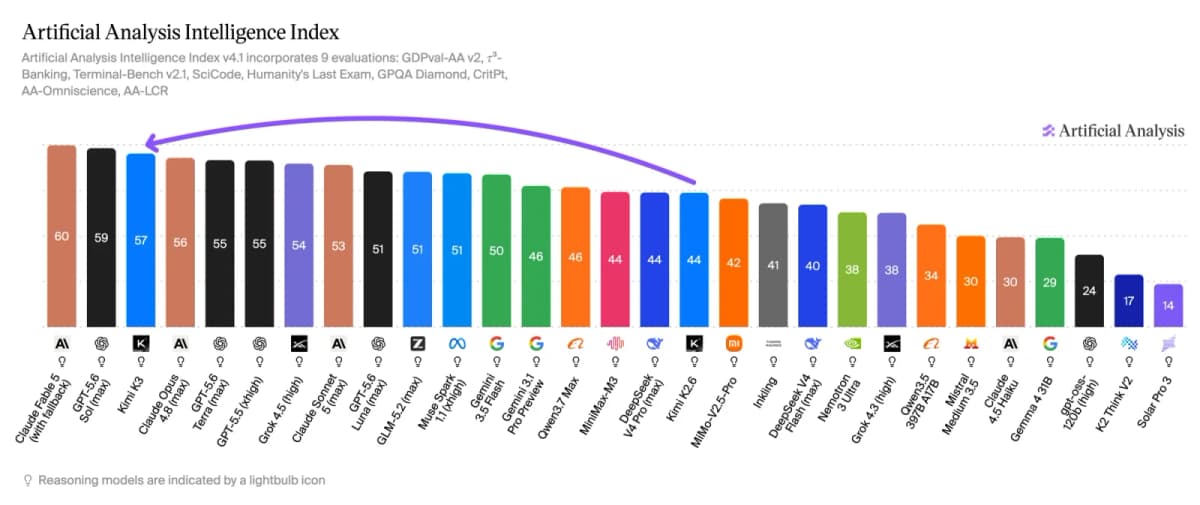
*Source: Artificial Analysis, July 17, 2026. Its v4.1 index combines nine coding, reasoning, knowledge, and agentic evaluations.*
The two-point gap between K3 and Sol is small enough to matter less than harness quality, latency, token use, and failure recovery. The three-point gap to Fable 5 is still real. K3 has reached the frontier group; it has not won the group.
Where does Kimi K3 win?
Frontend coding and visual iteration
K3's strongest independent result is the Frontend Code Arena. Human evaluators compare anonymous, runnable frontend outputs and vote for the better result. K3 reached 1,679 Elo, 48 points above Fable 5 and 61 above Sol. Arena also placed it first in six of seven frontend categories.
That result matters to teams building landing pages, dashboards, design recreations, and visual tools. It measures preference for working output, not only whether a unit test passes.
Moonshot's broader coding table is mixed. K3 leads Program Bench at 77.8 and SWE Marathon at 42.0. Sol leads DeepSWE at 73.0 and Terminal-Bench 2.1 at 88.8. Fable 5 leads FrontierSWE at 86.6 and Moonshot's internal Kimi Code Bench comparison at 76.9.
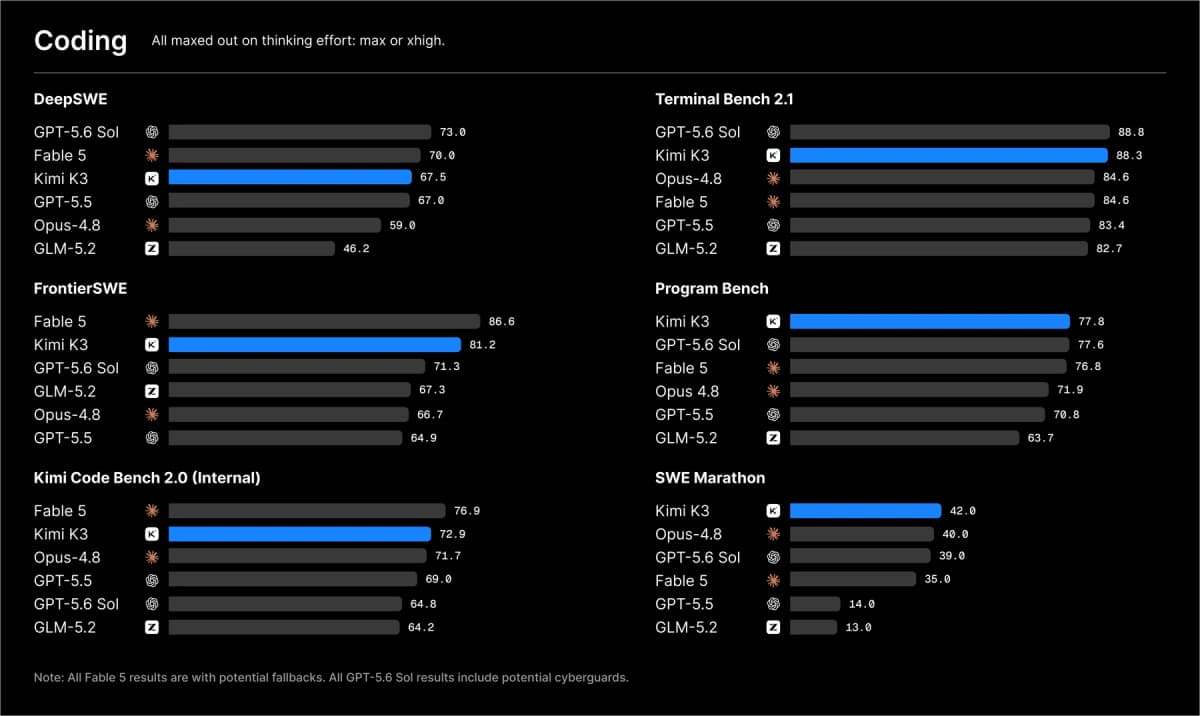
*Source: Moonshot AI's Kimi K3 launch post. These are vendor-assembled results, and the models sometimes use different agent harnesses.*
Harness choice changes the score. K3 often runs in Kimi Code, Sol in Codex, and Fable in Claude Code. A benchmark can measure the model, the harness, or the interaction between both. I would rerun a representative repository task inside the tool I plan to deploy.
Automation and knowledge work
Artificial Analysis gives K3 a 53% score and first place on AutomationBench-AA. On AA-Briefcase, a private long-horizon knowledge-work evaluation, K3 scores 1,547 Elo. That beats Sol's 1,495 and trails Fable 5's 1,583.
Moonshot's evaluation also puts K3 narrowly ahead on BrowseComp and SpreadsheetBench 2. Fable leads GDPval-AA, JobBench, and the broad AA-Briefcase score. Sol remains strongest on presentation quality within the AA-Briefcase breakdown.
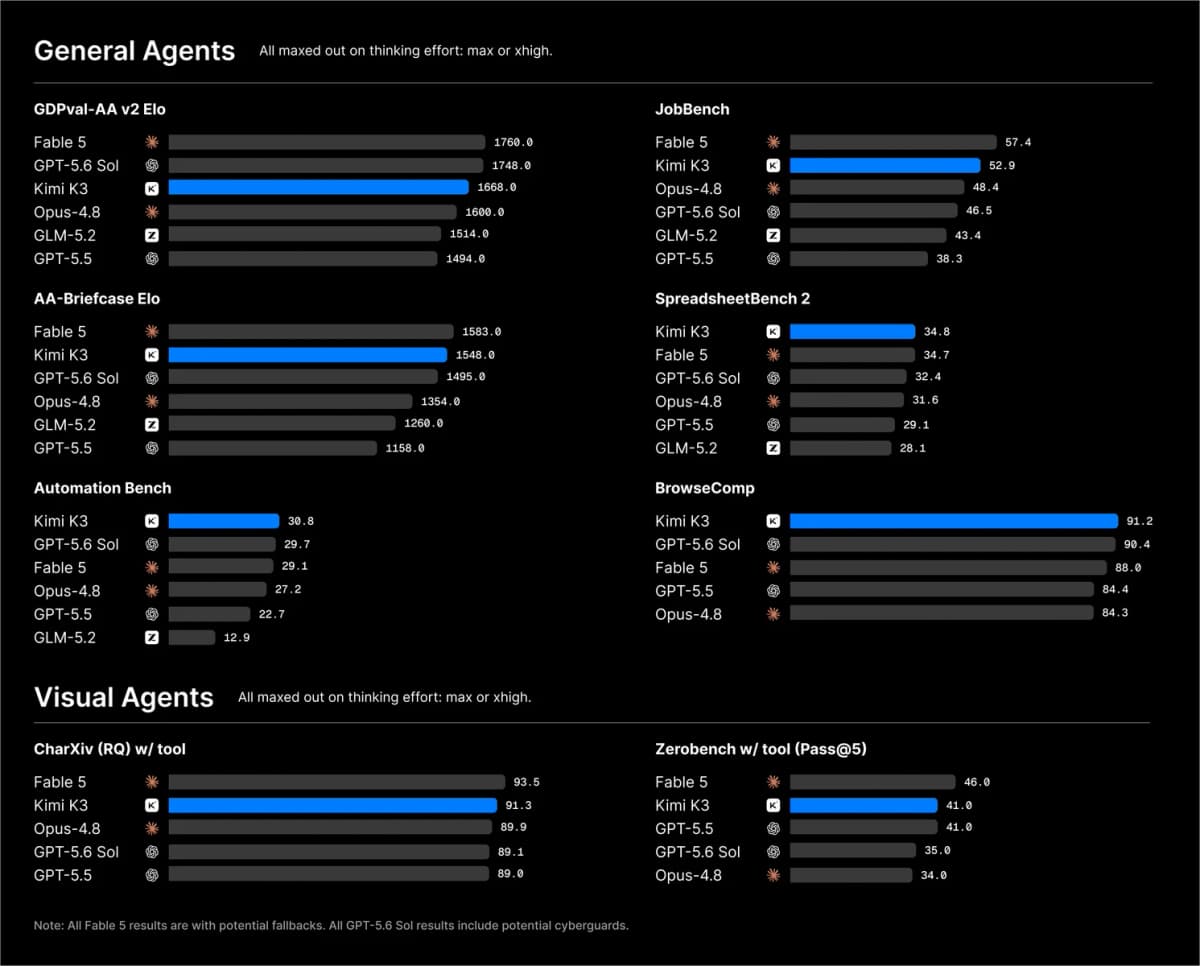
*Source: Moonshot AI. The chart includes independent scores, public leaderboards, and Moonshot-run tests; read its footnotes before treating the bars as one controlled experiment.*
K3 looks useful for research agents, spreadsheet work, and browser automation. Fable remains the safer bet when analytical quality matters more than price. Sol fits teams already using Codex, the Responses API, hosted tools, and programmatic tool calling.
Where does Kimi K3 still trail?
Broad reasoning and expert knowledge
Fable 5 keeps a clear lead on Humanity's Last Exam. Moonshot reports 53.3 for Fable, 44.5 for Sol, and 43.5 for K3 without tools. With tools, the scores rise to 63, 58, and 56. That is a larger gap than the overall index suggests.
Sol posts the strongest published scores on several science, computer-use, and long-context tests in OpenAI's launch table. Fable leads GDPval-AA and AA-Briefcase overall. K3 wins selected tasks, but it does not show the same consistency across categories.
Knowledge reliability
K3 improved its AA-Omniscience accuracy from 33% to 46% compared with K2.6. Its hallucination rate also rose from 39% to 51%. The combined Omniscience score improves from 6 to 18 because K3 answers more questions correctly, yet the regression in unsupported answers deserves testing on citation-heavy work.
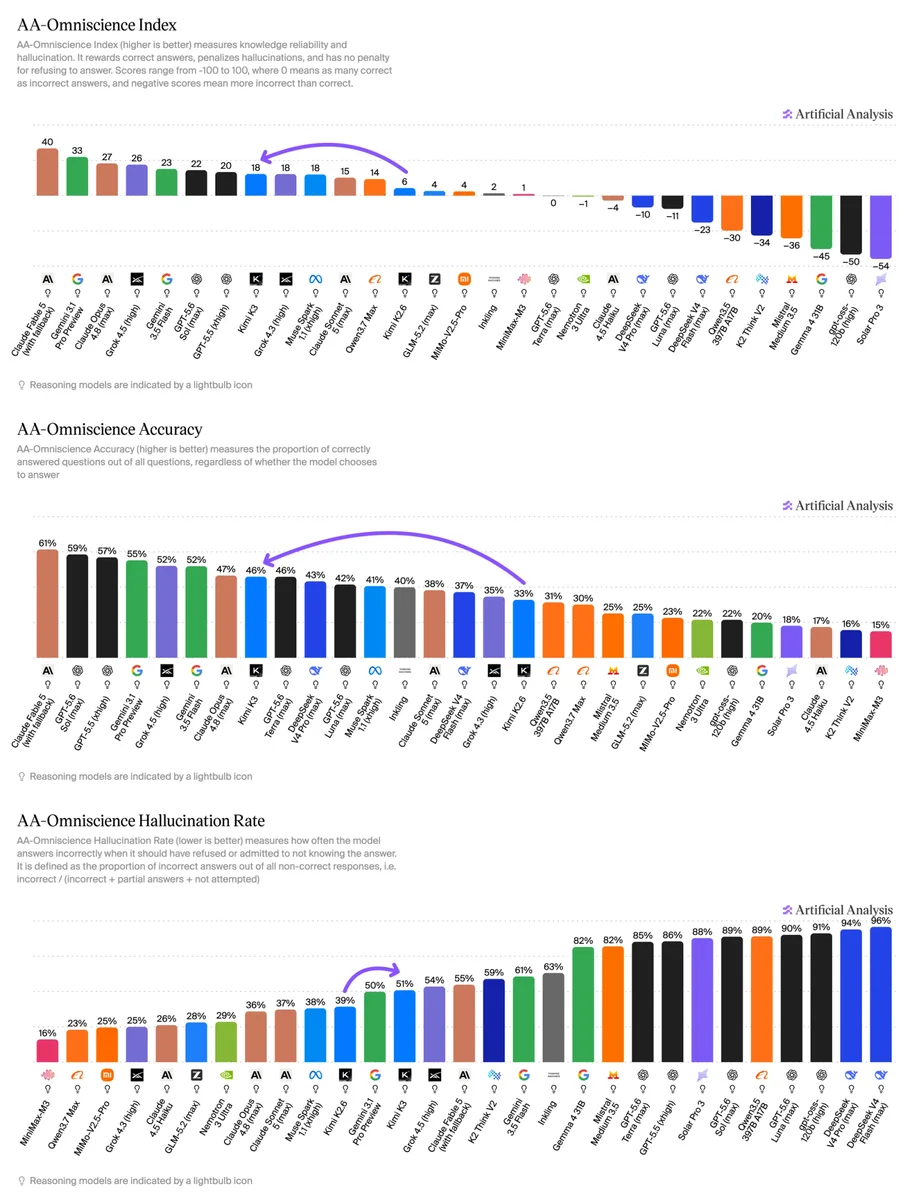
*Source: Artificial Analysis. The hallucination rate belongs to AA-Omniscience and should not be generalized to every prompt type.*
I would require source retrieval, quoted evidence, and deterministic verification before using any of these models for factual publishing. K3's result does not change that rule.
Is Kimi K3 cheaper in practice?
The list prices make K3 look decisive:
Artificial Analysis estimates $0.94 per intelligence-index task for K3, $1.04 for Sol, and $2.75 for Fable 5. K3's token use narrows its list-price advantage over Sol to ten cents on that workload. Fable costs much more, but it also finishes first on the overall index and the hardest knowledge-work tests.
Price per token is an incomplete budget. Production cost includes retries, tool calls, review time, latency, and the work required to recover from a wrong answer. A model that charges half as much and needs twice as many repair loops has not saved money.
Why my stack stays OpenAI and Anthropic
I already use OpenAI and Anthropic for coding, research, and agent workflows. K3 has not given me enough evidence to absorb a third production provider yet.
OpenAI remains my default for agentic coding because Sol leads the independent Coding Agent Index at 80, integrates with Codex and the Responses API, and has the broadest tool surface for my work. My GPT-5.6 Sol and Fable 5 comparison→ covers that routing decision in more detail.
Anthropic remains my second route for long, difficult analysis and complex codebase work. Fable 5 leads the overall intelligence index, GDPval-AA, AA-Briefcase, and Humanity's Last Exam. Its $10/$50 price and 30-day data-retention requirement mean I will reserve it for work where the quality gain covers those constraints.
My standard comes from building AI agents that actually work→: finished tasks, observed tool failures, and review cost matter more than a headline score.
K3 enters a test lane with three jobs:
I will reconsider production routing after Moonshot releases the weights and technical report, after I review the final license, and after K3 survives those tests. Teams with heavy frontend or automation workloads may reach that point sooner.
A practical model choice
Choose Kimi K3 for a controlled evaluation when frontend quality, browser automation, or lower API list prices dominate the workload.
Choose GPT-5.6 Sol when you need a mature coding-agent environment, broad tool support, strong presentation quality, and consistent results across technical tasks.
Choose Claude Fable 5 when the job is long, ambiguous, and analytically difficult enough to justify the higher cost and data-retention constraints.
My answer today is OpenAI plus Anthropic, with K3 under test. Moonshot has earned that test. It has not earned an automatic migration.
Sources and methodology
I checked Moonshot's Kimi K3 launch post and API pricing, Artificial Analysis's independent K3 evaluation, Arena's blind frontend ranking as reported by AP, OpenAI's GPT-5.6 release and Sol model documentation, plus Anthropic's Fable 5 launch and Claude Fable 5 API guide.
All scores and prices are current as of July 18, 2026. Model providers can change pricing, routing, safeguards, and serving behavior without changing the model name.