Grok 4.5 vs GPT-5.6 Sol is the first comparison in this release cycle that makes cost a serious reason to test another provider. It still does not make me replace OpenAI or Anthropic.
SpaceXAI's latest model reaches the frontier, runs quickly, and charges $2 per million input tokens and $6 per million output tokens. Independent testing puts it close to the leading coding agents. The same testing places it five points behind Sol and six behind Claude Fable 5 on overall intelligence.
As of July 18, 2026, my route stays OpenAI first and Anthropic second. Grok 4.5 enters a controlled test lane for coding agents, automation, and high-volume workloads. I have not used it in production yet, so this comparison separates published measurements from my own routing decision.
The short verdict
Grok 4.5 has a clear role. It is a cost-efficient frontier model, not the new quality leader.
What is Grok 4.5?
SpaceXAI released Grok 4.5 on July 8 as its flagship for coding, agentic tasks, and knowledge work. The company trained it alongside Cursor and made it available through the xAI API, Grok Build, and Cursor.
The model accepts text and images, returns text, and supports function calling, structured outputs, and configurable reasoning. Its context window is 500,000 tokens. The published knowledge cutoff is February 1, 2026, so current information requires xAI's web or X search tools.
Grok Build is open source, which gives teams a way to inspect the agent loop, context assembly, tool dispatch, hooks, skills, plugins, and MCP integration. The Grok 4.5 model itself remains proprietary; SpaceXAI has not released its weights.
Grok 4.5 vs GPT-5.6 Sol vs Claude Fable 5
The broad comparison favors Anthropic and OpenAI on quality, then Grok on cost. These values combine independent Artificial Analysis tests with each provider's current API documentation.
| Measure | Grok 4.5 | GPT-5.6 Sol | Claude Fable 5 |
|---|---|---|---|
| --- | ---: | ---: | ---: |
| Artificial Analysis Intelligence Index | 54 | 59 | 60 |
| Coding Agent Index | 76 in Grok Build | 80 in Codex | 77 in Claude Code with fallback |
| Cost per Intelligence Index task | $0.31 | $1.04 | $2.75 |
| Context window | 500k tokens | 1.05M tokens | 1M tokens |
| API input/output per 1M tokens | $2 / $6 | $5 / $30 | $10 / $50 |
| Weights | Closed | Closed | Closed |
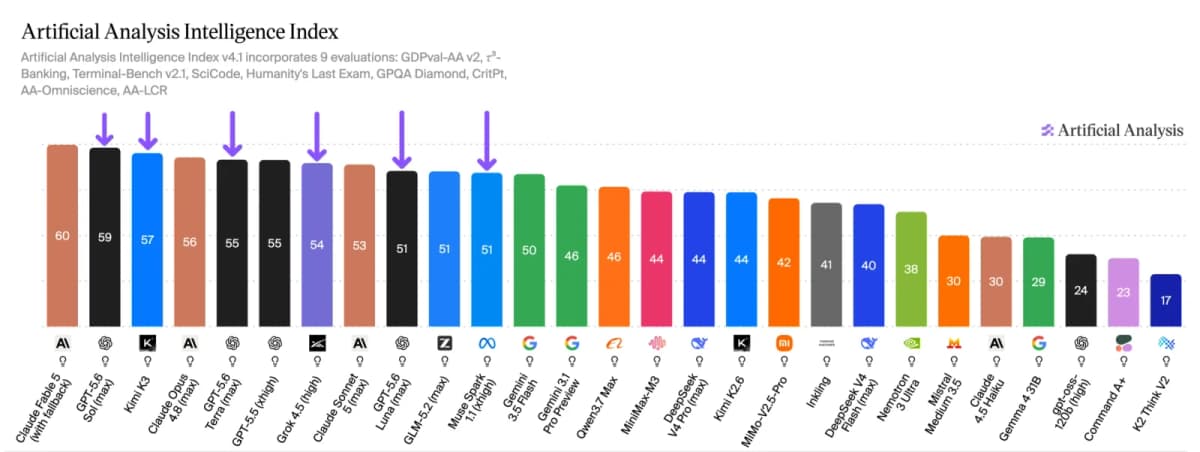
*Source: Artificial Analysis, July 17, 2026. Its v4.1 index combines nine agentic, coding, reasoning, knowledge, and long-context evaluations.*
Five points separate Grok from Sol, and six separate it from Fable. That gap is large enough to show up in hard tasks, but small enough that cost, latency, and tool reliability can reverse the practical result on high-volume work.
Where does Grok 4.5 perform well?
Coding agents and terminal work
Grok 4.5 scores 76 in Grok Build on the Artificial Analysis Coding Agent Index. Sol leads at 80 in Codex. Fable 5 scores 77 in Claude Code, although that configuration can fall back to Opus 4.8.
One point separates Grok from the tested Fable configuration. Four points separate it from Sol. This is close enough to justify repository-level trials, especially when an agent runs hundreds of tool calls and output-token costs compound.
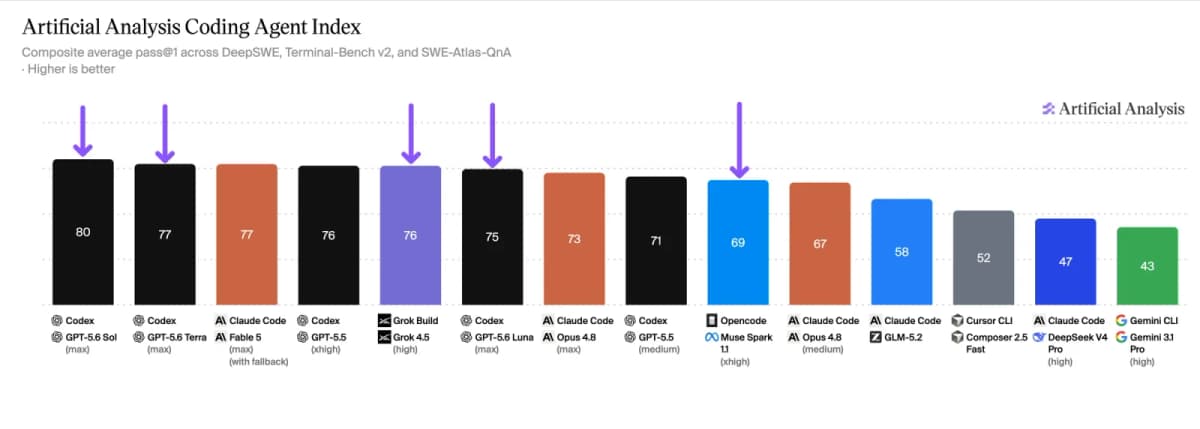
*Source: Artificial Analysis. The index averages DeepSWE, Terminal-Bench v2, and SWE-Atlas-QnA. Harnesses differ, so the chart measures the model-agent combination.*
SpaceXAI's launch table tells a similar but less current story. Grok leads SWE Marathon at 29.0%, scores 83.3% on Terminal-Bench 2.1, and reaches 64.7% on SWE-Bench Pro. Fable 5 leads four of the five coding tests shown. SpaceXAI compared Grok with GPT-5.5 rather than GPT-5.6 Sol, so I would not use that vendor table for a direct Sol verdict.
Speed and token efficiency
Artificial Analysis measured Grok 4.5 at roughly 112 output tokens per second. SpaceXAI reports 80 tokens per second and says the model used 15,954 output tokens per resolved SWE-Bench Pro task, 4.2 times fewer than Claude Opus 4.8 in its comparison.
Those figures describe different test setups, but they point in the same direction: Grok is designed to finish agentic work with less output. The saving matters when a coding agent reads files, runs commands, repairs failures, and repeats the loop.
Is Grok 4.5 the cost winner?
For prompts below 200,000 tokens, xAI charges $2 per million input tokens, $0.50 for cached input, and $6 for output. Once a prompt crosses 200,000 tokens, the rates double to $4, $1, and $12 across the whole request.
The short-context list price is 60% below Sol on input and 80% below it on output. Fable 5 costs five times more for input and more than eight times more for output.
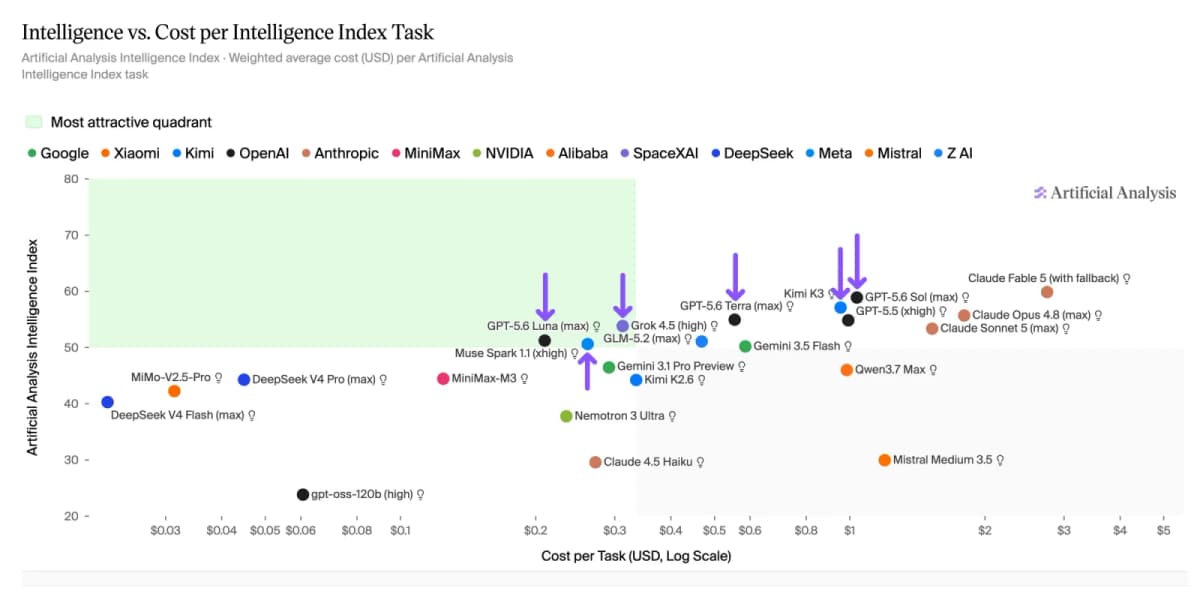
*Source: Artificial Analysis. Cost per task includes the tokens each model used, rather than comparing price cards alone.*
The independent task cost is more useful than the price card: $0.31 for Grok, $1.04 for Sol, and $2.75 for Fable. Grok gives up five intelligence points to Sol while cutting that test cost by about 70%.
Production cost still includes failed tool calls, repeated patches, review time, and regressions. A cheap run that needs a senior developer to repair the result can cost more than an expensive clean run.
Where does Grok 4.5 trail?
Overall quality and long context
Sol and Fable lead the broad independent index. Both also offer roughly twice Grok's context window. That difference affects large repositories, long research packets, and agent sessions that cannot compact their history without losing useful evidence.
Grok's launch benchmarks reinforce the gap. Fable leads DeepSWE 1.0, DeepSWE 1.1, Terminal-Bench 2.1, and SWE-Bench Pro in SpaceXAI's own chart. Grok wins SWE Marathon, which tests longer software-engineering tasks, but one win does not establish consistent leadership.
Knowledge reliability
Grok 4.5 improved AA-Omniscience accuracy from 35% for Grok 4.3 to 52%. Its hallucination rate rose from 25% to 54%. The combined Omniscience score increased from 18 to 26 because Grok answered more questions correctly, but it also gave more unsupported answers instead of declining.
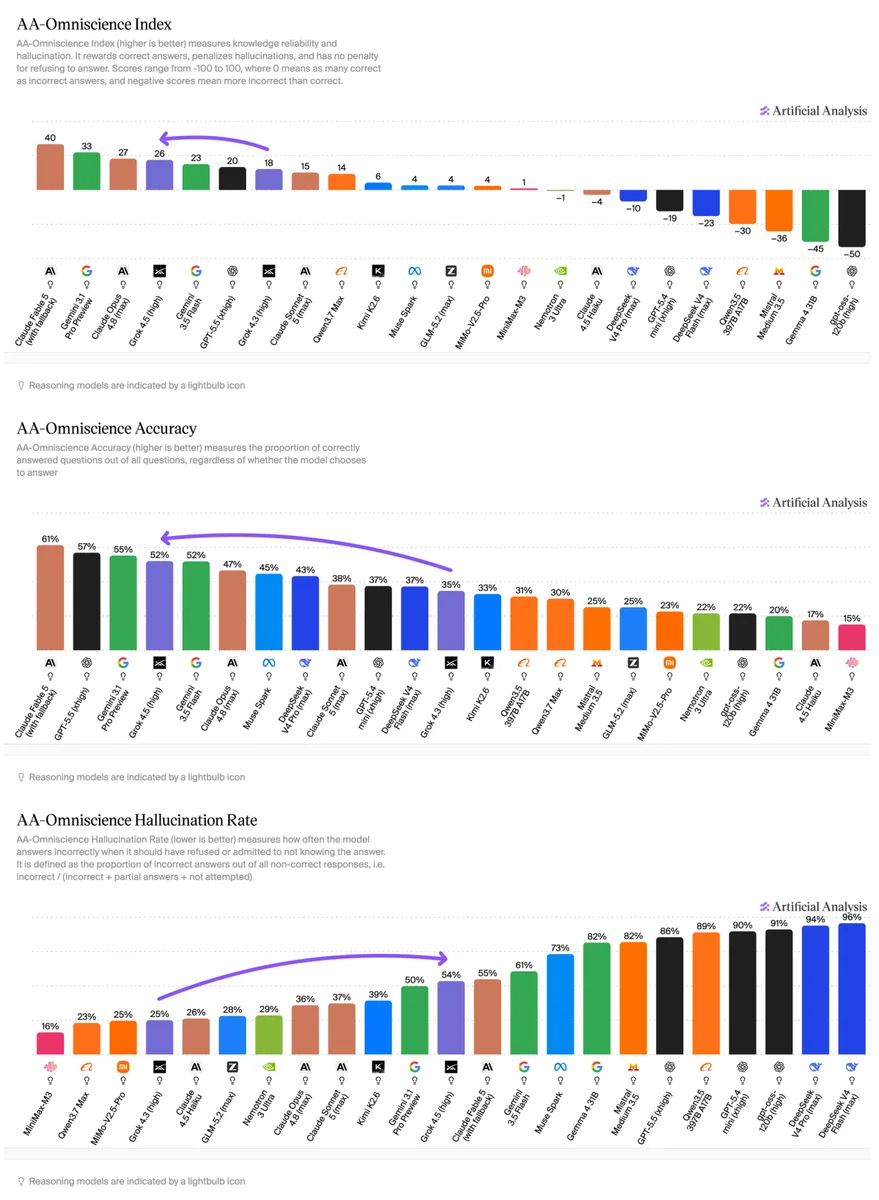
*Source: Artificial Analysis's Grok 4.5 evaluation. The hallucination rate belongs to AA-Omniscience and should not be generalized to every prompt type.*
I would require retrieval, quoted evidence, and external verification for factual publishing with Grok. The same rule applies to Sol and Fable, but Grok's accuracy-versus-hallucination shift deserves a dedicated test.
What blocks Grok 4.5 for my current stack?
I need EU-compatible access for this deployment. xAI's Grok 4.5 documentation still says API-console access is unavailable to EU users and expected later in July. That may change soon, but it blocks a stable production route today.
xAI stores API inputs and outputs for 30 days by default and says it does not train on them without explicit permission. Zero Data Retention is available for eligible teams, although enabling it removes stateful Responses API features, Files and Collections, and Batch API support. Any production trial needs a data-handling review before code or customer material reaches the service.
OpenAI remains my default because Sol leads the current coding-agent index, has a 1.05-million-token context window, and fits the Codex and Responses API workflows I already use. My GPT-5.6 Sol and Fable 5 comparison→ explains that route in more detail.
Anthropic remains my second route for long, ambiguous analysis where Fable's quality lead can cover its higher price. Grok needs to beat one of those routes on finished-task cost, not token price alone.
My standard comes from building AI agents that actually work→: measure completed work, tool failures, review time, and recovery after a bad action.
How I would test Grok 4.5
I would reconsider routing after EU access opens and Grok passes those tests. Until then, Grok 4.5 is a benchmark-worthy candidate rather than a production dependency.
A practical model choice
Choose Grok 4.5 when high-volume agent work, fast output, and cost per completed task dominate the decision—and when its 500,000-token context and regional availability fit your deployment.
Choose GPT-5.6 Sol when you want the strongest current coding-agent result, a mature tool surface, and a larger context window inside the OpenAI ecosystem.
Choose Claude Fable 5 when the task is analytically difficult enough to justify the highest token price and you value its lead on the broad intelligence benchmark.
My route remains OpenAI plus Anthropic, with Grok in testing. Grok 4.5 makes that test economically interesting. The published results do not justify a migration yet.
Sources and methodology
I checked SpaceXAI's Grok 4.5 announcement, model documentation, live pricing table, security FAQ, and Grok Build open-source announcement. Independent results come from Artificial Analysis's Grok 4.5 evaluation and its July 17 frontier comparison. I used OpenAI's GPT-5.6 Sol and Anthropic's Claude Fable 5 documentation for competing specifications and prices.
Scores, prices, access notes, and product behavior are current as of July 18, 2026. Providers can change serving behavior, pricing, regional access, and model aliases without changing the article.