NVIDIA NIM Free Models List 2026: The Best APIs for Coding and Agents
If you want free AI API access in July 2026, stop treating NVIDIA NIM like a side quest.
It is one of the few places where you can test serious models for coding, long-context work, and agent loops without opening five billing accounts first. That matters more now that the frontier keeps moving. OpenAI previewed GPT-5.6 Sol on June 26, 2026 and Anthropic launched Claude Opus 5 on July 24, 2026. Premium models are getting better. They are not getting cheaper or simpler to compare.
That is why the practical question changed.
The question is no longer which lab has the flashiest launch. The question is which free API lets me test useful work today.
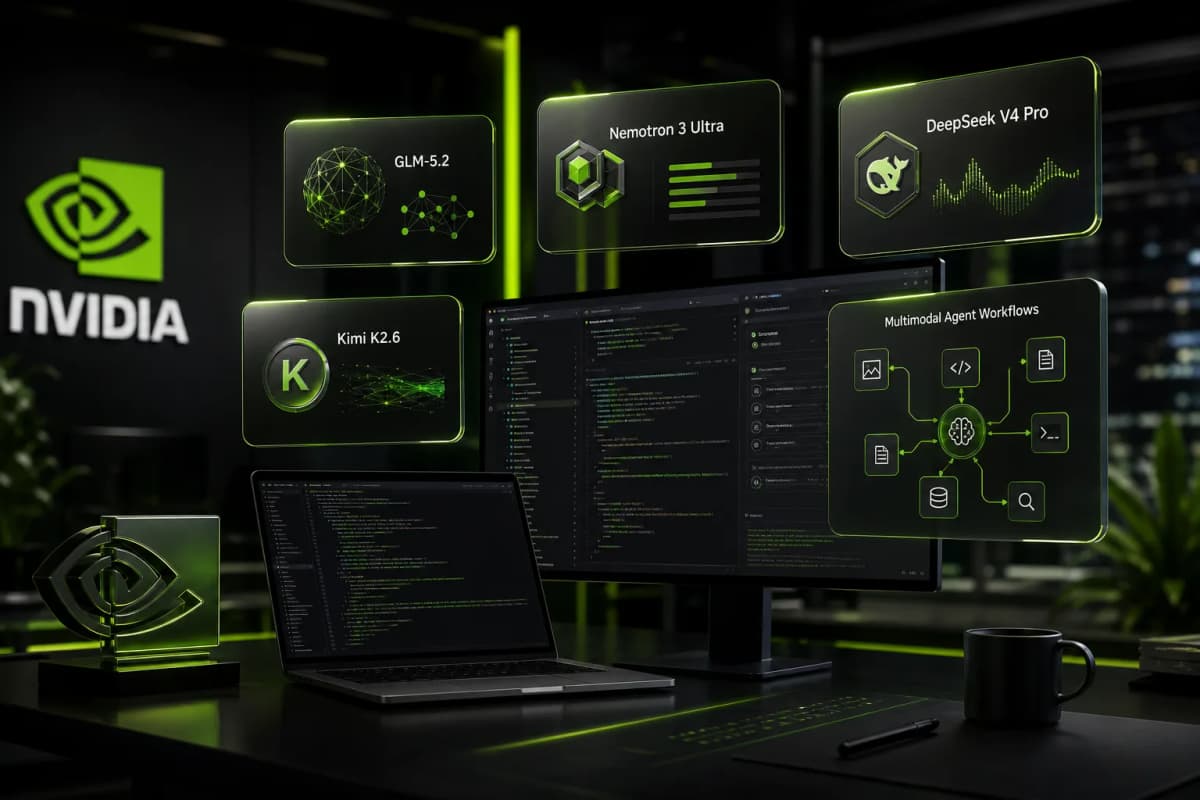
My short answer is this:
This article is the catalog view. My earlier NVIDIA NIM case study→ is still the hands-on story. If you want the GLM-specific numbers first, read my separate GLM-5.2 NVIDIA free API benchmarks→ article after this one.
Why this topic is worth your time right now
NVIDIA's own developer site now frames NIM as free serverless APIs for development. On the featured models page, several entries are clearly labeled Downloadable Free Endpoint. That is the signal that matters.
You are not reading another vague free AI roundup built from old screenshots. You are looking at a live catalog that NVIDIA is actively updating.
The current catalog also lines up with where the wider AI market is going:
That is exactly why this traffic angle is stronger than another general model review. Searchers looking for NVIDIA NIM free models list 2026 or NVIDIA NIM API available models list 2026 are not browsing for entertainment. They are already trying to build something.
The best NVIDIA NIM free models right now
1. GLM-5.2 is the best default for coding and long context
If I had to pick one free NIM model to test first today, I would start with GLM-5.2.
On NVIDIA's documentation, Z.ai describes GLM-5.2 as its latest flagship model for long-horizon tasks, with a 1 million token context window and a stronger focus on coding, debugging, and agentic workflows. That is the right profile for the kind of work many developers actually care about now: repo navigation, multi-step reasoning, tool calling, and sustained sessions that do not collapse after a few turns.
Why it stands out:
My practical take: if you are evaluating free NIM models for coding assistants, internal tools, or multi-step automation, GLM-5.2 is still the strongest place to begin.
2. Nemotron 3 Ultra 550B A55B is the best NVIDIA-native bet
If GLM-5.2 is the best default, Nemotron 3 Ultra 550B A55B is the best lean into NVIDIA's own stack option.
NVIDIA's model documentation describes Nemotron as a family of open models with open weights, training data, and recipes, built for specialized AI agents. The Ultra variant is positioned around agentic reasoning, coding, planning, and tool calling, with a 1M context profile on the NIM reference page.
That combination matters for two reasons.
First, it is not just another hosted inference endpoint. It is part of a larger NVIDIA story around open agent infrastructure. Second, if you care about self-hosting later, Nemotron gives you a cleaner strategic path than relying only on third-party model catalogs.
I would test Nemotron first when:
3. DeepSeek V4 Pro is the strongest current momentum pick
DeepSeek V4 Pro is the model I would test when I want to know what the broader developer crowd is likely to touch next.
On NVIDIA's featured models page, DeepSeek V4 Pro is described as a 1M-context model with an MoE architecture aimed at coding tasks. NVIDIA also shows a visible usage signal on that page: millions of API calls over the last 30 days. That does not prove quality on its own, but it does prove attention.
Attention matters because it changes the support surface around a model. More users means more examples, more bug reports, more benchmarks, and faster ecosystem learning.
Why DeepSeek V4 Pro belongs high on this list:
If you are the kind of builder who wants a free model with both capability and current market momentum, DeepSeek V4 Pro is one of the best NVIDIA NIM models to test immediately.
4. Kimi K2.6 is the multimodal agent pick most people will miss
Kimi K2.6 deserves more attention than it usually gets in free API roundups.
NVIDIA's featured catalog describes it as a 1T multimodal MoE tuned for long-horizon coding, agentic tool use, and image/video understanding. That makes it different from the usual text-only coding model framing.
This is where a lot of teams miss the real opportunity.
The future workflow is not only prompt in, text out. It is repo plus browser plus screenshot plus document plus tool call. A model that can sit inside that multimodal loop is much more valuable than a model that only writes decent code in isolation.
I would not call Kimi K2.6 the safest first pick for everyone. I would call it one of the most interesting free NIM experiments if your workflow already mixes coding with media or interface context.
5. Inkling is the newest wildcard worth testing early
The newest entrant on my list is Inkling from Thinking Machines Lab.
NVIDIA's NIM docs describe Inkling as a general-purpose multimodal autoregressive transformer that accepts text, image, and audio inputs and is intended for coding assistants, agentic systems, tool use, and general conversational applications. The page surfaced this week, which makes it one of the freshest models in the catalog.
That freshness is exactly why it belongs here.
Not because it has already won the market. It has not. It belongs here because free catalogs are most valuable when they let you test emerging models before consensus hardens around them.
If your work touches multimodal retrieval, speech-plus-code workflows, or experimental assistants, Inkling is the free model I would put on the test list now rather than six weeks from now.
What free NVIDIA NIM access does not solve
This is the part where most free-model posts get dishonest.
Free access does not magically remove three hard problems:
A free endpoint can still be the wrong endpoint.
That is why I would not ask which model is best in the abstract. I would ask:
That last point matters because free access changes how aggressively you can compare. It does not replace comparison.
What the latest AI news changes for this list
The last month pushed this topic harder, not softer.
OpenAI's GPT-5.6 preview raises the bar for serious coding and agent work. Anthropic's Claude Opus 5 launch does the same for long-running professional workflows. Google has also kept the pressure on the open side through Gemma 4 and Gemini 3.5 updates.
That does not weaken NVIDIA NIM as a topic. It strengthens it.
Why? Because every new frontier launch makes the free evaluation layer more valuable. Most developers cannot justify switching premium APIs every time a lab drops a new flagship. They need a test bench first. NVIDIA's catalog is becoming that test bench.
That is the real strategic value of this list.
What the GitHub heat says about demand
If you want proof that this space is shifting from model fandom to workflow building, look at the repo heat on July 25, 2026:
That matters because the same people searching for free model APIs are often the people wiring coding agents, MCP servers, and fallbacks a week later.
If you want the workflow layer after this article, I already broke that stack down in Best Free AI Coding Tools in 2026→.
My practical recommendation
If you only want a ranked answer, use this order:
If you already read my older NIM case study, this is the update I would act on now: do not treat NVIDIA NIM as one free endpoint with one lucky model. Treat it as a model lab.
That is the more useful mindset in July 2026.
Final verdict
The best free AI APIs in NVIDIA NIM right now are not good enough for free. They are strategically useful because they let you compare serious models before you commit to a paid stack.
That is a stronger reason to care than price alone.
If you want one safe default, pick GLM-5.2. If you want the most NVIDIA-native agent story, pick Nemotron 3 Ultra. If you want momentum, test DeepSeek V4 Pro. If you want multimodal range, add Kimi K2.6 and Inkling to the bench.
That is the free stack I would test before paying for another model war.
Sources
FAQ
Is NVIDIA NIM really free in 2026?
For development use, NVIDIA explicitly markets NIM with free serverless APIs and labels several featured models as downloadable free endpoints. That does not mean the catalog or limits will never change, so check the live Build pages before treating any free path as permanent.
Which NVIDIA NIM free model is best for coding?
Right now I would start with GLM-5.2, then compare it with DeepSeek V4 Pro and Nemotron 3 Ultra. GLM-5.2 looks like the best general default for long-context coding and agent workflows.
Should I use NVIDIA NIM instead of OpenAI or Anthropic?
Use NIM first for evaluation, cost-sensitive prototypes, fallback layers, and internal tools. For the highest-stakes production work, premium frontier models still earn their place. The value of NIM is that you can test more ideas before you pay for that last step.