Multimodal Embeddings: Test Each Modality Before Production
Audience: Advanced practitioners building search, RAG, recommendation, or agent systems over text, images, video, and visual documents.
Multimodal embeddings can reduce several retrieval pipelines to one vector space. They do not reduce evaluation to one score. A model can lead an aggregate benchmark while missing short video events, exact terms, chart labels, or page-local evidence that a production system needs.
The production rule is simple: keep text, image, video, and visual-document results separate; compare dense, sparse, and hybrid retrieval where each is relevant; measure what the encoder never saw; and treat every model change as an index migration.
Three papers released within five days make that boundary unusually clear. UEmbed generates dense and sparse representations in one pass. Douyin's DME trains a compact vector to preserve retrieval evidence. ReLoop-UME adds recurrent depth without generating rationale tokens. All report stronger retrieval, but their failure patterns point to different operational risks.
What are multimodal embeddings?
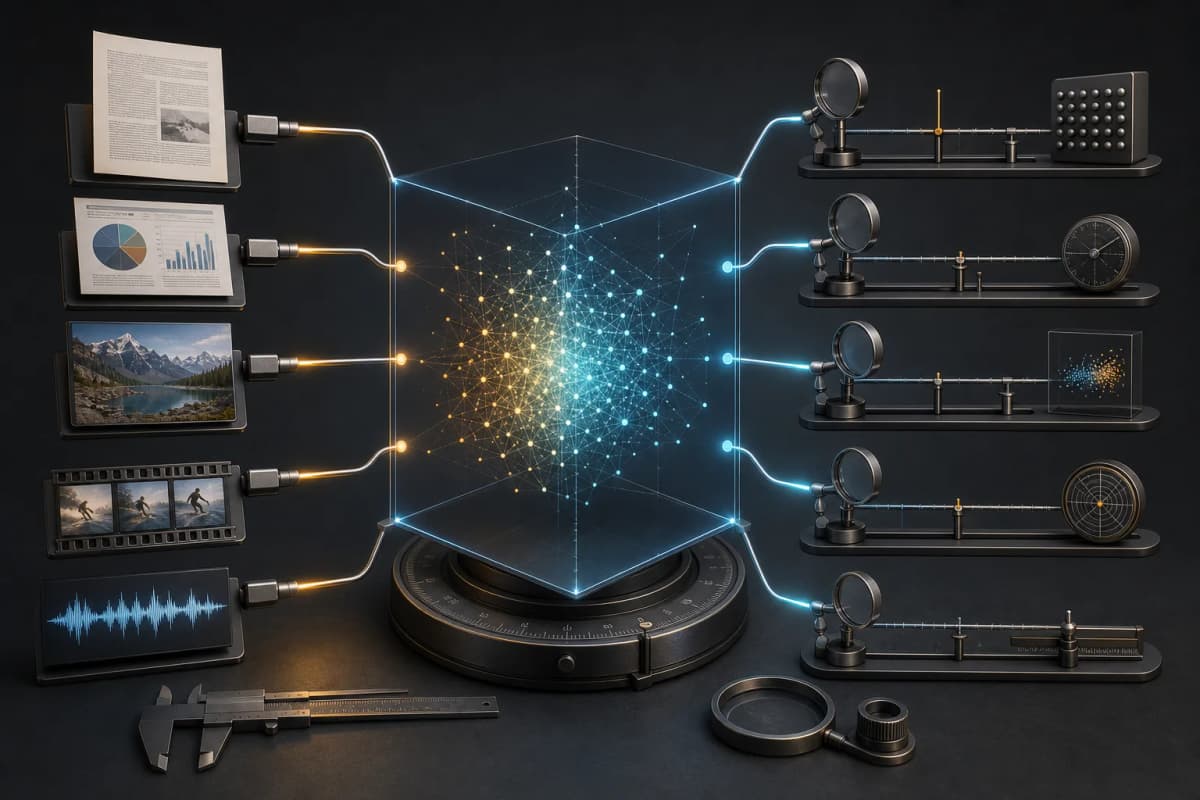
Multimodal embeddings map different input types into vectors that can be compared in a shared space. A text query can retrieve a photograph, a video can match a text description, or a screenshot can retrieve a visually similar document page.
That shared interface is useful because the retrieval system can use approximate nearest-neighbor search instead of running a generative model across every candidate. It also hides meaningful differences. Text contains exact lexical signals. Images contain local objects and relations. Video adds event timing and frame selection. Visual documents combine layout, OCR, tables, charts, and page context.
Current systems expose those differences in their own limits. Google's Gemini Embedding 2 documentation maps text, images, video, audio, and PDFs into one space, but processes at most 32 frames per video and does not process a video's audio track. PDFs are limited to six pages per request. The Qwen3-VL-Embedding-2B model card supports text, images, screenshots, video, and mixed inputs with a 32K context and configurable dimensions from 64 to 2,048.
Those capabilities are inputs to an evaluation plan, not evidence that every modality works equally well for a specific corpus.
What the three new papers actually measured
The papers optimize different parts of the same retrieval constraint: retain enough evidence for discrimination without turning every query into a slow generation task.
| System | Mechanism | Reported result | Important boundary |
|---|---|---|---|
| --- | --- | --- | --- |
| UEmbed | One causal pass produces dense and learned sparse vectors | UEmbed-9B reports 71.8 dense and 71.0 sparse on MMEB-V2 | Sparse quality is weaker cross-lingually; video has a larger dense-sparse gap |
| DME | Contrastive pretraining plus training-only latent reasoning and reconstruction | DME-2B reports 74.8 and DME-9B 78.4 on MMEB-V2 | Internal production data, evaluation set, and the 0.1% Lifetime metric are not public |
| ReLoop-UME | Reuses a shared middle-to-late block with retrieval registers | ReLoop-UME reports 44.9× lower latency than UME-R1 in its H20 setup | It adds training cost and cannot recover video evidence omitted during frame sampling |
These numbers come from the authors' experiments. They are not results from a common production environment, and they should not be compared as if hardware, data, model scale, and serving stacks were controlled.
UEmbed: dense and sparse retrieval in one pass
UEmbed appends 16 learnable special tokens to a decoder-only multimodal model. Each token predicts sparse weights over a separate vocabulary partition; the final end-of-sequence state supplies the dense vector. The authors release 2B, 4B, and 9B variants trained on public data.
UEmbed-9B reports 71.8 for dense retrieval and 71.0 for sparse retrieval on MMEB-V2. The hybrid result adds 0.3 points for text and 0.5 for visual documents over dense retrieval, with little change for images and video. That result supports a narrow inference: learned sparse signals can complement dense retrieval where exact terms or document text matter. It does not show that hybrid search improves every modality.
The limitations are practical. The training data skews toward English and Chinese, and the paper reports weaker cross-lingual sparse generalization. Its sparse representation also retains vocabulary artifacts. Video shows a larger gap between dense and sparse performance, and the paper does not provide a full inverted-index efficiency study.
The UEmbed repository was only days old when checked on August 4, 2026. It had two commits, six stars, no forks, and no releases. Those numbers describe maturity, not model quality. The implementation is early enough that production teams should expect interface and serving changes.
DME: train the vector to retain retrieval evidence
The Douyin Multimodal Embedding technical report separates learning into two stages. Large-scale contrastive pretraining first creates a broad shared space. Training-only latent reasoning and cross-conditional reconstruction then pressure the compact embedding to preserve fine-grained evidence about its counterpart.
The reported MMEB-V2 score rises from a 70.9 baseline to 72.5 after stage-one pretraining, 73.8 after evidence-grounded latent reasoning, and 74.8 after reconstruction for the 2B model. The 9B model reports 78.4. The paper also reports a 2.92% relative gain on an internal offline set and a 0.1% gain on an internal Lifetime metric in an online A/B test.
The authors measured those production results inside Douyin. The paper infers that evidence-preserving training improves industrial retrieval without generative serving overhead. A reader cannot independently reproduce the internal dataset, metric definition, traffic mix, or deployment conditions from the report. The practical interpretation is therefore limited: reconstruction can be a useful training objective, but the online number is not a transferable forecast.
ReLoop-UME: add computation along depth
ReLoop-UME asks whether a model can do more retrieval-specific computation without generating intermediate tokens. It identifies a middle-to-late region where positive and negative examples separate, reuses that parameter-shared block four times, and carries evidence through five learnable retrieval registers.
On MMEB-V2, the 2B model reports 63.2 overall versus 58.0 for VLM2Vec-V2 and 60.1 for UME-R1 in the paper's comparison. The 7B model reports 65.9. On a single H20 GPU, the authors measure 201 milliseconds per sample: 44.9× faster than UME-R1 and 1.5× faster than PLUME, but 1.3× slower than the non-recurrent VLM2Vec-V2 baseline.
The aggregate improvement hides a warning. ReLoop-UME-2B scores 40.5 on the paper's video slice, below PLUME's 44.1; the 7B result also trails UME-R1 on video. The method samples eight frames. Its own limitations state that recurrence cannot recover evidence that sampling omitted, and that temporal-boundary smoothing can miss short events.
Why one benchmark average is insufficient
MMEB-V2 was introduced with VLM2Vec-V2 to cover 78 datasets: 36 image, 18 video, and 24 visual-document datasets. That breadth makes it useful for model development. A mean across those tasks still applies weights that may have little connection to a production workload.
Consider three systems that receive the same aggregate score:
The first needs lexical precision and screenshot understanding. The second lives or dies on temporal coverage. The third needs page-local OCR, layout, and modifier accuracy. Averaging their failures produces a clean number and a poor decision.
The same principle applies to general model benchmarking. A reproducible task set should represent the work a system will do, as described in How to Benchmark AI Models for Real Work→. For retrieval, that task set must preserve the modality and failure type of every query.
A reproducible multimodal embedding evaluation
Start with a frozen corpus snapshot and a query set that contains known relevant evidence. Keep the original source object, the embedding input, and the relevance judgment together. Otherwise, an encoder failure and an ingestion failure become indistinguishable.
1. Build modality slices before choosing metrics
Create separate slices for text, images, video, and visual documents. Split them again by the behavior that matters:
Add a coverage field for every example. Record whether the source evidence reached the encoder. A missed frame, cropped chart legend, or omitted PDF page must not be scored as an embedding error.
2. Compare complete retrieval pipelines
Test at least these candidates against the same relevance judgments:
The hybrid baseline matters because the UEmbed result shows gains concentrated in text and visual documents rather than every modality. The text baseline matters because captions, OCR, and structured metadata may be cheaper to index, easier to debug, and better for exact terms than a native multimodal vector.
If the system already has a RAG test harness, reuse its query, relevance, and regression structure. The RAG evaluation workflow→ separates retrieval misses from answer-generation failures.
3. Measure quality, coverage, and cost together
Report metrics per slice and as distributions, not only as one mean.
| Dimension | Minimum measurement |
|---|---|
| --- | --- |
| Retrieval quality | Recall@k, nDCG@k, and evidence hit rate per slice |
| Fine-grained accuracy | Exact identifier, modifier, table cell, chart label, and event-boundary checks |
| Input coverage | Frames, pages, regions, audio, and metadata presented to the encoder |
| Runtime | p50 and p95 query latency, encoding throughput, reranker latency |
| Storage | Vector dimensions, sparse postings, index bytes per object |
| Migration | Full re-embedding time, write amplification, dual-index duration |
| Reliability | Empty output, timeout, malformed media, and model-version failure rates |
A valid summary keeps the worst important slice visible. For example, promote a candidate only when the weighted aggregate improves and no protected slice exceeds its regression budget.
promote = aggregate_gain > 0
          and text_regression <= budget.text
          and image_regression <= budget.image
          and video_regression <= budget.video
          and visual_doc_regression <= budget.visual_doc
          and p95_latency <= budget.latency
The budgets are product decisions. The structure prevents an image-heavy benchmark from compensating for video failure in a video-search product.
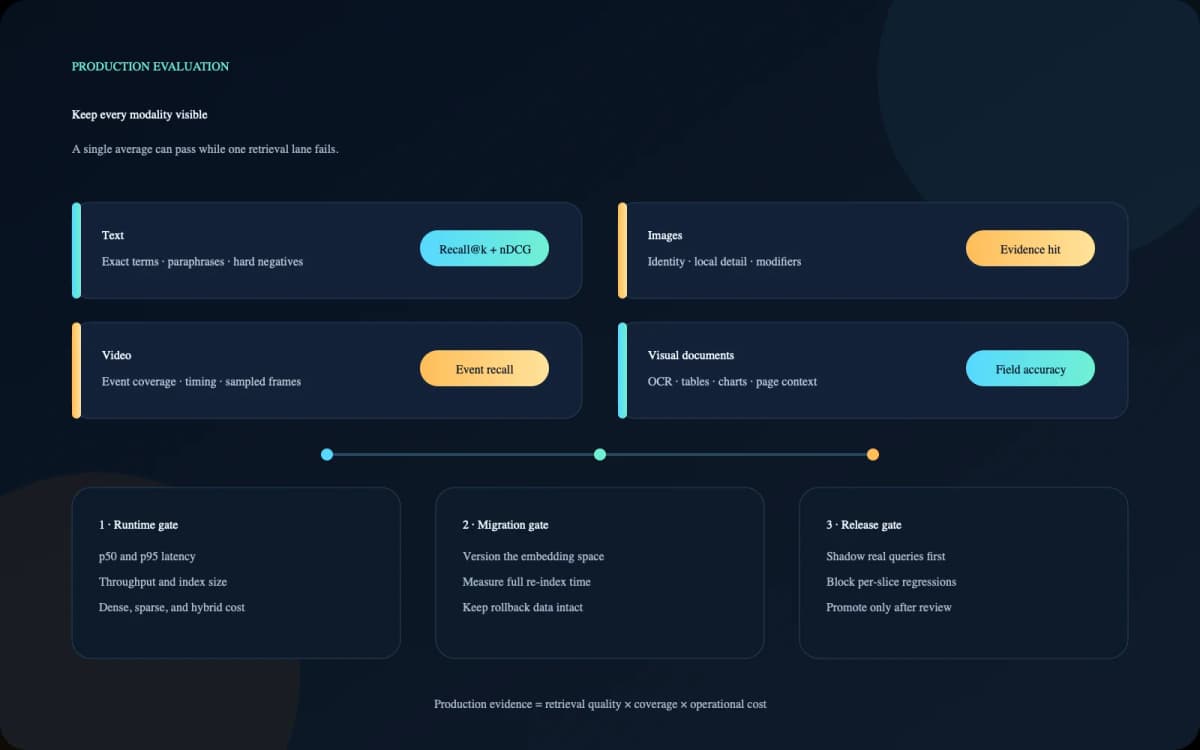
*Evaluate each retrieval lane first, then apply shared runtime, migration, and release gates.*
4. Version the embedding space
An embedding model version is part of the stored data format. Google's migration guide states that gemini-embedding-001 and gemini-embedding-2 produce incompatible spaces, so upgrading requires re-embedding all existing data. Query vectors from one space cannot be compared directly with document vectors from the other.
Use immutable index versions such as corpus-model-dimension-preprocess-date. Build the new index beside the old one, replay a fixed query set, shadow real traffic, and keep rollback possible until quality and latency stabilize. Record the encoder, dimension, prompts or task instructions, frame sampler, PDF renderer, OCR version, and score-fusion logic in an AI bill of materials→.
5. Shadow production queries before switching
Offline evaluation controls the known cases. Shadow traffic tests the actual distribution without changing user-visible results. Log both candidate lists, latency, empty results, and the slice or input type associated with each disagreement. Review disagreements before a partial rollout.
Do not use clicks alone as relevance truth. Position bias and the current ranker shape what users can click. Combine sampled human judgments, downstream task success, and behavioral signals.
A decision framework for production
Use a multimodal embedding model when raw visual or temporal evidence changes relevance and a text representation loses that evidence. Keep a simpler text or hybrid pipeline when the corpus is mostly prose, exact identifiers dominate, or reliable captions and OCR already capture the useful signal.
| Workload | Strong first candidate | Reason |
|---|---|---|
| --- | --- | --- |
| Product search with names, SKUs, and images | Dense multimodal + lexical fusion | Visual similarity and exact terms both matter |
| Screenshot or visual-document RAG | Multimodal dense + OCR/BM25 + reranker | Layout and local text need separate signals |
| Long-form video search | Segment-level index with explicit frame and audio coverage | One vector for the full video hides short events |
| Mostly text documents with occasional images | Text dense + BM25 baseline first | Lower index and migration complexity |
| Cross-modal agent memory | Versioned multimodal index with strict provenance | Retrieval needs source, time, and modality boundaries |
Do not choose a larger model before testing preprocessing. Frame selection, page segmentation, OCR, query instructions, and negative examples can dominate the result. Open-source activity can reveal implementation friction, but it is not a quality benchmark. As of August 4, 2026, the Qwen3-VL-Embedding repository had 32 commits and 55 open issues; recent issues included serving endpoints and representation mismatches. Those are engineering signals to investigate, not reasons to accept or reject the model.
What the evidence supports
The papers support three concrete conclusions.
First, a compact multimodal vector can retain more retrieval-specific computation than a single unmodified forward pass. DME adds training-only objectives; ReLoop-UME adds recurrent depth; UEmbed derives dense and sparse views together.
Second, the representation mechanism changes the failure pattern. Sparse retrieval carries lexical and cross-lingual risks. Recurrent depth carries training and latency costs. Video remains vulnerable to sampling before the embedding model runs.
Third, production evidence must be local. The authors measured useful benchmark and system results, but no paper measured your corpus, query mix, latency budget, index migration, or cost of a wrong retrieval.
The useful conclusion is operational: adopt multimodal embeddings only after each modality passes its own retrieval and coverage tests. The shared vector space can simplify serving. The evaluation should stay deliberately uneven.
FAQ
Should text and image embeddings use the same index?
They can share an index when the model was trained to place those modalities in one compatible space and cross-modal retrieval is part of the task. Keep separate fields or indexes when lexical retrieval, modality-specific filters, different update rates, or independent rollback matter. Test score fusion on real relevance judgments instead of assuming one layout is better.
Do I need to re-embed data when changing models?
Usually yes. Embedding spaces from different models or incompatible versions cannot be compared safely. Build a versioned replacement index, re-embed the corpus, shadow queries against both indexes, and keep the old index until the new one passes per-slice quality and latency gates.
Claim checks
| Claim | Status | Evidence boundary |
|---|---|---|
| --- | --- | --- |
| UEmbed-9B reports 71.8 dense and 71.0 sparse on MMEB-V2. | Verified | UEmbed paper, version 1, August 3, 2026. |
| UEmbed hybrid gains are concentrated in text and visual documents. | Verified | Paper reports +0.3 for text and +0.5 for visual documents, with little change elsewhere. |
| DME-2B reports a cumulative rise from 70.9 to 74.8 across its training stages. | Verified | DME ablation table; the result belongs to the authors' setup. |
| DME's 0.1% online gain predicts the impact of another deployment. | Rejected | Internal metric, traffic, data, and deployment conditions are not public. |
| ReLoop-UME is 44.9× faster than UME-R1. | Qualified | Measured in the paper's single-H20 setup; not a universal serving ratio. |
| Recurrent depth can recover a video event omitted by frame sampling. | Rejected | The paper states that unseen evidence cannot be recovered. |
| One MMEB-V2 average is enough for a production decision. | Rejected | The benchmark spans 78 datasets and different modalities; production weights and failure costs differ. |
| Gemini Embedding 2 processes every video frame and its audio track. | Rejected | Official docs cap processing at 32 frames and exclude video audio. |
| Upgrading from Gemini Embedding 001 to 2 requires re-embedding existing data. | Verified | Google documents the spaces as incompatible. |
| Repository stars or open issues prove retrieval quality. | Rejected | They are adoption and maintenance signals, not controlled quality measurements. |