
If someone asks you to delete their data from an AI system, removing one row from a database is not the whole job. Machine unlearning can reduce or redirect a model's response to specific training examples, but it does not automatically clean the rest of the stack: vector indexes, fine-tuned adapters, cached prompts, checkpoints, replicas, backups, and exports. NIST defines machine unlearning as selectively removing the influence of specific training points from a trained model, and it explicitly notes that efficient approximate techniques may avoid full retraining from scratch. That is narrower than "the entire system forgot the data." NIST
For most teams, the practical answer is layered. First trace where the data went. Then stop reuse. Then delete or restrict derived artifacts. Only after that do you decide whether the model weights need retraining or approximate unlearning. Google's 2023 Machine Unlearning Challenge used exactly that model-centric framing: an unlearned model should become hard to distinguish from one retrained without the forget set, while still preserving performance on the retained set. Google Research
Table of contents
What machine unlearning actually means
Machine unlearning is a model-level operation. It is about reducing the influence of selected data on a trained model's behavior. That can mean exact retraining on the retained set, or an approximate method that aims to get close enough without paying the full retraining cost. NIST uses both ideas in its glossary entry, and Google's challenge page frames the gold standard as similarity to a model retrained from scratch without the forgotten examples. NIST Google Research
That definition matters because AI systems rarely end at the model weights. A production stack usually includes:
Deleting only one of those layers can still leave the data reachable somewhere else. In practice, "remove this data from AI" is a lineage problem before it becomes a model-editing problem.
Why a normal delete flow is not enough
Many AI products never trained on the data they are asked to delete. They only retrieved it at inference time. In that case, the job is to remove source records, derived embeddings, caches, and access paths. Model unlearning is irrelevant because the model weights were never changed.
The harder cases start when the data affected weights, adapters, or persistent memories. Then you need to separate four situations instead of treating every deletion request the same way.
| Situation | Immediate removal work | Is model unlearning required? | What evidence should remain |
|---|---|---|---|
| --- | --- | --- | --- |
| The data only lived in source systems and logs | Delete or restrict the source record, exports, logs, and caches | No | Record IDs, deletion timestamp, retention path |
| The data also entered RAG or search | Remove source files, chunks, embeddings, vector rows, cache keys, and reindex jobs | Usually no, unless those documents were later used for training | Reindex completion, retrieval tests, chunk counts |
| The data affected a fine-tuned model or adapter | Remove source artifacts and decide between retraining, adapter replacement, or approximate unlearning | Yes | Forget-set definition, retained-set checks, old model retirement |
| The data may be inside a third-party foundation model | Remove your copies and open a provider-level process | Maybe, but only the provider can do it | Ticket, vendor statement, contract/policy path |
That table is why "delete button" is the wrong mental model. The right model is scoped removal plus evidence.
A practical seven-step workflow
1. Scope the request and freeze reuse
Start with the exact identifiers: user ID, file hash, document IDs, vector collection names, training batch IDs, or ticket references. Then stop new reuse. Pause ingestion, retraining, export jobs, or syncs that would recreate the same data while you clean it up.
If the request is privacy-driven, keep the legal framing narrow. GDPR Article 17 creates a right to erasure in defined circumstances, but it does not tell you which technical layer to touch first. The European Data Protection Board's 18 December 2024 opinion on AI models also says models trained with personal data cannot in all cases be treated as anonymous. Preserve an explicit deletion workflow instead of assuming the model is outside scope. EUR-Lex EDPB
2. Trace the lineage before you delete anything
Map the full path:
This is where an AI bill of materials→ becomes useful. If you do not know which model, adapter, or index consumed the record, you cannot prove removal later.
3. Delete or restrict source and derived artifacts
Now clear what you can clear deterministically:
For retrieval-heavy systems, this step often matters more than model editing. The same logic appears in RAG evaluation→: if retrieval is the path that reintroduces bad content, you fix retrieval before blaming the model.
A public AnythingLLM issue reported that deleted documents' embeddings allegedly remained retrievable in one Weaviate-backed setup. One issue is anecdotal evidence, not a platform-wide finding. It still shows why every delete flow needs a negative retrieval test for document IDs, distinctive phrases, and paraphrases.
4. Decide whether the model weights changed at all
This is the branching point teams often skip.
Google's 2023 challenge defines the model-side goal: the unlearned model should resemble one retrained without the forgotten examples while retaining the useful behavior learned from the rest of the data. Google Research
5. Build evaluation sets before changing weights
You need at least three slices:
This is the same discipline that makes AI agent permissions→ auditable: define what must stop, what must stay, and what evidence counts.
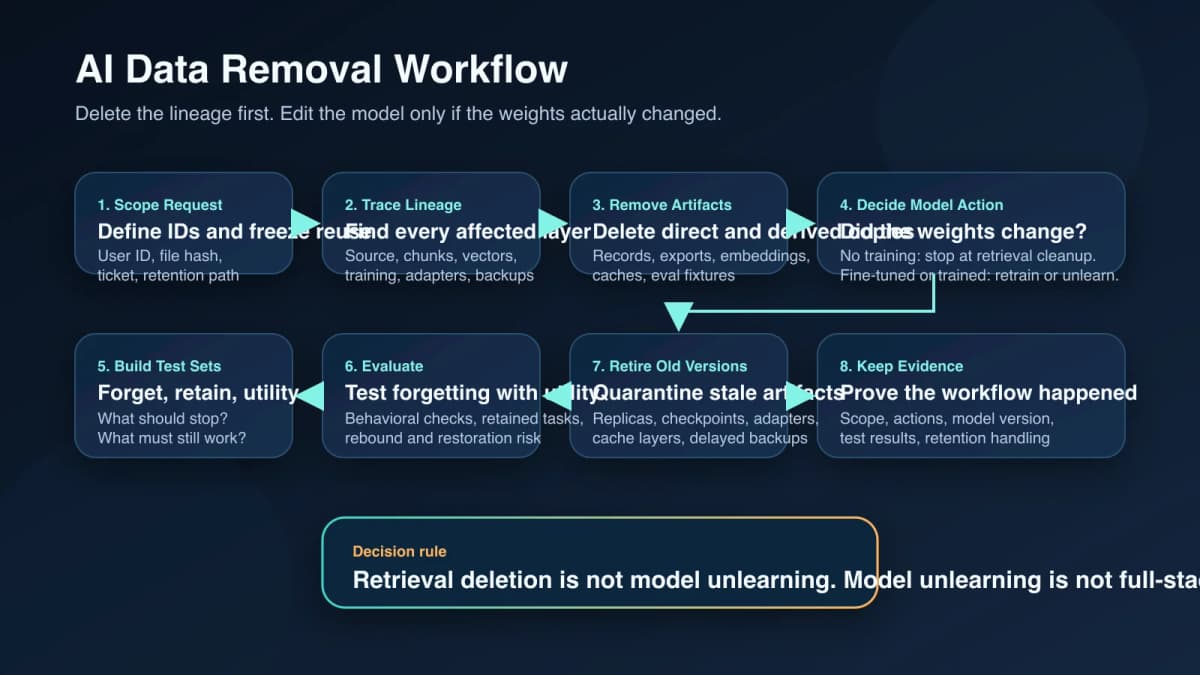
*Caption: Deletion work starts with data lineage and derived artifacts. Model unlearning only begins after you prove whether weights were affected.*
6. Test forgetting and retained utility together
Recent research makes the tradeoff clear.
The paper *Behavioral Audit of Machine Unlearning Has a Privacy Cost* argues that, for convex models, a black-box behavioral audit cannot both catch insufficient unlearning and avoid leaking retained-set membership information to an honest-but-curious auditor. The authors also show empirical evidence that this tension persists in non-convex settings. That means one clean audit score is not the same thing as a universal proof of safe forgetting. arXiv
Google Research's June 10, 2026 audit framework approaches the problem from another direction. It proposes Regularized f-Divergence Kernel Tests to make auditing more sensitive and to control false positives more reliably across sample sizes. The result is a statistical test, not proof of complete deletion. Google Research
PrivUn separates three recovery levels: direct retrieval, in-context recovery, and restoration through fine-tuning. Use the tiers that match your access to the model. A refusal on the original prompt can pass the first check while a stronger recovery path still exposes the target.
7. Retire stale artifacts and keep evidence
After the model-side work, remove or quarantine stale replicas, checkpoints, adapters, and caches. Then keep an evidence package:
That evidence is what turns a deletion workflow into something support, security, legal, and engineering can all verify.
What the latest unlearning research actually supports
Three recent papers are useful here, but they support different claims.
Behavioral audits are not free
The June 2026 paper on behavioral auditing is the strongest warning against overclaiming. Its core result is not "unlearning is impossible." The result is narrower and more useful: under a dishonest owner and an honest-but-curious auditor, a behavioral audit can create a privacy-audit tradeoff. If your compliance story depends on black-box probing alone, you may leak information about the retained data while trying to verify forgetting. arXiv
Targeted editing can work on selected benchmarks
*ZeroUnlearn* is a more optimistic result. It reframes machine unlearning as a model-editing problem, reports strong benchmark results on Llama-3.2, Llama-3.1, and Qwen-3, and says its closed-form few-shot update keeps the SVD step below 0.3 seconds on MCF and ZsRE while end-to-end editing grows from about 0.04 hours at 10 samples to 3.35 to 3.82 hours at 1000 samples, with total memory around 14.9 to 17.4 GB. Those numbers matter because they show that approximate unlearning is not automatically too expensive to test. arXiv
But the limitations matter more than the headline. The paper evaluates selected open models and benchmark datasets such as MCF, ZsRE, and an adapted single-hop version of MQUAKE. It also uses targeted layer selection to avoid damaging general capability. That is evidence for promising benchmark-scale fact removal, not proof that a production system has fully erased every copy of sensitive information. arXiv
Continual deletion is still weak in multimodal systems
*ICU-Bench* is the sobering counterweight. The benchmark contains 1,000 privacy-sensitive profiles from medical reports and labor contracts, 9,500 images, 16,000 question-answer pairs, and 100 sequential forget tasks. Its conclusion is simple: current multimodal unlearning methods struggle in continual settings and do not simultaneously preserve forgetting quality, retained utility, and long-sequence stability. If your product gets repeated deletion requests over time, this is the paper to read before promising clean automation. arXiv
Taken together, the papers support a practical position:
What to promise users and stakeholders
Promise less. Verify more.
Good language sounds like this:
Bad language sounds like this:
If you need a short rule, use this one: machine unlearning is one layer inside a broader AI data removal workflow.
FAQ
Does deleting a vector database row make the LLM forget?
No. It can stop a retrieval path from reintroducing the data, which is often the right first fix for RAG systems. But if the same content was used for fine-tuning, continual training, or persistent model memory, deleting the vector row alone does not change the weights.
Can machine unlearning prove my data is gone from every model copy?
Not by itself. Recent auditing research shows that black-box audits have limits, and production systems often include caches, adapters, checkpoints, replicas, and backups outside the audited model surface. You need system-level evidence, not only a model-level score. arXiv Google Research
Claim checks
| Claim | Check | Source |
|---|---|---|
| --- | --- | --- |
| Machine unlearning means removing the influence of specific training points, and approximate methods may avoid full retraining. | Matches NIST glossary wording and scope. | NIST machine unlearning glossary |
| Google's challenge treats retraining without the forget set as the model-side reference point. | Described on the official challenge announcement. | Google Research challenge announcement |
| Behavioral black-box audits can create a privacy-audit tradeoff. | Supported by the June 2026 theoretical and empirical paper. | Behavioral Audit of Machine Unlearning Has a Privacy Cost |
| One refused answer proves durable forgetting. | Rejected; PrivUn separates direct output checks from in-context and fine-tuning recovery. | PrivUn |
| ZeroUnlearn reports strong benchmark results with practical runtime and memory ranges, but on selected open models and datasets. | Supported by the paper's experiment and complexity sections. | ZeroUnlearn |
| Continual multimodal deletion remains hard for current methods. | Supported by ICU-Bench dataset scale and main findings. | ICU-Bench |
| AI models trained with personal data cannot always be treated as anonymous. | Stated in the EDPB opinion summary and opinion text. | EDPB Opinion 28/2024 |
| One GitHub issue establishes a platform-wide deletion defect. | Rejected; it is an anecdotal integration report used only to motivate a negative retrieval test. | AnythingLLM issue #3958 |