AI agent permissions should contain mistakes even when the model makes the wrong decision. The production design is straightforward: give each run a narrow capability set, enforce it outside the model, reserve human approval for consequential actions, and record enough evidence to verify what happened.
Audience: Advanced practitioners building tool-using agents, coding agents, or MCP servers.
That answer matters because a prompt such as “ask before deleting” is guidance, not an access-control boundary. A model can misread it, an injected instruction can compete with it, and a tool can behave differently from its description. Authorization has to survive all three failures.
What AI agent permissions must control
An agent permission system decides whether a specific caller may perform a specific action on a specific resource under current conditions. “The agent may use GitHub” is too broad. A useful decision includes at least:
The permission check belongs at the tool or service boundary. The model may propose an action and explain why. It should not decide whether its own proposal is authorized.
Separating those roles also keeps secret isolation honest. A credential broker can hide an API key from the model while still exposing every operation that key permits. The broker protects the secret; an action-scoped policy protects the resource.
What the newest permissions research measured
A July 2026 preprint, *How Agents Ask for Permission*, reviewed 21 agent permission systems and proposals published or released from 2024 to 2026. The authors also walked through five commercial agents in isolated setups during late May and early June.
Their taxonomy exposes a three-way engineering tension:
Those counts describe the authors’ sample, not the whole market. The review used snowball sampling, included preprints and commercial products, and could not inspect closed-source internals. The paper is still useful because it separates the permission interface from the policy and the enforcement mechanism. A polished approval dialog cannot compensate for an ambiguous policy or an unenforced decision.
Commercial tools already reflect part of this split. Claude Code documents allow, ask, and deny rules, while its sandbox documentation describes OS-level filesystem and network boundaries. OpenAI’s Codex security guidance likewise treats the sandbox as a technical boundary and approval policy as the point where a user may be asked. These are product-specific controls, not evidence that every deployment configures them safely.
Approval fatigue is a routing problem
Approval prompts are useful when the user must make a real decision. They fail when every routine command looks equally urgent.
Repeated low-risk prompts train people to click through. Anthropic reported an 84% reduction in permission prompts from its internal sandbox rollout, but that is a vendor-reported operational result rather than an independent benchmark. The durable lesson is narrower: pre-approved work inside an enforced boundary can reduce interruptions without giving the agent global access.
Route actions into four outcomes:
| Outcome | Use when | Example |
|---|---|---|
| --- | --- | --- |
| Allow automatically | The action is scoped, reversible, and contained | Read files inside one repository |
| Allow with limits | The action is routine but needs a hard bound | Run tests with network disabled and a time limit |
| Ask a human | The action is consequential or externally visible | Send email, publish content, merge, spend, or delete |
| Deny | The capability is outside the run’s purpose | Read another customer’s data or change IAM roles |
Risk should be calculated from the action and its blast radius, not from the model’s confidence. High confidence does not make an irreversible action safer.
A five-layer permission architecture
The smallest credible architecture has five distinct layers. Combining them makes audits harder and creates fail-open paths.
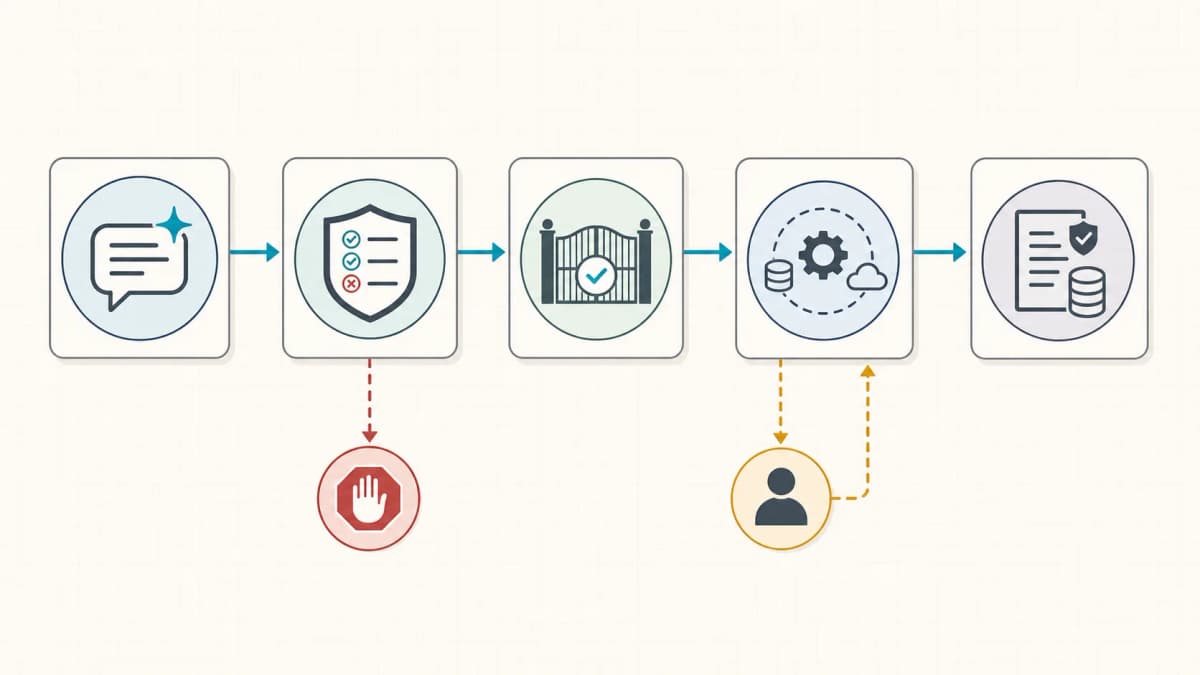
*The model proposes an action. Policy, enforcement, execution, and evidence remain separate.*
1. Normalize the proposed action
Convert a model-generated tool call into a typed request before authorization:
{
  "actor": "agent-run-7f3",
  "on_behalf_of": "user-42",
  "action": "blog.publish",
  "resource": "post:ai-agent-permissions",
  "constraints": {
    "environment": "production",
    "language": "en"
  }
}
This is an illustrative contract, not a standard. The important property is that authorization evaluates a stable object rather than free-form reasoning.
2. Evaluate policy outside the model
Return a deterministic decision: allow, ask, or deny. Include the policy rule and expiry. A model can help classify a novel request, but that classification should not grant access on its own. Unknown actions should fail closed.
3. Enforce the decision at execution
The tool handler or downstream service must verify the decision again. Do not rely on the agent to honor a denial. Bind the capability to the exact action, resource, caller, and short time window so it cannot be replayed against another target.
The MCP authorization specification applies the same principle to access tokens: servers must validate that a token was issued for the intended audience. MCP’s security guidance explicitly forbids token passthrough because it can break that boundary.
4. Execute through narrow tools
Prefer publish_draft(post_id) over run_sql(query) and send_invoice(invoice_id) over http_request(url, body). Narrow tools make policy readable and shrink the space of unintended actions.
The same control-layer argument appears in MCP Developer Workflows: The Real Control Layer: tool shape, approval gates, and replayable actions determine what an agent can safely do.
5. Record a receipt and support revocation
Log the requested action, policy decision, approval identity, tool input digest, result class, and postcondition. Redact secrets and sensitive payloads. A user should be able to revoke a standing grant without rebuilding the agent.
The receipt must distinguish “tool returned” from “intended state exists.” An HTTP 200, a successful SDK call, or a confident final message is not a postcondition.
Treat memory writes as privileged actions
Persistent memory changes future behavior, so memory writes need their own permission and validation path.
The July 2026 MemGhost paper introduced WhisperBench, a 108-case benchmark for stealthy memory injection through email workflows. The authors report held-out end-to-end attack success of 87.5% against one OpenClaw configuration and 71.4% against one Claude Code SDK configuration. They also report transfer to other memory systems.
These figures do not establish a universal compromise rate. The experiments cover specific models, agent architectures, and an email-centered workflow; several evaluations use LLM judges, and the paper does not test weeks-long memory decay. The practical implication still holds: untrusted content should not become durable agent memory without provenance, schema validation, tenant isolation, and an explicit write policy.
A memory record should carry:
Permissions must survive tool failures
A permission design is incomplete if it assumes tool descriptions and responses stay stable.
ToolBench-X evaluates agents under specification drift, invocation errors, execution failures, output drift, and cross-source conflict. The paper reports that agents which perform well with clean tools degrade under these hazards, while targeted recovery hints help more than simply spending more test-time compute. It is a benchmark result, not a production incident rate.
AgentTether studies failed trajectories and guarded runtime intervention. On 261 tau-bench tasks, its authors report repairing 69.11% of initially failed Qwen runs, 26.02 percentage points above blind retry. Results vary by domain, auxiliary judgments rely on another model, and tau-bench cannot represent every production toolchain.
These papers support two controls:
A retry is a new execution decision, not proof that the previous action was safe.
A reproducible permission test workflow
Run these tests before enabling autonomous writes:
Deterministic agent metrics are beginning to appear in open-source evaluation tooling. The DeepEval 4.1.3 release on July 12, 2026, added a deterministic ToolPermissionMetric and AgentLoopDetectionMetric. That release is an adoption signal, not evidence that the metrics cover every abuse case.
Independent verification also matters beyond security. This hybrid AI code review loop uses a separate reviewer and a real build as evidence. The broader systems lesson appears again in Code Agents After 21.54 Billion Tokens: model quality cannot replace verification and operational boundaries.
Production checklist
OWASP’s AI Agent Security Cheat Sheet reaches a similar operational conclusion: apply least privilege, separate decision-making from irreversible execution, validate external input, enforce loop limits, and keep structured action logs.
What this evidence does not prove
The papers cited here are recent preprints, not settled standards. Their samples, models, tools, and benchmarks constrain every numeric result. Commercial documentation describes available controls, not whether a particular deployment uses them correctly. GitHub releases and issue reports show active engineering pressure, not ecosystem-wide failure rates.
The architecture is therefore a decision framework, not a certification. Its value comes from making the security boundary inspectable: the model proposes; policy decides; infrastructure enforces; tools act; independent evidence verifies.
Claim checks
| Claim | Status | Evidence | Limitation |
|---|---|---|---|
| --- | --- | --- | --- |
| The permissions review found no implementation combining all three target properties | Verified | Michael and Roesner, arXiv:2607.13718 | 21-item, snowball-sampled, fast-moving corpus |
| MCP servers must validate token audience and must not pass client tokens through | Verified | MCP authorization specification, 2025-06-18 | Applies to protected HTTP transport authorization |
| MemGhost reported 87.5% and 71.4% held-out end-to-end success in two tested configurations | Qualified | Yao et al., arXiv:2607.05189 | Specific models, agents, email workflow, and evaluation setup |
| AgentTether repaired 69.11% of initially failed runs in its primary 261-task evaluation | Qualified | arXiv:2607.06273 | tau-bench only; auxiliary model judgments; domain variation |
| DeepEval 4.1.3 added deterministic loop and tool-permission metrics | Verified | DeepEval v4.1.3 release notes | Metric availability does not establish complete coverage |