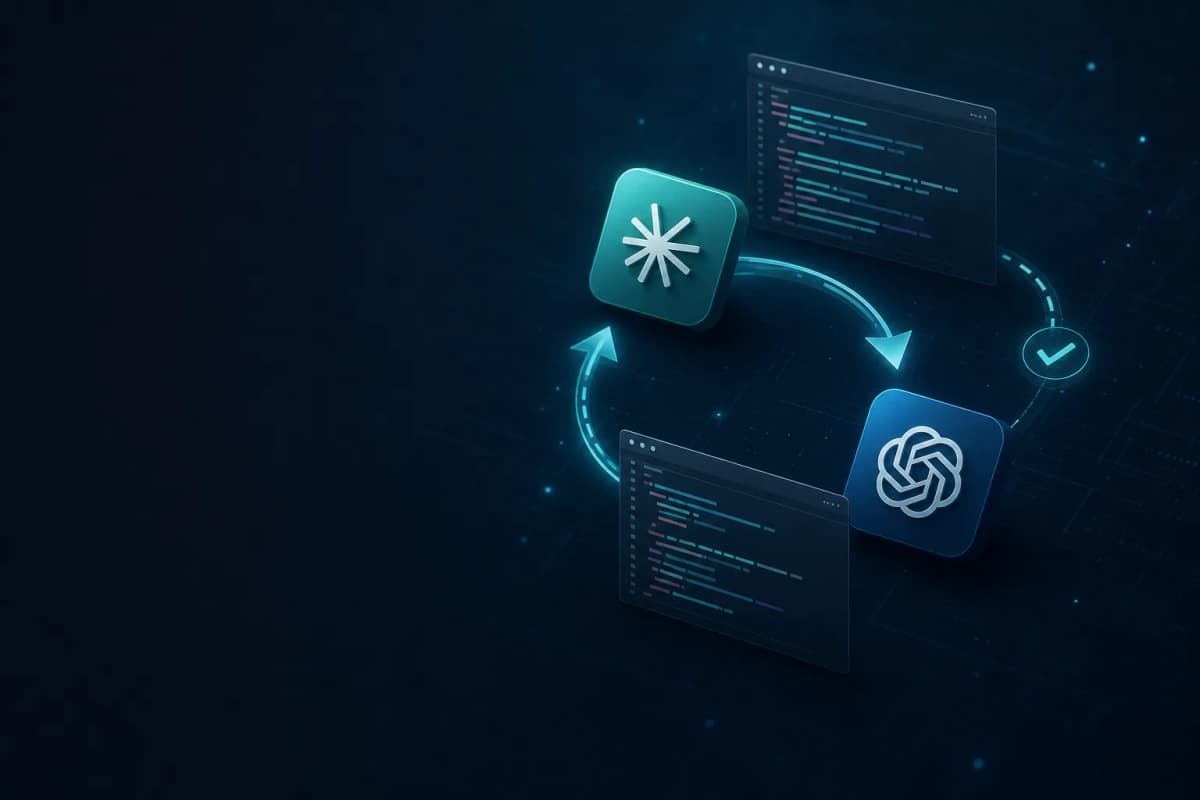
There's a category of work where a single AI agent quietly fails: large, multi-step cleanups where one wrong assumption compounds across dozens of edits. My answer is hybrid AI code review — two different frontier models in a loop, one building and one reviewing — and last week it took a messy SwiftUI prototype to zero App Store blockers in an afternoon, without me writing a line of the code.
The two models were Claude Opus 4.8 as the engineer and Codex (GPT-5.5) as the reviewer, bouncing every task through my AI bridge until it passed a real build. In my experience this hybrid AI code review setup consistently beats either model working alone, and this run was the clearest proof yet. Here is exactly how it worked.
Start with a plan, not a vibe
You do not hand an agent "make this production ready." That is how you get confident nonsense.
So I started with a plan. I had Claude clone the repo (a baby-memory iOS app called Kiddays), read the *entire* codebase with parallel sub-agents, and produce a production-readiness audit: 39 concrete items — 9 hard App Store blockers, the rest high and medium severity. Every item had a file, a line, an effort estimate, and a proposed fix.
That audit became `PRODUCTION_READINESS.md` — a markdown checklist with `- [ ]` boxes, sorted blockers-first. One file, the single source of truth. Every task in it was small, specific, and *checkable*. That last word matters: if you cannot tick a box and prove it, it is not a task, it is a wish.
The hybrid AI code review loop, step by step
I ran the whole thing on a self-paced loop (Claude Code's /loop mode). Each iteration handled one task, or a tight cluster of related ones, and always followed the same rhythm.
The five-step rhythm
codex exec --sandbox read-only -o /tmp/answer.txt <<'PROMPT'
Pair-reviewing a fix for this SwiftUI app. Here are the files...
Recommend the idiomatic iOS 17 approach, flag pitfalls, validate the diff.
PROMPTThen the loop fires again, and again, for hours, unattended. The whole point of hybrid AI code review is that this cycle runs without me babysitting it — the build, not my attention, is what gates each step.
Why two models beat one
The magic is not either model individually — both are excellent, and I have written before about how Claude Opus 4.8 beat Codex on my own codebase→. The magic is that they have different blind spots, and a reviewer that did not write the code has no ego invested in the diff.
The catches that paid for the setup
A few real moments from this run:
This is the difference between a rubber stamp and review. Codex refuted things; Claude integrated the good refutations and defended the rest. The diff got better at the boundary between two models that do not share a brain — which is the whole pitch behind governed agent workflows→: structured handoffs beat one model talking to itself.
The honest part: agents hang, so build a watchdog
Twice, the Codex CLI hung on me — not on the thinking, but on shutdown, when its background MCP servers failed to close cleanly. I traced the first stall to the MCP bootstrap myself, after the process sat dead for minutes. In an unattended loop, one hang stalls everything.
The fix was a hard watchdog: a kill-timer around every consult, plus disabling MCP for the call entirely (`-c mcp_servers={}`) so there was nothing to hang on. The loop detected the stall, killed the zombie process, grabbed the answer that was already written, and kept going. "Nothing gets stuck" is not a nice-to-have in autonomous work — it is the whole game.
The result
What is left is only the work no model can do for you: create the in-app-purchase products in App Store Connect, stand up the real backend, get a lawyer to sign off the privacy policy. Each one is flagged in the checklist with exactly what is needed.
Method and sources
This is a first-hand account of one real run on my own Kiddays codebase. The reviewer was the Codex CLI (GPT-5.5); the model-to-model handoff used my open-source ai-collab-bridge skill. The iOS-specific decisions were checked against Apple's own StoreKit, SwiftData, and file-protection documentation — and, more importantly, every single change was confirmed by a clean `xcodebuild` from scratch before I called it done. I am not reporting what the models claimed; I am reporting what compiled.
The takeaway: a team, not an assistant
Across the projects where I have leaned on hybrid AI code review, the unlock was never "find the one model that does everything." It was a stack:
One model writing code is an assistant. Two models reviewing each other against a build that can say no is starting to look like a team — and on this run, that team shipped 39 production fixes while I watched.