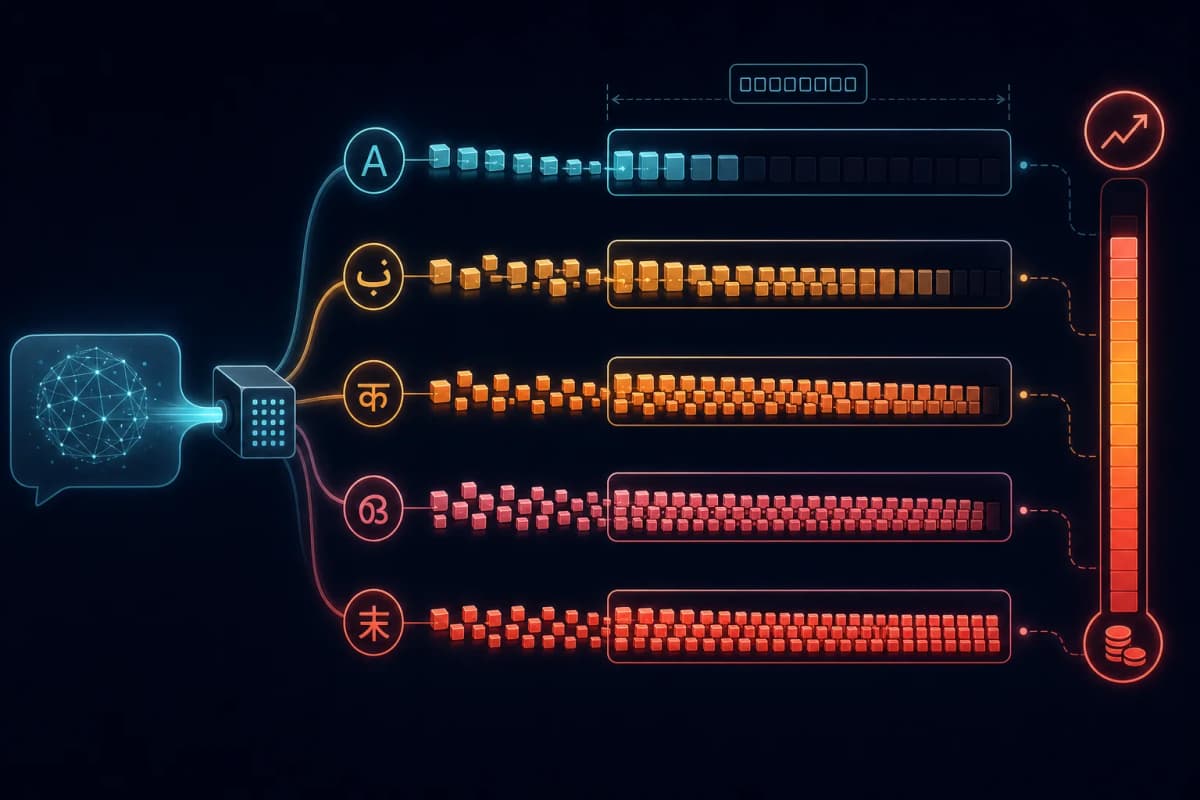
The LLM tokenizer tax is a measurable cost and context penalty. Two prompts can carry the same meaning yet consume very different token counts because they use different languages.
A July 2026 study tested 997 aligned sentences across six tokenizers. With OpenAI's older cl100k_base encoding, ten Indian languages had a mean word-fertility tax of 8.0 times relative to English. Malayalam reached 13.04 times. The newer o200k_base cut the mean to 2.1 times. The study does not prove that tokenization alone causes worse answers. It does show that price and usable context can diverge before a model starts reasoning.
Audience: Intermediate
Direct answer: Do not estimate a multilingual AI product from English token counts. Test the exact tokenizer on aligned production text, measure the whole request, evaluate quality separately, and rerun the test whenever the model or tokenizer changes.
What the LLM tokenizer tax measures
Language models receive token IDs, not words or characters. A tokenizer splits text into token units and maps them to IDs; some tokenizers normalize text first. Common fragments can fit into one token. Less represented scripts or word forms may break into several tokens or bytes.
The paper's headline metric is word fertility: tokens per whitespace-delimited word. Its tokenizer tax is the word fertility of one language divided by English word fertility under the same tokenizer.
For a production screen, an aligned token-count ratio is often easier to use:
aligned token-count ratio for language L =
tokens for aligned content in language L
÷
tokens for the English version
These metrics answer related questions, but they are not interchangeable. Name the metric you report. Both comparisons need semantically aligned text. Counting unrelated sentences, or a list of common words, can produce an attractive number that says little about a real application.
Researchers also use fertility, often defined as tokens per word. Word fertility is intuitive, but word boundaries are not equally clear across languages. Add character fertility, bytes per token, and the share of unmerged bytes when you need to diagnose why a gap exists.
This distinction matters because token count has several different consequences:
| Question | What token count tells you | What it does not establish |
|---|---|---|
| --- | --- | --- |
| What will the API charge? | A direct input to the bill when the provider prices per token | The final bill when caching, batches, or discounts apply |
| How much text fits? | A direct limit under a token-based context window | How much context the model will use well |
| Will the request be slower? | More tokens can add processing work | A fixed latency multiplier across providers and hardware |
| Will the answer be worse? | A reason to run a language-specific quality test | That tokenization caused an accuracy gap |
The last row is the easiest one to overclaim.
What the 2026 research found
The new Tokenizer Tax study used aligned sentences from FLORES-200. It compared ten Indian languages with English, Arabic, Spanish, and French across six tokenizers. The authors measured word and character fertility, bytes per token, unmerged single-byte tokens, and the amount of source text that survived a fixed context budget.
Three results matter for engineering decisions:
cl100k_base, the mean word-fertility tax for the Indian languages was 8.0 times English. Malayalam reached 13.04 times.cl100k_base to o200k_base reduced the mean tax from 8.0 to 2.1 times, a 73% reduction.High-tax languages produced unmerged single-byte tokens for 27–43% of their tokens. Across the sampled languages with valid word boundaries, that rate correlated with the word-fertility tax at r = 0.89. The authors attribute the gap to insufficient vocabulary coverage for those scripts.
A 2023 NeurIPS paper found tokenization-length differences of up to 15 times across languages. An EMNLP 2023 study measured cost and utility across 22 languages and found that token-based API pricing can charge some language communities more for comparable content.
Recent work also shows that the gap is a design choice, not an unavoidable property of a script. Parity-aware byte-pair encoding (BPE) changes the merge objective to help the currently worst-compressed language. Its authors report up to an 89% reduction in token-cost inequality, measured with a cross-language Gini coefficient, with little change in global compression. A separate controlled study across 11 Southeast Asian languages placed parity-aware BPE on the efficiency–equity Pareto frontier for comparable 1.5-billion-parameter base models. That result does not establish the same tradeoff at frontier scale or after alignment.
The accuracy claim needs restraint
The July study found a raw correlation of r = -0.61 between fertility and reading-comprehension accuracy for 13 language points. After controlling for language resource level, the partial correlation became r = 0.25.
There are more reasons to avoid a causal headline: the fertility numbers and accuracy scores came from different tokenizer/model settings, the sample was small, and translated benchmark sentences are not a production workload. The paper supports strong claims about token counts, context, and token-priced costs. It does not isolate tokenizer fertility as the cause of lower answer quality.
Measure your own multilingual token cost
The research gives a warning, not your production ratio. A support assistant, retrieval system, or coding agent has its own language mix and prompt structure.
Use this workflow before launch and after every model change.
1. Build an aligned sample
For an initial screen, collect 100–1,000 examples from the workload you expect:
Use reviewed translations of the same meaning. Keep an ID that connects every language variant. Do not compare random text pulled from separate language corpora. This screening range is not a statistical minimum: the required sample depends on the number of languages, workload variance, and how precisely you need to estimate tail behavior.
Store the sample as JSON Lines:
{"id":"support-001","language":"en","text":"Reviewed English text"}
{"id":"support-001","language":"sv","text":"Reviewed Swedish translation"}
{"id":"support-001","language":"tr","text":"Reviewed Turkish translation"}
2. Pin the tokenizer
The tokenizer belongs to a model version. Record both. OpenAI's official `tiktoken` repository exposes cl100k_base and o200k_base; its model mapping also shows that model families can use different encodings. For a closed model, prefer the provider's official counter when one exists. Google's Gemini API, for example, exposes a `countTokens` method. For an open model, load the exact artifact with the model's documented tokenizer pipeline, such as the one described in the Hugging Face Tokenizers API.
Do not assume two models from the same vendor share a tokenizer. Do not assume a local library already knows a model released yesterday.
3. Calculate a distribution, not one ratio
Install and pin the counter:
python -m pip install "tiktoken==0.13.0"Then run:
import json
from collections import defaultdict
from math import ceil
from statistics import mean, median

import tiktoken

BASELINE = "en"
ENCODINGS = ("cl100k_base", "o200k_base")

groups = defaultdict(dict)
with open("aligned-samples.jsonl", encoding="utf-8") as source:
    for line in source:
        row = json.loads(line)
        groups[row["id"]][row["language"]] = row["text"]

def percentile(values, probability):
    ordered = sorted(values)
    index = max(0, ceil(len(ordered) * probability) - 1)
    return ordered[index]

for encoding_name in ENCODINGS:
    encoding = tiktoken.get_encoding(encoding_name)
    counts = defaultdict(list)
    ratios = defaultdict(list)

    for sample_id, variants in groups.items():
        if BASELINE not in variants:
            raise ValueError(f"{sample_id} has no {BASELINE} baseline")

        baseline_tokens = len(encoding.encode(variants[BASELINE]))
        if baseline_tokens == 0:
            raise ValueError(f"{sample_id} has an empty baseline")

        for language, text in variants.items():
            token_count = len(encoding.encode(text))
            counts[language].append(token_count)
            ratios[language].append(token_count / baseline_tokens)

    for language in sorted(counts):
        print(
            encoding_name,
            language,
            f"mean_tokens={mean(counts[language]):.1f}",
            f"mean_ratio={mean(ratios[language]):.2f}x",
            f"median_ratio={median(ratios[language]):.2f}x",
            f"p95_ratio={percentile(ratios[language], 0.95):.2f}x",
            f"max_ratio={max(ratios[language]):.2f}x",
            sep="\t",
        )
The mean can hide a few long requests that overflow the context window. Inspect p50 (the median), p95 (the 95th percentile), and the maximum before using the result in a capacity plan.
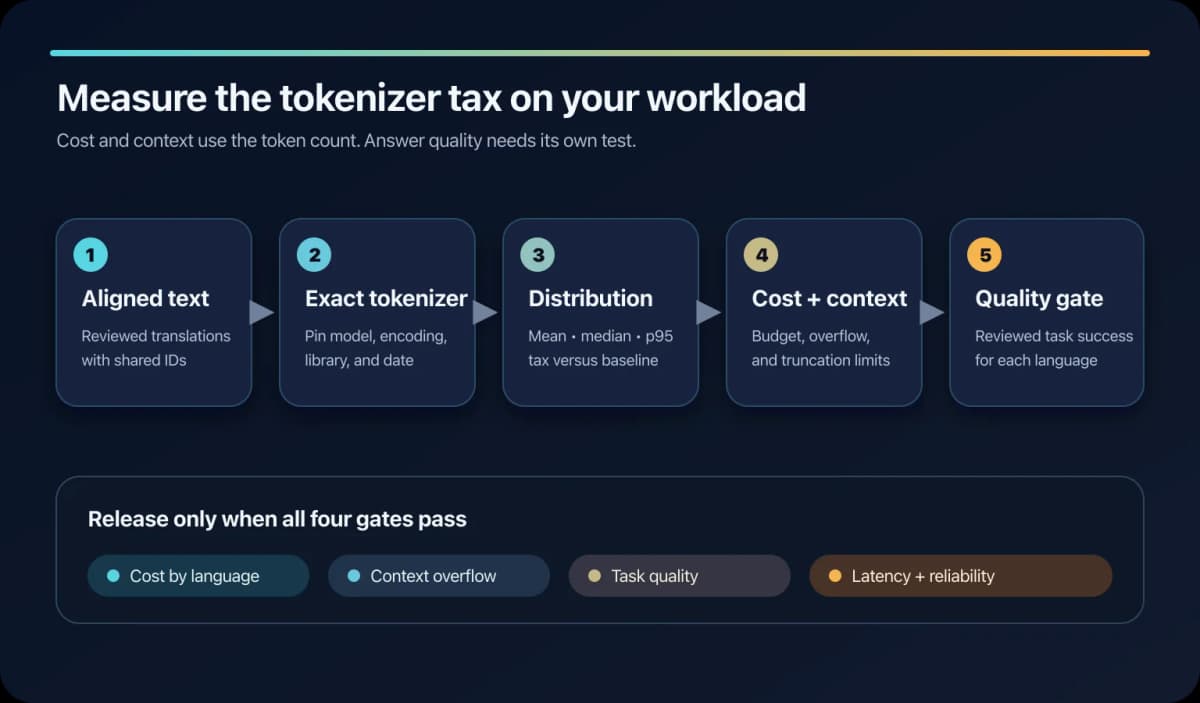
*Measure aligned production text with the deployed tokenizer, then use the distribution to set cost and context limits. Quality remains a separate evaluation.*
4. Measure the complete request
The visible user message is only one part of an API call. Include:
This is especially important for agents. A large JSON tool schema can dominate a short user request. A localized RAG passage can dominate an English system prompt. Measure the final serialized request whenever the provider exposes that representation.
5. Convert tokens into operating limits
For a simple token-priced API:
monthly input cost =
monthly calls × mean input tokens × price per million tokens
÷ 1,000,000
Suppose a hypothetical API charges $1 per million input tokens. One million requests at 1,000 input tokens cost $1,000. If aligned requests in another language average 2,500 tokens, the input portion becomes $2,500 before caching or discounts.
Context needs a separate calculation:
usable input budget =
context window
- reserved output
- system and tool overhead
- safety margin
Apply the observed language ratio to the content portion, not blindly to the entire request.
The AI reasoning-token cost guide explains why token budgets need a product limit, not only a model limit. For RAG and coding systems, cross-repository context design shows why sending more context is not automatically useful. If API choice is still open, the existing free AI API case study provides a broader comparison framework.
Set a multilingual acceptance gate
A lower token ratio is useful only if the model still meets the product requirement. Use four separate gates:
| Gate | Example metric | Decision |
|---|---|---|
| --- | --- | --- |
| Cost | p50 and p95 input cost by language | Reject or reroute when the budget is exceeded |
| Context | overflow and truncation rate by language | Change chunking, retrieval, or model window |
| Quality | task success on a reviewed set for each language | Do not infer this from token count |
| Operations | p50 and p95 latency, error rate, cache hit rate | Verify on the actual provider and region |
For a multilingual RAG system, chunk by the deployed tokenizer rather than a shared character count. For an agent, measure tool traces and retries as well as the first request. For a support product, track cost per resolved case, not cost per call. These choices stop the token metric from becoming a vanity benchmark.
Use a language-specific route only when it improves the full scorecard. A cheaper tokenizer paired with a weaker model can save input tokens and increase retries. A larger context window can hide poor chunking until the bill grows. The correct unit is the completed user task.
What teams can change
Application teams cannot retrain a commercial model's tokenizer, but they still have options:
Teams training their own models have a deeper choice. The parity-aware BPE results suggest that a tokenizer objective can reduce cross-language inequality without sacrificing much overall compression. The Southeast Asian study adds controlled evidence that fairness and efficiency do not have to move in opposite directions.
Treat the tokenizer as part of the model contract. Version it, benchmark it, and include it in migration reviews.
Limits of the evidence
The newest study is a preprint. It uses translated FLORES-200 sentences, a modest set of languages, and a whitespace-based word metric that does not fit every writing system equally well. Its byte-detection method is tokenizer-specific.
The strongest conclusion is model-independent: when one aligned language produces more tokens, it gets less text into a fixed token window. The cost conclusion holds when a provider bills those extra tokens at the same unit price. Cache policies and volume discounts can change the final invoice.
Accuracy needs its own test. Training-data coverage, model architecture, post-training, evaluation design, and cultural context all affect results. Token fertility may contribute to a gap, but the July paper does not isolate that causal effect.
Multilingual tokenizer checklist
Frequently asked questions
Why do some languages use more LLM tokens?
Subword vocabularies reflect their training data and merge rules. Common English fragments are often represented efficiently, while less represented scripts can be split into smaller pieces or bytes. The size of the gap depends on the exact tokenizer and the text.
Does a higher token count mean a worse answer?
No. It directly affects token-priced cost and the amount of text that fits in a token window. It does not prove lower answer quality. Test quality separately on reviewed examples in each language.
How can I count tokens before an API call?
Use the provider's official counting endpoint when available. For OpenAI encodings, tiktoken can count locally. For open models, load the exact tokenizer artifact shipped with the model. Pin versions so a later update does not silently change the measurement.
Can switching models remove the tokenizer tax?
It can reduce the gap. The July study found a large improvement between cl100k_base and o200k_base. A model switch also changes quality, output cost, caching, latency, and operational behavior, so compare the complete workload rather than token counts alone.
Sources
Claim checks
| Claim | Status | Evidence boundary |
|---|---|---|
| --- | --- | --- |
cl100k_base averaged an 8.0× Indic word-fertility tax and reached 13.04× for Malayalam on the study sample | Verified | Reported for 997 aligned FLORES-200 sentences, not every prompt |
o200k_base reduced the study's mean tax to 2.1× | Verified | A tokenizer comparison; not a full model-quality comparison |
| High-tax languages retained 12–23% of English's usable characters at 8,192 tokens | Verified | Model-free context result on aligned study text |
| Parity-aware BPE reduced cross-language token-cost inequality by up to 89% | Verified | Authors' Gini-based result under their training and evaluation setup |
| A higher tokenizer tax causes lower answer accuracy | Not established | The July paper's adjusted analysis did not support a simple causal reading |