
If your product falls under EU AI Act Article 50, a machine-readable watermark is not the whole job. Providers and deployers have different duties. Some deployer duties still require a clear label that a person can notice without special tools. The rule applies from August 2, 2026. The limited December 2, 2026 grace period covers only the Article 50(2) marking duty for systems placed on the market before August 2. The official Commission FAQ and guidance pages now spell that out directly. European Commission FAQ Guidelines page
This article is an engineering checklist, not legal advice. The goal is narrower: turn the official scope, dates, exceptions, and review thresholds into product controls you can actually ship. This checklist focuses on Article 50(1), Article 50(2), and the generative-content duties in Article 50(4). It does not cover the separate Article 50(3) duties for emotion-recognition and biometric-categorisation systems. Confirm role, scope, and any exception with qualified counsel before relying on this workflow.
EU AI Act Article 50: who has to do what?
The Commission's current guidance splits the work by actor. Providers handle direct AI interaction notices and machine-readable marking of synthetic outputs. Deployers handle deepfake labels and some public-interest text labels. Guidelines page Quick facts
| Actor | Trigger | What the official guidance says |
|---|---|---|
| --- | --- | --- |
| Provider | Direct AI interaction with a natural person | Inform the person from the first interaction unless it is obvious they are interacting with AI. |
| Provider | Synthetic text, image, audio, or video output | Add a machine-readable mark and enable detectability, subject to scope limits and exemptions. |
| Deployer | Deepfake exposure | Give a clear and perceivable disclosure by first exposure at the latest. |
| Deployer | Public-interest text without human review or editorial control | Clearly label the text as AI-generated or AI-manipulated. |
That split matters because it kills one common shortcut: a provider's hidden mark does not automatically satisfy a deployer's visible disclosure duty. The Commission says deployers cannot rely only on the machine-readable mark embedded by the provider. European Commission FAQ
The dates that matter
The core Article 50 duties apply from August 2, 2026. The Commission FAQ adds a limited grace period for the Article 50(2) marking duty until December 2, 2026, but only for generative AI systems placed on the market before August 2, 2026. Content generated before August 2 does not need retroactive labeling, though the Commission encourages it where possible. European Commission FAQ Quick facts
The law sets two relevant dates. Your rollout plan may add a third internal policy date:
2026-08-02: new systems and new deployer labels must be ready.2026-12-02: the limited Article 50(2) marking grace period ends for qualifying pre-existing systems.What providers need to build
For providers, the direct-interaction rule is the simpler one. If the system is a real two-way interaction with a natural person, and the interaction is not obviously AI, the person must be informed from the start of the first interaction. The Commission says the "obvious" exception should be interpreted narrowly. European Commission FAQ
The harder part is output marking. Providers of systems that generate synthetic text, images, audio, or video must apply machine-readable marks and enable detectability. The same FAQ also says some outputs are outside scope or exempt, including source code, some machine-to-machine outputs without human exposure, and some closed-loop industrial or product-development uses. European Commission FAQ
That is where teams usually oversimplify the work. The following is an implementation interpretation, not a verbatim Commission checklist. A provider duty is not "turn on watermarking." It is:
If you already track providers, runtimes, and output routes in an AI bill of materials→, extend that inventory with per-output marking coverage and verification results. If you do not, Article 50 becomes much harder to prove later.
What deployers still need to do
Deployers have a different problem. Their obligations are visible, contextual, and exposure-based. A hidden mark in a file is not enough when a person is watching or reading the result.
For deepfakes, the Commission says the disclosure must happen by first exposure at the latest and must be understandable without special tools. For public-interest text, the deployer must label the content unless it underwent real human review or editorial control. The Commission is explicit that spell-checking and grammar cleanup do not count. European Commission FAQ
This is where workflow design matters more than detection technology:
The deployer question is not "Was AI involved?" The deployer question is "What did we expose to people, and what review evidence do we have for that specific asset?"
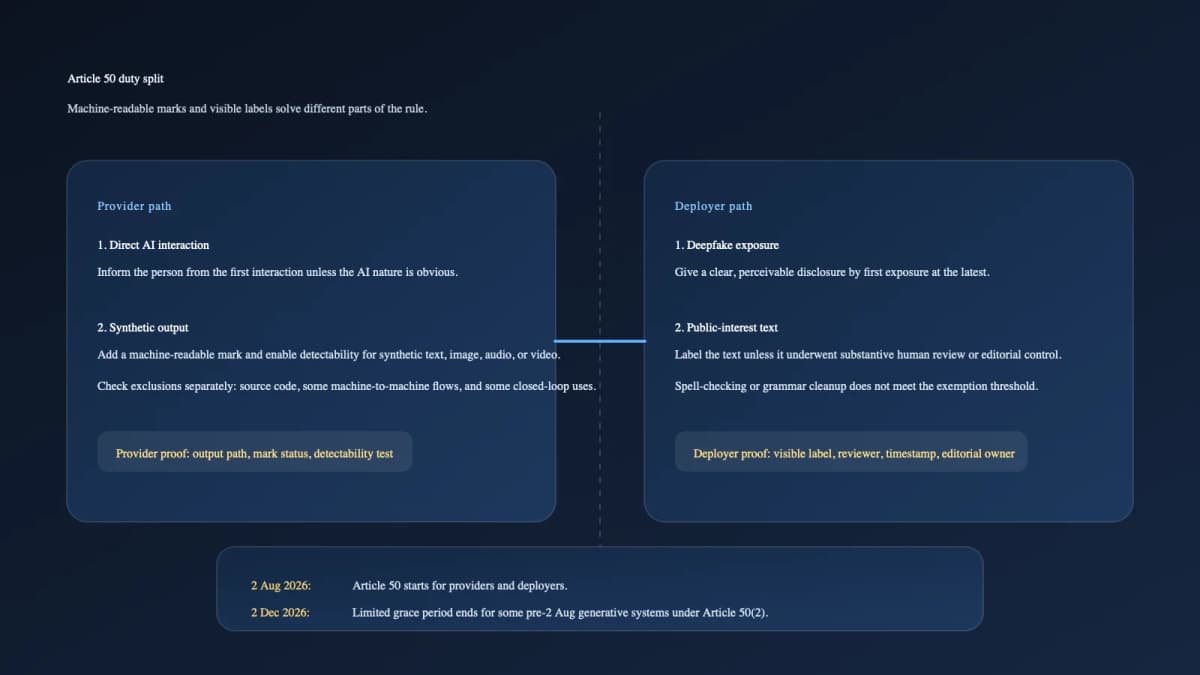
*Caption: Article 50 splits provider and deployer duties. The machine-readable mark and the visible label solve different problems.*
Why watermarking alone is not enough
Current provider documentation already shows why a single-layer solution is weak.
OpenAI says C2PA metadata helps content carry provenance information. It also says metadata can be stripped, lost during upload and download, or broken by transformations such as resizing and screenshots. As of July 29, 2026, OpenAI's documentation describes a second layer through SynthID for supported images and a public verification preview. OpenAI provenance OpenAI verify
Google's public SynthID text docs make the same point from another angle. They describe how text watermarking works, but they also say detector confidence can drop sharply after thorough rewriting or translation. That limitation matters for Article 50 because deployer duties include public-interest text, where edited text is normal rather than exceptional. SynthID Text docs
ElevenLabs now positions SynthID plus C2PA as part of its audio transparency stack and says it started rolling the watermark to free text-to-speech generations first before expanding coverage. That is useful implementation evidence, but it is still provider-reported rollout status, not proof that every downstream platform will preserve the signal. ElevenLabs SynthID post
Recent research lands in the same place. The Article 50 structural-gaps paper argues that compliance cannot be reduced to post-hoc labeling. The provenance framework paper argues that provenance metadata and watermarking solve different proof problems. The faceted-attribution paper argues that coarse "AI was used" disclosures miss where, how, and under what review the system intervened. The practical engineering interpretation is narrower: Article 50 compliance needs workflow evidence as well as technical marking. Structural gaps paper Provenance framework Faceted attribution paper
A practical engineering checklist
1. Inventory every public output path
List each system that can produce public-facing text, images, audio, or video. Do not stop at the model name. Include the surface that delivers the output, the actor that controls publication, and whether the output reaches a natural person. The Commission's provider and deployer split is applied at the system and exposure level, not at the model-brand level. European Commission FAQ
Minimum fields:
2. Separate provider duties from deployer duties in code
Do not put one generic ai_disclosure=true flag on the asset and call it done. You need separate controls:
provider_marking_statusprovider_detectability_checkdeployer_visible_label_statushuman_review_statuseditorial_responsibility_ownerThat separation is what lets you prove why a marked file still needed a visible label, or why a public-interest text asset was exempt because a qualified reviewer signed off substantively.
3. Define a real human-review threshold
The Commission says substantive review requires relevant knowledge and professional judgment, and editorial control means a responsible entity can approve, change, or reject the substance of the text. Spell-checking is explicitly out. European Commission FAQ
If your CMS review step cannot answer:
then the evidence for relying on the review exception is incomplete.
4. Test transformation survival, not only generation success
For machine-readable marks, the engineering question is not only "can we embed it?" It is "does it survive the actual path the asset takes?"
Test at least:
OpenAI, Google, and ElevenLabs all describe robustness, but none claims a perfect signal after every transformation. OpenAI provenance SynthID overview ElevenLabs SynthID post
5. Keep a verification path operators can actually run
The open-source C2PA stack is active enough to use in real workflows today. C2PA's conformance program and trust list are live, c2patool can inspect or add manifests, and the c2pa-rs release train is still moving in July 2026. C2PA conformance c2patool docs c2pa-rs releases
That gives you a simple operator path:
6. Treat exceptions as explicit policy, not tribal memory
The Commission guidance describes several condition-dependent exclusions and exceptions. It lists source code; outputs intended exclusively for machine-to-machine processing without human exposure; and some closed-loop industrial or product-development outputs as outside scope in the circumstances it describes. It also distinguishes assistive standard editing, substantive review of public-interest text, and certain evidently artistic, creative, satirical, fictional, or analogous deepfakes. These are not blanket exemptions; document why a specific output path meets the relevant conditions. European Commission FAQ
If those exceptions live only in human memory, they will drift. Put them in a decision tree, policy table, or release checklist and tie each exception to the content path where it is allowed.
Where current tooling already helps
OpenAI, Google, and ElevenLabs now give teams real building blocks, but each block has limits.
OpenAI
As of July 29, 2026, OpenAI says it is a C2PA Conforming Generator Product, applies SynthID to supported images generated through ChatGPT, Codex, and the API, and offers a research-preview verifier for OpenAI-generated images. It also says no detection method is foolproof and a missing signal is not proof that the image was not AI-generated. OpenAI provenance OpenAI verify
Google positions SynthID as a cross-media watermarking system for images, audio, text, and video. Its text docs are unusually concrete: watermarking is implemented as a logits processor, but translation and thorough rewriting can weaken detection. That is useful because it tells you where not to over-promise. SynthID overview SynthID Text docs
ElevenLabs
As of July 29, 2026, ElevenLabs says its audio detector first checks for a SynthID watermark and then falls back to its AI Speech Classifier when no watermark is found. That is the right pattern conceptually: provenance signal first, weaker inference signal second. ElevenLabs Audio Detector documentation
C2PA and open-source verification
C2PA remains the most practical open standard for provenance metadata. The official spec, conformance program, and command-line tooling are enough to support validation gates in a production pipeline. C2PA home C2PA spec c2patool docs
What not to assume
Do not assume any of the following:
Those are the failure modes that create false compliance confidence.
Final take
A concise engineering reading of EU AI Act Article 50 is this: providers must make synthetic outputs detectable, and deployers may still need to make them obvious to people.
That is why the right implementation is a chain, not a badge:
If you build it that way, Article 50 becomes an engineering control surface. If you reduce it to "we added a watermark," you may miss a separate deployer obligation. This architecture can support compliance evidence, but it does not determine legal scope or guarantee compliance.
FAQ
Does a provider's machine-readable mark satisfy a deployer's deepfake label duty?
No. The Commission FAQ says deployers cannot rely only on the provider's machine-readable mark. Deepfakes still need a clear and perceivable disclosure to the exposed person. European Commission FAQ
When does human review exempt public-interest text from labeling?
Only when a natural person deliberately reviews the substance of the content with relevant knowledge or an editorial entity can approve, alter, or reject the text on substantive grounds. Formal checks like spelling or grammar cleanup do not qualify. European Commission FAQ
Are source code and machine-to-machine outputs in scope under Article 50(2)?
Not always. The Commission FAQ lists source code, some machine-to-machine outputs without human exposure, and some closed-loop industrial uses as outside scope or exempt, with conditions. European Commission FAQ