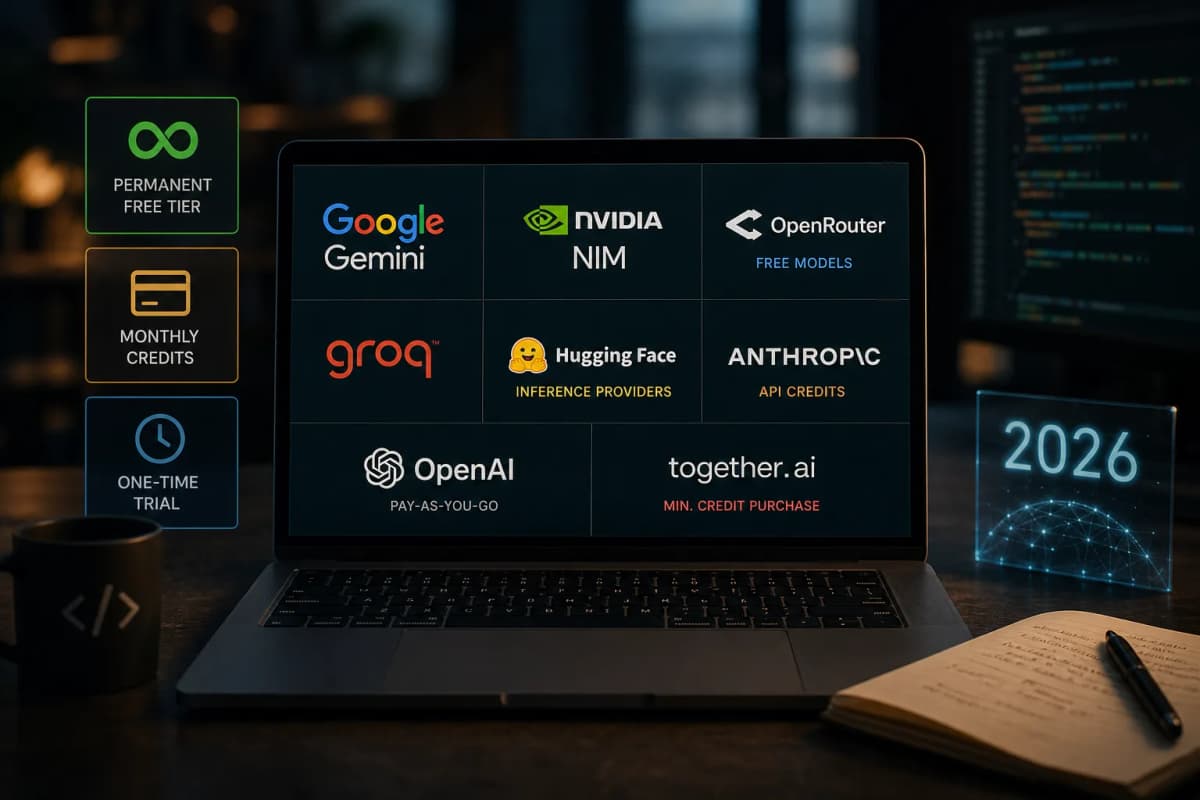
If you are hunting for a free AI API in July 2026, the first thing I would do is separate three things: a real ongoing free tier, monthly credits, and one-time trial access. Those are not the same product, and mixing them leads to bad stack decisions.
I wrote this update for builders who need something they can test today, repeat tomorrow, and scale only if the economics make sense. I will show you which providers still offer usable free access, where the limits are, and why the July 2026 model wave changed expectations without changing the billing rules.
The real question: what is actually free?
Most roundup posts use “free” too loosely. In practice, you will run into one of four models:
That distinction matters more now because model quality moved up faster than access policies. OpenAI GPT-5.6 landed on July 9, 2026. Google followed with Gemini 3.6 Flash and Gemini 3.5 Flash-Lite on July 21, 2026. Anthropic then pushed Claude Sonnet 5 and Claude Opus 5 on July 24, 2026.
Those launches raised the bar. They did not magically make every API free.
Quick verdict on the providers that still matter
| Provider | What is free | Best use case | Main limitation |
|---|---|---|---|
| --- | --- | --- | --- |
| Google Gemini Developer API | Ongoing Free Tier on select models | Repeated prototyping, multimodal tests, serious evaluation | Free-tier data and limits are still not the same as paid access |
| NVIDIA NIM | Free developer access for prototyping | Testing strong open models without self-hosting | Prototyping lane, not a production guarantee |
| OpenRouter | Free router and :free model variants | Fast model comparison from one endpoint | Availability and rate limits vary by model |
| Groq | Free developer access / free key experience on eligible accounts | Speed tests and lightweight apps | Limits depend on account and can change |
| Hugging Face Inference Providers | $0.10 monthly credits for free users | Tiny experiments inside the HF ecosystem | Too small for real recurring use |
| Anthropic | Trial credits for new users, not a free tier | Quick Claude evaluation | Not a durable free API strategy |
My short version is this: Google Gemini Developer API is still the strongest real free tier, NVIDIA NIM is the best open-model prototyping lane, and OpenRouter is the fastest way to compare free variants without account sprawl. Groq is worth testing. Hugging Face is fine for small experiments. Anthropic is the benchmark for quality, not free access.
Why Google still leads the free-tier conversation
Google keeps the cleanest ongoing free path for developers. Its pricing and billing docs still separate Free and Paid access clearly, and the current July 2026 docs show Gemini 3.6 Flash and Gemini 3.5 Flash-Lite as the key current low-friction options to test through the Developer API.
That matters because a free AI API is only useful if you can keep using it after the first demo. Google gives you a real place to build, retry, and compare outputs without forcing a card immediately.
However, the tradeoff is real. Free-tier usage comes with policy and quota limits, and the platform still makes it clear when you need to move into billing. That is fair. I prefer that over fake “free” branding that disappears once you actually integrate the endpoint.
Why the July model launches matter even when the API is not free
The July 2026 launches changed the baseline for developer expectations.
OpenAI GPT-5.6 made people expect better reasoning and cleaner tool use. Gemini 3.6 Flash and 3.5 Flash-Lite raised the expectation that fast, low-cost models should still be capable. Anthropic’s Claude Sonnet 5 and Opus 5 reminded everyone that the best models are still usually not the cheapest ones to access.
That is the point. Model quality and API access are separate problems. A great model launch does not equal a free endpoint. It only means the gap between what developers want and what they can afford got more obvious.
NVIDIA NIM is the best open-model testing lane
NVIDIA NIM is still one of the strongest options if you want to try serious open models without standing up your own GPU stack. NVIDIA documents free developer access for prototyping through its developer program, which makes it much easier to evaluate current open models in real workflows.
I like this lane because it removes infrastructure friction. You can test extraction, classification, code-adjacent prompts, and agent flows without first deciding on Kubernetes, GPU provisioning, or a hosting bill.
That is why NIM belongs in a real free AI API comparison. It is not the cheapest path forever. It is the cleanest way to test serious models quickly.
OpenRouter is the comparison layer I would use first
OpenRouter stays valuable because it solves routing, not just model access. Its free router and :free model variants let you compare models through one API instead of signing up for five different providers.
That sounds small until you actually build evaluation loops. If you want to compare prompt stability, latency, output format, or coding behavior, OpenRouter saves time immediately. It also makes the tradeoff visible: free variants can move, disappear, or change rate limits.
That is fine if your goal is comparison.
When I would use OpenRouter
Groq is useful, but treat it as an account-based free lane
Groq is still worth testing because it gives you a fast developer experience and a real feel for low-latency model calls. The important detail is that Groq’s limits are account-based and can change, so you should not assume a universal permanent free tier.
I would use Groq for latency-sensitive experiments, UI prototypes, and lightweight internal tools. I would not build a business assumption around its free access unless the current account terms clearly support your usage pattern.
That is the right mindset for any “free” API in 2026. Test it, measure it, and read the limit docs before you commit.
Hugging Face and Anthropic belong in different buckets
Hugging Face gives free users $0.10 per month in Inference Providers credits. That is enough to try the flow, but not enough for meaningful repeated usage unless you keep topping it up. It is a monthly credit model, not a real free tier.
Anthropic is different again. With Claude Sonnet 5 and Claude Opus 5 now in the market, the quality conversation is stronger than ever. But Anthropic’s API access still fits the trial-credit model for most new users, which makes it a benchmark for quality rather than a free endpoint you can rely on.
I would describe it this way:
Why GitHub and agent-tool momentum raised the bar
The current wave of GitHub Copilot-style workflows, code agents, and MCP-driven tools changed what developers expect from an API. People no longer want one-off demos. They want repeated calls, tool use, retries, and evaluation loops.
That shifts the standard for what “free” should mean. A token bucket that dies in one afternoon is not enough for real agent testing. If you want to experiment with coding agents, search pipelines, or automation workflows, you need a provider that survives more than a quick proof of concept.
That is why free API access now gets judged against operational reality, not marketing copy. The stack must support iteration.
My practical ranking for July 26, 2026
If I had to choose today, this is how I would rank the options for actual builders:
That ranking is based on how long you can keep testing, how much friction you face, and how honest the access model is. I care less about the logo and more about whether the endpoint survives real use.
How I would choose the right free AI API
Pick Google Gemini Developer API if:
Pick NVIDIA NIM if:
Pick OpenRouter if:
Pick Groq if:
Pick Hugging Face if:
Use Anthropic if:
Final verdict
The best free AI API in July 2026 is still the one that keeps you building after the first test run. For that reason, I would start with Google Gemini Developer API, use NVIDIA NIM for open-model prototyping, and keep OpenRouter ready when I want to compare free variants fast.
Groq can be useful. Hugging Face is fine for small credits. Anthropic is the quality benchmark, not the free choice. And with GPT-5.6, Gemini 3.6 Flash, Gemini 3.5 Flash-Lite, Claude Sonnet 5, and Claude Opus 5 now shaping expectations, the real standard is simple: the API must be usable, documented, and repeatable.
That is what still works.
FAQ
What is the best free AI API for developers in 2026?
For most developers, Google Gemini Developer API is still the best answer because it offers a real ongoing free tier on select models and supports repeated testing.
Is NVIDIA NIM free?
NVIDIA documents free developer access for prototyping through NIM API endpoints. I would treat it as a strong testing lane, not a permanent production-free promise.
Is OpenRouter actually free?
OpenRouter offers free routing and :free model variants, but availability and limits can vary. It is best for comparison and experimentation.
Is Anthropic a free API option?
Not really. Anthropic is best viewed as a premium baseline with trial access, especially now that Claude Sonnet 5 and Claude Opus 5 are in the market.
Why do monthly credits and free tiers matter so much?
Because they change how long you can test. A real free tier supports repeated workflow development. Monthly credits and trial access usually do not.