I love the idea of AI companies sharing some of the wealth they create with society. The Anthropic Public Benefit Fund makes that conversation concrete: ownership, decisions and, eventually, support people could use.
I want this kind of commitment to become normal. Sweden should help shape it, too. But the details matter. A percentage of a company is different from money in someone's bank account.
The short version: Anthropic announced a fund backed by company shares. Elon Musk made a separate promise involving SpaceX, not Tesla. Neither announcement means everyone now receives an AI payment.
Research checked on November 4, 2026. The hero is an AI-generated editorial illustration of an imagined setting, not an actual Anthropic-funded building.
How does the Anthropic Public Benefit Fund work?
On October 18, Anthropic announced the Anthropic Public Benefit Fund, a wholly owned entity intended to support public-benefit work. The announcement proposed an initial 5% share commitment, subject to stockholder approval. Possible uses include nonprofit donations and direct support for particular populations. Those are options, not an open application scheme. Anthropic: Investing in the public benefit
Anthropic chose an LLC, a limited liability company, rather than a conventional US charity. The company says this allows different forms of giving and that the equity will not fund lobbying or political donations. It was already a public benefit corporation; this announcement did not turn it into a nonprofit.
The attraction, for me, is making public benefit part of how a company allocates ownership. People outside the company should be able to benefit from its success, not only buy subscriptions to its products.
What has changed since the announcement?
The newer preliminary IPO prospectus says Anthropic contributed 846,840,960 non-voting Class N shares. Its stated 5% uses fully diluted shares as of June 30, 2026, assuming conversion of the Amazon Notes. This is company-reported allocation, not evidence of cash reaching recipients.
The filing allows discretionary additions of up to 2% at successive 50% share-price milestones, starting from the IPO price. A milestone requires 90 of 120 trading days above the threshold and a ten-day average above it before issuance. Growth does not trigger an automatic payment.
The board controls allocations pending a separate governance structure. Founder pledges are distinct, voluntary and nonbinding. Anthropic preliminary prospectus: public-benefit initiatives and governance
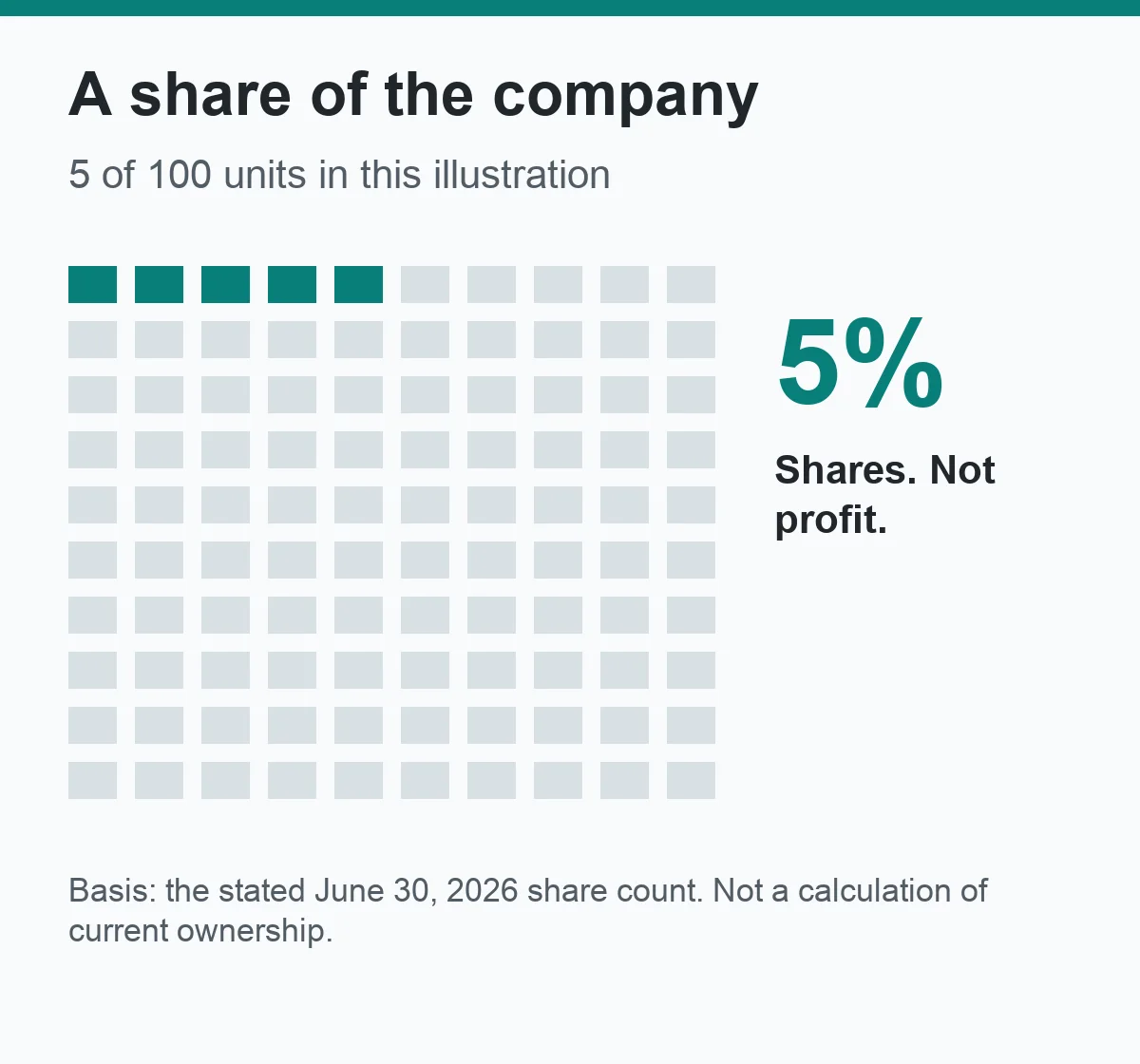
Diagram: a simplified illustration of the initial allocation, not a current post-IPO ownership calculation or a profit-sharing rate.
How could shares become help for ordinary people?
A share is a small ownership interest in a company. Its value can rise or fall. Holding valuable shares does not automatically provide money to spend on a course, rent or wages.
Picture a fund receiving shares. Before someone benefits, the people running it need rules about who qualifies and how support reaches them. They might transfer shares, sell some to fund grants or support organisations doing useful work. Each choice needs administration and scrutiny.
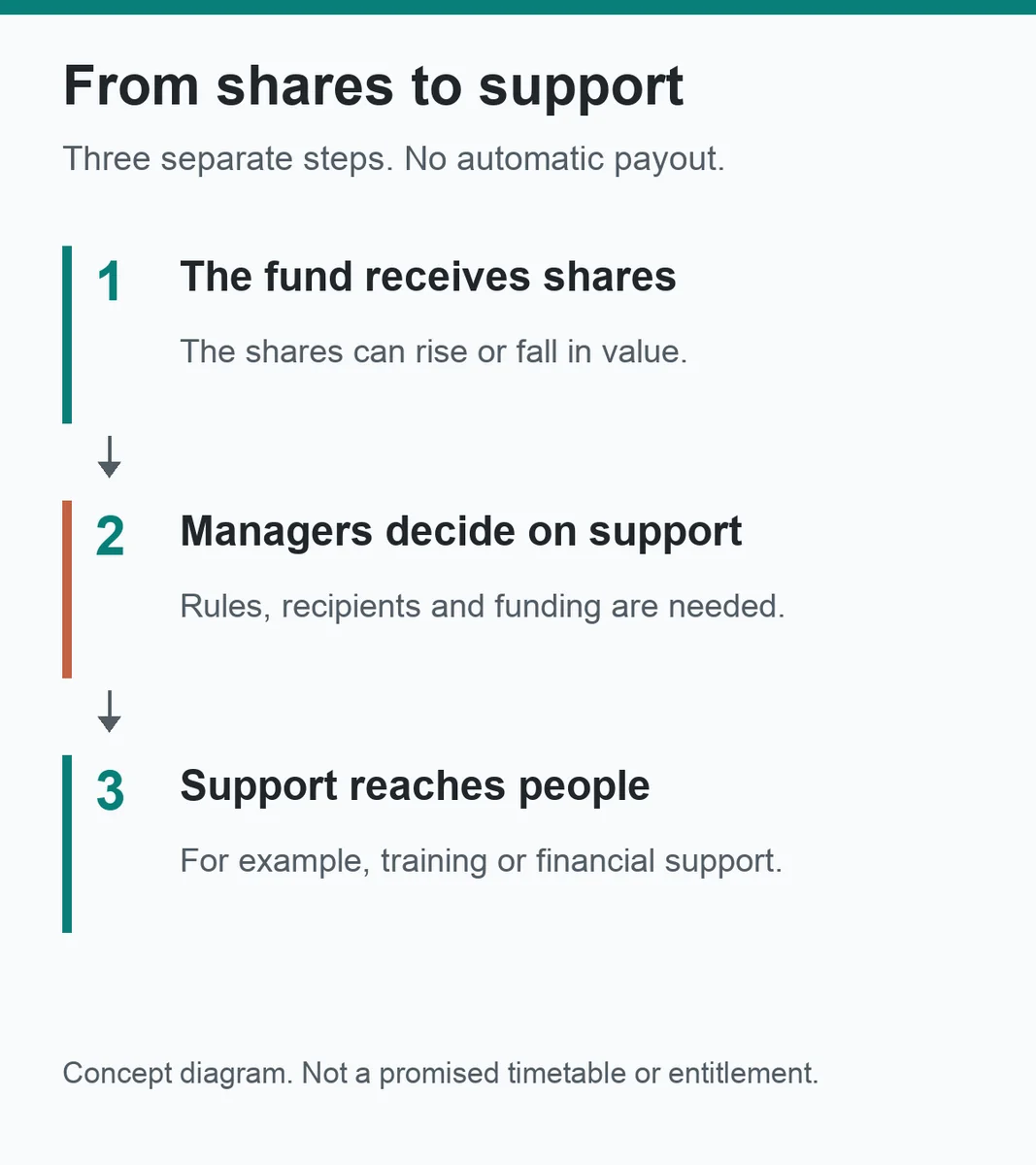
Concept diagram, not an announced payment timetable. People still need to see who decides, who qualifies and what reaches recipients.
I would judge success by the last stage. A worker completing useful training matters more than a large valuation in a press release. An accessible public service matters more than the number of shares mentioned at launch.
We also need to separate support for people from voting power over the AI company. Receiving an economic benefit does not necessarily give citizens a say in how a model is built or deployed.
Did Tesla announce the same thing?
The related Musk promise concerns his SpaceX shares, not Tesla giving away a percentage of profits. ABC News reported on October 19 that he pledged one of his shares to every child in America in 2027. It also reported that he had not explained the distribution process or age cutoff. ABC News: Musk's SpaceX share pledge
That is a personal pledge to distribute shares. Anthropic's arrangement puts shares into a company-owned fund. Both raise questions about sharing wealth, but the recipient, decision-maker and route to support differ. I would not combine them into one programme or count promised shares as delivered support.
What do other people say?
The most useful reactions ask who makes decisions and when help arrives.
In interviews with the Chronicle of Philanthropy, Pledge 1% executive Jan D'Alessandro welcomed the flexibility of Anthropic's approach. She saw room for a structure that can adapt to needs that remain uncertain, and a chance for other companies to become more ambitious.
Phil Buchanan, president of the Center for Effective Philanthropy, raised a different concern: existing nonprofits already know how to help communities. He questioned whether a flexible LLC needs to replace established routes for giving.
Ohio State accounting professor Brian Mittendorf drew attention to governance. Flexibility depends on trust in the decision-makers; formal charity structures provide safeguards that reduce that dependence. These are expert views, not a representative survey. Chronicle of Philanthropy: who decides and when?
TechRadar's Lance Ulanoff takes a more critical position: stock gifts and funds do not replace regulation or oversight of AI's effects. I agree with that limit. A company should not be able to buy permission to ignore harms through philanthropy. TechRadar: opinion on the stock pledges and public fund
My enthusiasm survives those objections. They help define what a credible version needs.
Is sharing AI wealth a new idea?
Researchers proposed a related idea in the 2019 paper The Windfall Clause: AI companies could commit early to sharing exceptionally large future profits for broad public benefit. That proposal concerns profits, whereas Anthropic's fund uses equity. It is useful background, not proof that either approach will work. The Windfall Clause research paper
Alaska offers an existing, different example of shared returns. Its Permanent Fund Dividend distributes money to eligible residents from investment earnings linked to mineral royalties. The eligibility rules and public institutions matter as much as the payment. It is not an AI fund or Anthropic's model. Alaska Permanent Fund Dividend: how it works
I take a practical lesson from both: define the commitment, the beneficiaries and the rules before relying on the money.
What could a Swedish version look like?
Sweden already has an AI strategy, adopted in February 2026. It includes societal benefit, responsible development and better public services. A Swedish wealth-sharing pilot would be my proposed addition to that discussion, not a measure announced in that strategy. Sweden's AI strategy
I would start small. Participating companies could make a clear commitment, with legal and tax review. I would want three safeguards:
A Swedish arrangement would need Swedish rules, rather than copying an American LLC.
A SEK 1 million example
To make the idea tangible, imagine SEK 1,000,000 of spendable annual funding. This is an invented example, not Anthropic's budget, a government proposal or an estimate of investment returns.
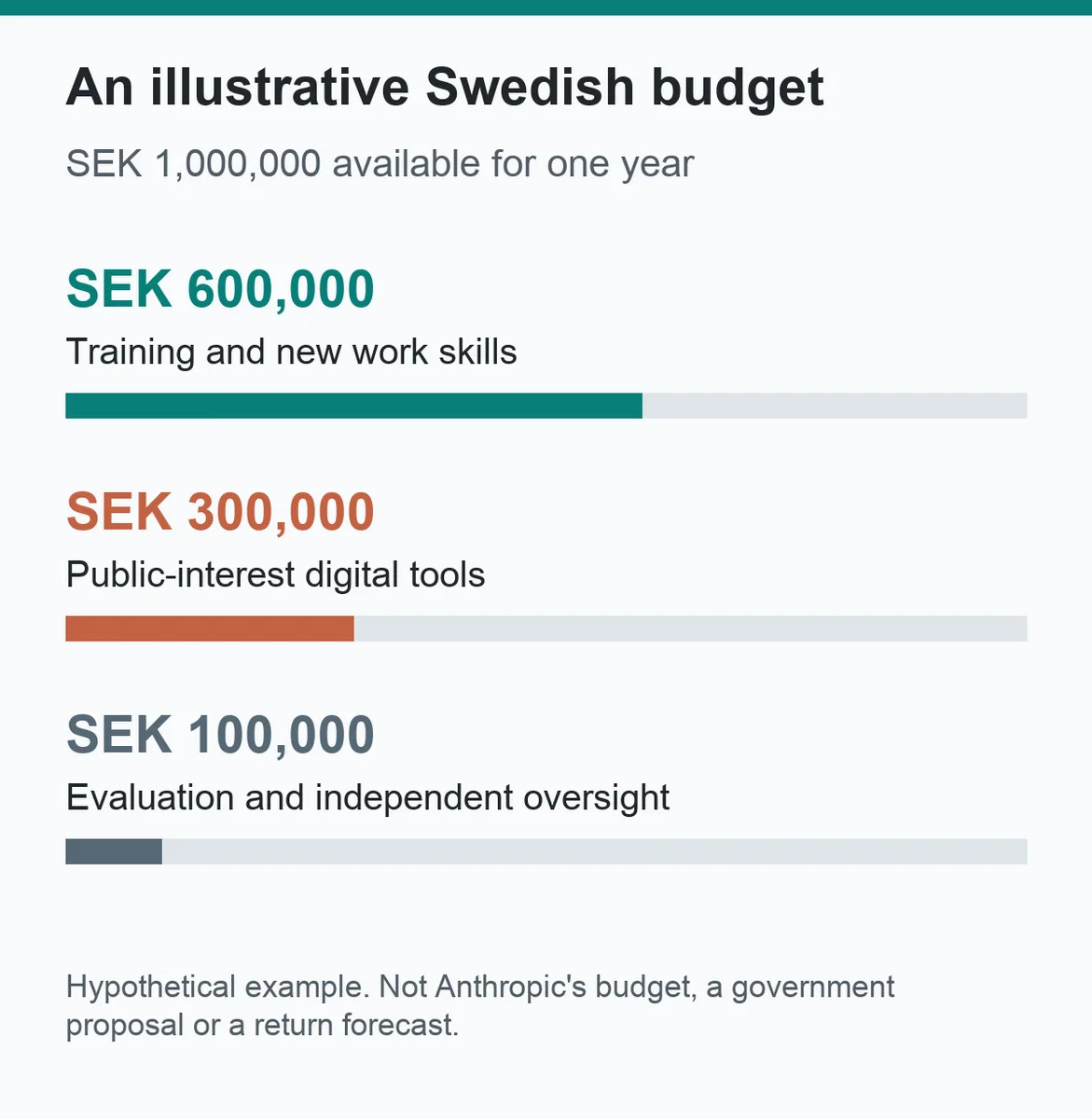
In this example, SEK 600,000 could pay for 50 training grants of SEK 12,000. That might help people learn a skill or change how they work. The course would still need to be useful; paying for attendance alone would not prove success.
Another SEK 300,000 could support a public-interest digital tool, with privacy and accessibility requirements. The remaining SEK 100,000 could fund evaluation and independent oversight. Those proportions are my illustration, not a recommendation for every fund.
For a person facing a changing job, this could mean access to training before their income disappears. For a small organisation, it could mean help adopting useful technology without handing over sensitive data. Direct cash support could be another option, but would need its own eligibility and funding rules.
Why I want Sweden to take this seriously
I use AI to build and automate work. I enjoy the pace, and I have also written about the AI productivity paradox: wanting to work more, not less. That excitement does not answer how everyone else shares the gains.
AI also has costs. My article about AI reasoning tokens and compute demand looks at another part of that discussion. A public-benefit fund cannot settle questions about electricity, jobs or safety by itself.
I want Sweden to explore this while insisting on published spending, independent review and useful outcomes. Taxes, labour protections and democratic decisions still belong in the picture.
I believe sharing a defined part of AI-created wealth could become a normal expectation. That is my hope, not a prediction I can prove. Anthropic has given us something specific to examine. I would like us to help improve the idea, then measure what people receive.