I think Suno v6 sounds damn good. That is my honest reaction to where Suno is now, rather than a claim that every generation beats a human production or that everyone agrees with me.
The more interesting question is how we got here. In a few model generations, Suno has moved from short generated songs toward a workflow where you can ask for changes to specific parts of a track. Meanwhile, developers are releasing local music models with downloadable weights, editing tools and increasingly serious ambitions.
I like the sound I am hearing from Suno. I also want to understand how much control we gain, what we give up, and whether open-source alternatives can fit a producer's workflow. This article combines that personal view with release history, published evaluations and attributed reactions. It is not my own controlled listening test of all these models.
How did Suno get to v6?
Suno's history makes more sense as a progression in control than as a sequence of bigger version numbers. These are selected milestones, not every release.
December 2023: Microsoft's Copilot integration brought Suno's text-to-song generation into a major consumer assistant. Copilot's Suno integration.
March 21, 2024: v3 made short songs accessible. Suno released v3 to all users with generation of complete two-minute songs. The company emphasized audio quality, broader styles and improved prompt adherence. It also acknowledged that quality, control and speed still needed work. Suno's v3 announcement.
November 19, 2024: v4 added ways to revisit an idea. Suno introduced Remaster and the ReMi lyrics assistant, alongside updates to Covers and Personas. A creator could rework an earlier track or carry elements of its identity into another generation. Suno described cleaner sound and more dynamic structures as goals of the update. Suno's v4 announcement.
May 1, 2025: v4.5 focused on expression and prompting. Suno advertised richer vocals, more accurate genres, more detailed instrumental textures and faster generation. Its prompt helper expanded simple descriptions, while Covers aimed to retain more melodic detail. Those are the company's release claims, not measurements I have reproduced. v4.5 levels up creativity.
September 23, 2025: v5 pushed audio and creative control. Suno emphasized vocal naturalness, genre handling and variation controls for remastering older tracks. Suno: Introducing v5.
March 26, 2026: v5.5 made personalization more explicit. Voices, Custom Models and My Taste arrived together. Suno described training a personalized model from at least six tracks, bringing your own voice into creations and learning your preferences. Introducing v5.5: Voices, Custom Models and My Taste.
September 9, 2026: v6 became a family. Suno launched three variants and announced that it would retire earlier models as it moved onto the new generation. It also presented v6 as a collaboration with Warner Music Group, BMG and Believe. Suno's v6 announcement.
I see a clear shift across those releases: creators increasingly want to keep the part they like and change the part they do not. A good first result matters. Being able to develop it matters more once you start making a track you care about.
Suno v6 vs Wild vs Mini: what is different?
Suno positions the three models around different creative goals. The names do not describe three guaranteed levels of musical taste.
| Model | Suno's intended role | Access |
|---|---|---|
| v6 | A more predictable starting point for a defined musical brief | Pro and Premier |
| v6-wild | Exploration, genre blending and less predictable choices | Pro and Premier |
| v6-mini | Faster, lighter generation for trying ideas | All plans, including Free |
Suno's help page says all three support up to eight minutes per generation. That is a duration ceiling, not a guarantee that every output will be eight minutes long or hold your attention for eight minutes. What's new in v6?.
My starting approach would be to sketch with Mini, try Wild when an idea needs a different direction, and use v6 when I have a clearer brief. That is a workflow suggestion based on their documented roles, not a claim that I tested identical prompts across all three.
Official launch artwork: Suno, September 2026. The illustration identifies the release; it is not a benchmark or a screenshot of my session.
The change that matters: editing the song
The v6 launch describes section-level changes through natural language, lyric corrections without rebuilding a whole song, mashups from multiple sources and sampling workflows that isolate an element and develop it into something new. It also accepts starting material beyond text, including audio and visual inputs. Suno's v6 creation and editing notes.
Those capabilities interest me more than a claim that a model sounds better in every genre. A hook might already work. The chorus might need a different vocal treatment. Starting over risks losing the thing that made you want to keep the track.
I would judge these editing tools by preservation: did the requested change happen, and did the sections I wanted to keep survive? A convincing regenerated song is useful, but it is different from a precise edit. Suno's feature description does not prove perfect preservation in every case.
For a producer, the next step still involves listening and decisions. A generated arrangement can need EQ, automation, editing or replacement parts before it fits your own sound. My VST plugin picks by category cover tools for that finishing work.
What are other creators saying about v6?
The reactions do not line up neatly with my positive impression.
Moe Lueker reports a broadly positive comparison. In a September 19 walkthrough, he describes around 150 generated songs using repeated prompts and settings. He preferred v6 for fuller, more complete results, found useful unexpected directions in Wild and considered Mini a viable drafting option. He also discloses early access and a partnership with Suno, plus affiliate links. That context belongs beside the praise. Moe's v6, Wild and Mini comparison.
One Reddit tester praised fidelity but struggled with specific genres. The author of “V6 and Wild: Initial thoughts” reports roughly 50 generations, liking the sound while finding weaker adherence for styles including UK garage and liquid drum and bass. That is one user's experience, not evidence that a whole genre cannot work. V6 and Wild: Initial thoughts.
Other users describe a regression. In a separate thread, the original poster complains about duller sound, inconsistent vocal identity and familiar prompts producing more generic results. Replies include agreement and disagreement. Suno v6 feels like a massive downgrade.
I can think Suno sounds great and still take those complaints seriously. A polished mix, accurate genre, distinctive voice and useful surprise are different things. None of these discussions is a representative survey, and I would not turn them into a percentage of satisfied users.
Four open-source and open-weight alternatives to watch
Local models interest me because developers can build around them, retain specific checkpoints and choose their own workflow. Setup, hardware and licensing can make that freedom expensive in time.
“Open source” also needs care here. Three projects below publish permissive licenses; YuE2 separates its open-source code from more restrictive model-weight terms. This is a practical shortlist, not a measured popularity ranking.
1. ACE-Step 1.5 and its XL models
ACE-Step 1.5 is my first candidate to investigate for a local production workflow. Its documented capabilities include lyric-conditioned generation, reference audio, covers, selective repainting and LoRA personalization. The project publishes an MIT license.
Its April 2026 XL release adds a larger 4B diffusion decoder. The maintainers specify at least 12 GB of VRAM with offloading, and recommend at least 20 GB. Smaller configurations have different requirements; “runs locally” does not mean every checkpoint fits every laptop.
The editing and integration options appeal to me. I would test the actual hardware configuration before trusting any headline speed claim. The project's commercial-model comparisons are its own claims, not an independent v6 verdict.
2. HeartMuLa
HeartMuLa combines song generation with related music tools, including a codec and lyric transcription. The maintainers recommend their February 2026 3B release for generation and state that the repository and related weights use Apache 2.0.
I would put it on a shortlist for lyric-driven experiments and multilingual material. Its surrounding toolkit interests me as much as a single demo song. That is a reason to investigate, not my own assessment of its vocal quality.
3. DiffRhythm 2
DiffRhythm 2 targets full-length songs with aligned lyrics through a semi-autoregressive diffusion architecture. The repository explicitly licenses code and weights under Apache 2.0.
It provides inference scripts and reference-audio examples, but several convenience features remain on its TODO list. I see it as a useful research and integration candidate rather than a ready-made replacement for Suno's browser experience. The distinction matters if you want to make music tonight rather than maintain a Python environment.
4. YuE2: a new release with a licensing distinction
YuE2 arrived in September 2026 with an editable melody-and-chord plan before audio generation. That approach gives developers a different place to intervene in the composition.
Its code uses Apache 2.0. The model weights use CC BY-NC 4.0 with additional creator permissions. The project permits personal creators and musicians to monetize outputs under those terms, while companies need to discuss a commercial model license. Read the actual model license, not only the repository's license badge.
I find the editable composition particularly interesting. I am not presenting YuE2 as an unrestricted commercial backend or claiming its regenerated audio preserves an identical performance.
What do published benchmarks show?
The YuE2 team's WildSongBench comparison evaluates 192 prompts. Below are selected results from its published data, using standard YuE2 rather than its separate best-of-eight setting.
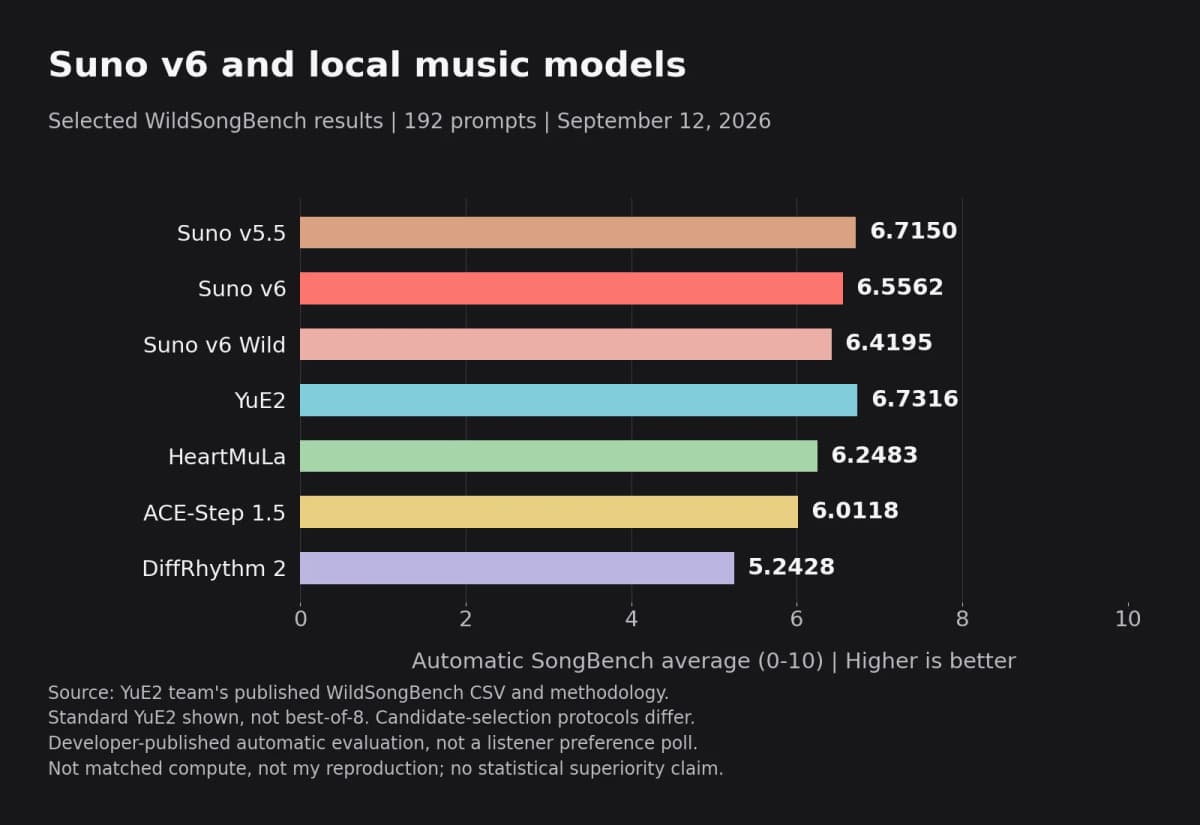
| Evaluated system | SongBench average, higher is better | Phoneme error rate, lower is better |
|---|---|---|
| Suno v5.5 | 6.7150 | 5.96% |
| Suno v6 | 6.5562 | 7.58% |
| Suno v6 Wild | 6.4195 | 7.45% |
| YuE2 | 6.7316 | 8.44% |
| HeartMuLa | 6.2483 | 10.71% |
| ACE-Step 1.5 | 6.0118 | 7.46% |
| DiffRhythm 2 | 5.2428 | 18.41% |
SongBench is an automatic quality evaluator. Phoneme error rate measures lyric transcription errors; it is not a score for whether you love the song. Different metrics favor different systems.
These are developer-published system comparisons, with candidate selection and differing generation protocols, not equal-compute tests or an independent listener poll. Treat them as a September 12 snapshot, not a score for subsequent updates. The data does not establish statistically significant superiority. It also shows why "newer always wins" is too broad: v5.5 scores above v6 on these two metrics, despite my positive impression of Suno now. YuE benchmark results and evaluation scope, full-precision results.
The rights story is still part of the history
The 2024 copyright complaint against Suno alleged unauthorized copying of recordings for training. That is an allegation in a court filing, not a conclusion I can establish by listening to a generated song. The filed complaint.
The v6 industry partnerships represent a change in Suno's stated approach, but they do not settle every dispute. MusicRadar reported further Universal and Sony allegations involving v6 on September 22, 2026. Universal and Sony's allegations about Suno v6.
Suno's current terms also distinguish free-tier personal, non-commercial use from conditional paid-tier commercial use, including permitted-download requirements. They do not guarantee that copyright exists in an output. Upload rights, remix rules and your distribution platform's policies still matter. Suno's Terms of Service.
My take: better sound makes control more valuable
I am positive about Suno's sound now. I want to use that progress to develop ideas, compare arrangements and try directions I might otherwise leave unfinished. I do not need to pretend every result is a finished record to find that useful.
My next comparison would keep the lyrics and brief fixed, listen at matched loudness and separate first impressions from editability. I would also count failed attempts and setup time. A tool that occasionally produces a brilliant song can still be difficult to use on a deadline.
Suno gives me a convenient place to explore. ACE-Step and the other local projects give me reasons to look beyond one hosted service. My earlier article on AI and music production covers that broader relationship; the recent releases make it more practical to investigate.
I like what I am hearing. Now I want tools that let me do more with the parts worth keeping.