You can make a complete track with free synth VST plugins. The difficult part is choosing a few instruments you will learn instead of installing another hundred presets and calling that progress.
My shortlist covers five different jobs: Vital for visual wavetable work, Surge XT for a broad hybrid engine, Dexed for DX7-style FM, TAL-NoiseMaker for a compact subtractive workflow and Zebralette 3 for spectral oscillator design.
Checked November 11, 2026. All five have a free option on their official developer pages. This is a source-checked selection guide, not a new audio shootout or a measured CPU ranking. I separate documented features from the sounds and exercises I would try.
Free synth VST plugins: choose by the job
| Synth | I would investigate it for | Free-version detail |
|---|---|---|
| Vital Basic | Visual wavetable sound design | Full synth engine; smaller included content library |
| Surge XT | Broad hybrid synthesis and layered patches | Free, open-source project |
| Dexed | DX7-style FM and compatible patch management | Free software under GPL v3 |
| TAL-NoiseMaker | Direct subtractive basses, leads and pads | Free download on the official product page |
| Zebralette 3 | Spectral waveform editing and animated timbres | Freeware; not the complete Zebra 3 instrument |
The table is a workflow map, not a claim that one synth wins every category. Bass, pads and leads are possible in several of them. I would choose the interface that makes the next useful sound easiest to build.
Vital Basic: a strong starting point for visual sound design
Vital provides its full synth engine in the Basic tier, with 75 presets and 25 wavetables listed on the official page. Paid tiers add content and other benefits; free does not mean a timed engine demo.
Vital displays waveforms, modulation and filter movement in an unusually direct way. That makes it a useful candidate for learning why a sound changes when an envelope, LFO or wavetable position moves.
I would start with one oscillator, a filter and an envelope. Make a plain bass patch before adding unison, stereo movement and effects. Then assign one modulation source to a clearly audible destination. You learn more from hearing one controlled change than from opening a complex preset and moving unrelated controls.
There is one important qualification to the phrase "all features": the website describes text-to-wavetable as a web service, with a daily request limit outside the unlimited paid options. Core synthesis and online service allowances are different things.
The current requirements list 64-bit systems and OpenGL 3 or later, with Windows, macOS and Ubuntu Linux packages. Check the download for your exact system rather than assuming an attractive interface will run on any old machine.
Surge XT: breadth without a collection subscription
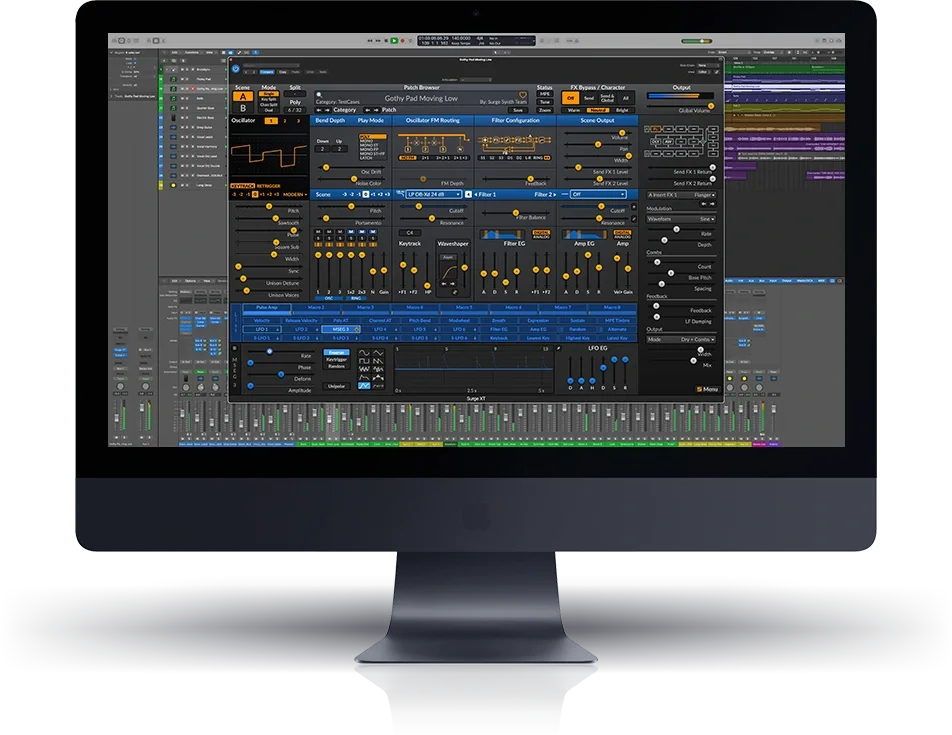
Official interface image: Surge Synth Team. Surge XT.
Surge XT is a free, open-source hybrid synthesizer with multiple synthesis approaches, flexible modulation, effects and two scenes for layered or split patches. The project also documents MPE and microtuning support.
This is the instrument I would investigate when one straightforward oscillator-and-filter path is no longer enough. The extra breadth is valuable, but it also means more decisions. A busy interface should not push you into changing everything at once.
A useful exercise is to make one simple sound in Scene A, then add a contrasting Scene B only when you can explain its role. A bright layer might provide attack while the first sound supplies body. If both layers are fighting for the same space, mute one before reaching for more processing.
The official FAQ distinguishes the open-source license and practical usage questions. The download page also separates release builds from nightly builds. For a session you need to recall later, I would start with a stable release rather than assume newer automatically means safer.
Dexed: learn FM rather than collect another analog-style synth
Dexed is closely modeled on the Yamaha DX7 and also works as a compatible patch librarian and manager. Its official page describes cross-platform support and DX7/TX7 SysEx handling.
Its value in this list is the different way it encourages you to think. FM can move from a clean, simple tone to a much more complex spectrum through operator relationships. That makes Dexed a useful learning candidate for electric-piano-like sounds, bells and sharper digital textures.
I would not begin by changing all the operators in a dense patch. Start with a simple arrangement, change one modulation relationship and listen to how the attack and harmonic content respond. Save several clearly named stages so you can compare them.
Compatible patch loading is also not a guarantee that every downloaded bank has appropriate redistribution or sample rights. Keep third-party content licenses separate from the synth's software license.
TAL-NoiseMaker: fewer detours between an idea and a patch
TAL-NoiseMaker offers a compact virtual-analog setup with oscillators, filters, envelopes, LFOs and built-in effects. The current product page provides free downloads and publishes separate operating-system packages.
I would reach for this kind of layout when I wanted a bass, lead or pad without spending the first twenty minutes choosing an architecture. A small control set can be a creative advantage when you already know the job.
Try making the same short bass phrase with a saw, pulse and a simpler low-frequency shape. Keep the MIDI and level consistent. Change the filter envelope before adding distortion or a chorus, and listen to whether the patch leaves room for the kick.
The developer describes low CPU use, but that is not a measured ranking in this article. Your patch, voice count, oversampling, host and computer determine the practical load. Test it in the arrangement you intend to run.
Zebralette 3: a small instrument with a deep oscillator
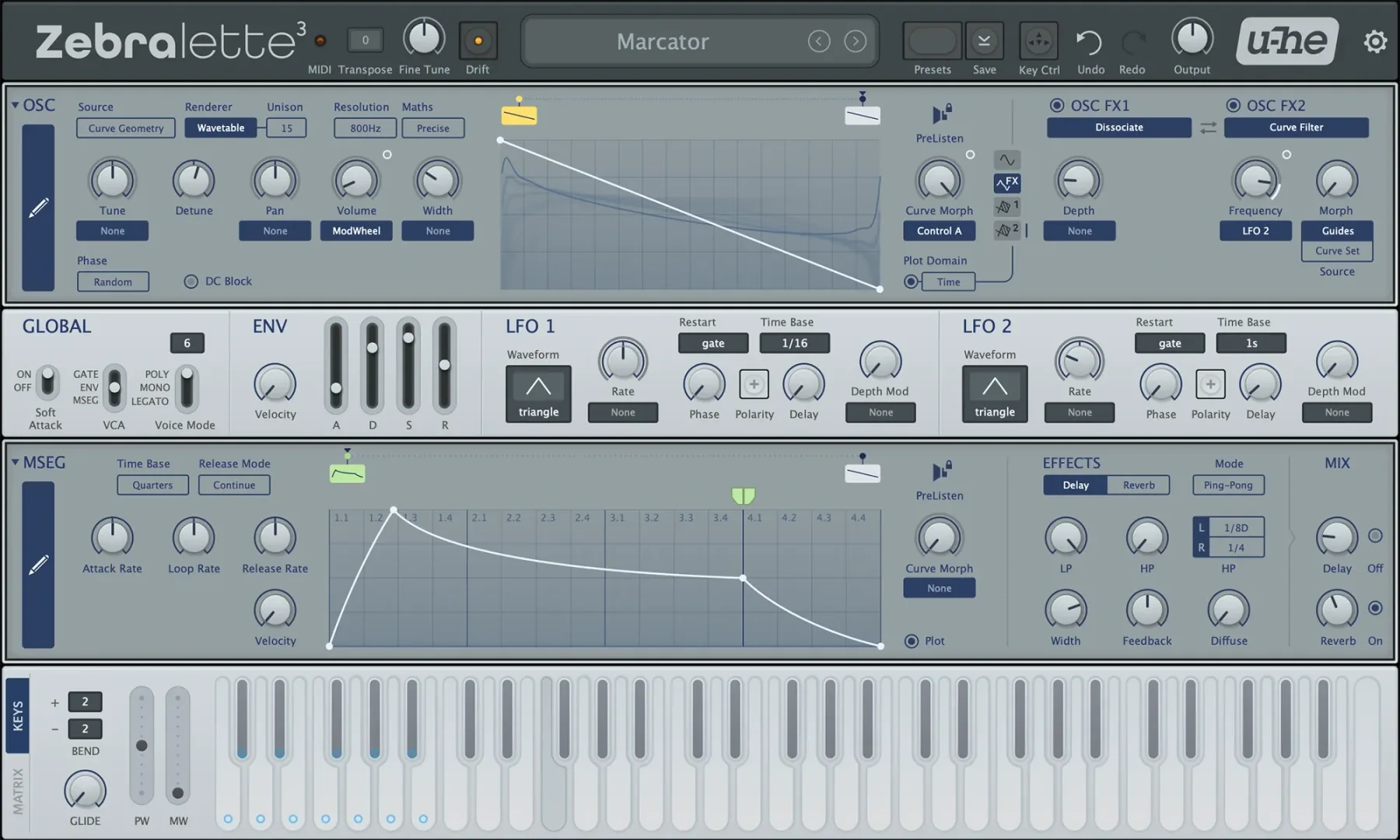
Official interface image: u-he. Zebralette 3.
Zebralette 3 takes a single spectral oscillator into a compact synth environment with modulation, delay and reverb. Its official page documents waveform editing, an MSEG and wavetable and additive rendering options. It is freeware, not the full paid Zebra 3.
This is the pick I would investigate when the movement inside a tone interests me more than stacking more oscillators. A single oscillator can still contain a lot of complexity.
My first exercise would be one sustained note. Shape a waveform, add slow movement and save a version before increasing the modulation depth. Then play a chord and check whether the texture still supports the song. A patch that fascinates on one note can become distracting across a progression.
Pay attention to the product name and download destination. Older Zebralette pages describe the previous Zebra2-based instrument. A link that loads successfully can still take you to the wrong generation.
Which free synth should you install first?
For a beginner who likes visual feedback, I would start by comparing Vital Basic and TAL-NoiseMaker. The choice is between a detailed visual wavetable workflow and a more contained subtractive layout, not between professional and unprofessional sound.
For broader synthesis experiments, investigate Surge XT. For a genuinely different method, add Dexed rather than another similar subtractive instrument. Choose Zebralette 3 when you want to spend time shaping the oscillator itself.
Install one first. Finish a patch and use it in a short arrangement before deciding what is missing. You can always add a second instrument when the limitation becomes clear.
Check formats, graphics requirements and project recall
"VST" is often used casually to mean any plugin, but formats matter. Logic uses Audio Units. Other DAWs may prefer VST3 or CLAP, and AAX support cannot be assumed across this list. Each developer's current download page is the authority for the package you need.
Surge XT explicitly provides an Intel/Apple Silicon universal Mac build. Vital publishes Apple Silicon support and graphics requirements. Check the remaining installers individually, especially if you rely on an older OS, Linux distribution or legacy host.
Save the synth version and any external presets or wavetables needed by a project. A song that depends on missing content is not made easier to recall by the fact that its instrument was free.
Learn one synth before buying the next
My VST picks by category cover paid and free tools with a wider scope. For more genuinely free instruments and effects, see the free plugin roundup and Steinberg's free classic VST collection.
I would spend the next hour making one bass, one lead and one pad in a single instrument. Keep the arrangement small enough that you can hear the decisions. The most useful download is the one you learn well enough to stop browsing.
Research and drafting were AI-assisted. The cover is an AI-generated editorial illustration; the interface images are official developer materials. No new listening comparison, installation test or CPU benchmark is claimed.