To understand how to use AI for learning without outsourcing your thinking, make the model wait.
Try the problem first, ask it to locate the earliest gap in your reasoning, take one hint at a time, then close the chat and rebuild the answer from memory. Finish with a new problem that the AI has not shown you.
Two July 2026 papers help explain why this sequence matters. A randomized experiment found higher immediate and one-week test scores when undergraduates had access to generative AI. A separate simulation study found that LLM teachers often interrupted early and revealed more of the solution than human teachers. The studies measure different things and neither proves that one workflow works for every learner. Together, they support a useful boundary: AI can improve the learning process, but task completion is not evidence that the learner can perform independently.
Reader level: Intermediate. You do not need a background in education research, but the article distinguishes randomized evidence, simulation results, subgroup associations, and practical interpretation.
Contents
The short answer: control when AI steps in
Keep the first attempt and final recall unaided. Give AI three narrow jobs in between: diagnose the first gap, reveal help gradually, and generate a different problem that tests the same skill.
This is a learner-controlled intervention policy. You decide when the model may enter, how much it may reveal, and what evidence will count as learning. A correct assisted artifact does not pass that test on its own.
What the July studies actually measured
The strongest recent evidence does not support either extreme. It does not show that AI inevitably harms learning. It also does not show that access to a capable model guarantees understanding.
| Evidence | Main finding | What it supports | What it cannot establish |
|---|---|---|---|
| --- | --- | --- | --- |
| Randomized undergraduate experiment | AI access raised immediate and one-week knowledge-test scores in the reported setting | AI can support learning under a controlled design | The effect of every AI workflow, subject, learner, or time horizon |
| INT-BENCH simulation | Tested LLM teachers intervened early, often, and with substantial solution content | Assistance needs timing and disclosure limits | Human learning outcomes from ordinary product use |
| 77-person algebra-hint study | 70% of generated hints passed review; human-hint gains were larger | AI hints require quality checks | A ranking of current AI tutors |
A randomized experiment found retained gains
Experimental Evidence on the Learning Impact of Generative AI, submitted July 9, randomized 211 undergraduates to an AI-allowed or AI-forbidden condition. Students learned one unfamiliar topic—blockchain, carbon capture, or CRISPR—then wrote an analytical essay. They took an unaided knowledge test immediately and returned about one week later for another test and essay without AI or external resources.
Measured: AI access raised immediate test scores by 6.7 percentage points from a 56.3% control mean. That equals 0.27 standard deviations in the paper. About one week later, the AI-allowed group remained 5.1 points ahead, also 0.27 standard deviations. Of the 211 students who entered the first session, 204 completed both sessions.
Measured: Access did not mean universal use. Sixty-eight percent of the treatment group used AI. Among treated students, 57% used it to explain concepts, 31% to draft responses, and 17% to summarize readings.
The researchers classified ChatGPT logs from AI users as augmentation, automation, mixed, or other. Forty-nine percent were classified as pure augmentation and 32% as pure automation. The automation group gained more on the first AI-assisted essay, but that essay advantage fell close to zero when AI was removed. The augmentation group retained positive test and essay estimates, although several subgroup estimates were statistically imprecise.
Important limit: Students were randomized to AI access, not to augmentation or automation behavior. That makes the overall access effect causal within the study. The behavioral subgroup contrast is an association. It cannot prove that asking for explanations caused the later difference.
The lab also held learning time largely fixed. The authors explicitly warn that the study does not establish that widespread AI adoption will raise total learning. Outside the lab, a student may use AI to finish early and spend the saved time elsewhere.
A simulation found that LLM teachers step in too early
AI Assistants Overassist, submitted July 23, introduces INT-BENCH. It simulates an LLM student solving 1,500 code-debugging, mathematics, and brain-teaser problems while an LLM teacher watches the reasoning trace and decides whether to intervene.
The standard teacher saw the trace in 50-character increments. An oracle teacher saw the full reasoning, answer, and correctness verdict before deciding whether and when to help.
Measured: Standard LLM teachers intervened in 90% of trials, on average after 18% of the reasoning trace. With full information, intervention frequency fell to 54% and average timing moved to 56% of the trace. Standard interventions produced a net accuracy gain of 0.20: 25.5% of initially wrong answers became correct, while 5.4% of initially correct answers became wrong.
Immediate accuracy improved, but context from the prior problem and intervention did not significantly improve performance on one new, related problem. The reported generalization changes ranged from -0.04 to +0.04 across the three domains.
The paper also compared LLM interventions with 50 people acting as teachers on 30 brain teasers. In the standard condition, LLM teachers revealed the full solution in 14.2% of interventions, compared with 5.4% for humans. Near-complete scaffolds appeared in about 45% of LLM interventions and 30% of human interventions.
Important limit: INT-BENCH studies simulated students. A model continuing a reasoning trace does not reproduce human memory, motivation, confusion, or cognitive load. Its transfer test used one related problem immediately after the original episode. The paper does not measure human retention over days or months.
Practical interpretation: A model can improve the answer while consuming the reasoning opportunity. Learning requires a separate test where the assistance is absent.
Why correct output can hide weak learning
An AI response can optimize the artifact in front of you: the solved equation, passing function, polished paragraph, or concise summary. Your learning goal is different. You need to reconstruct the reasoning later and apply it when the surface details change.
That creates three distinct outcomes:
| Outcome | What it proves | What it does not prove |
|---|---|---|
| --- | --- | --- |
| The assisted task is correct | The combined human-AI process produced a valid result | The learner can reproduce the method |
| The learner can explain the result | The learner can describe the reasoning now | The learner can transfer it to a new case |
| The learner solves a new case later | The skill survived a change of context and time | The skill will remain without further practice |
The boundary resembles any AI-assisted production workflow. A system can produce text that sounds complete while losing the author's judgment. The same risk is visible in using AI without losing the author's own context and standards. In code, a completed patch still needs an independent test; large code-agent workloads do not remove the need for verification.
Learning needs its own verification layer. The model should help create practice, diagnose errors, and adjust difficulty. It should not be the only place where the answer exists.
How to use AI for learning: a five-step workflow
This sequence is a practical synthesis, not a new learning theory. The April 2026 TACO framework already organizes learner control as Think, Ask, Check, and Own. It was derived from qualitative analysis of 133 Hong Kong secondary students' written reflections. The five steps below add an explicit hint ladder, unaided transfer problem, and delayed recall check to the same human-first boundary.
Use the workflow for a concept, a problem set, a piece of code, or an argument. One cycle can take 15 minutes. A harder topic may need several cycles.
1. Define the skill and attempt it unaided
Write one observable target:
Then attempt the task before opening the AI conversation. Preserve the attempt, including the point where you became uncertain. This gives the tutor evidence about your actual gap and prevents the model's answer from becoming your starting thought.
Do not ask, “Teach me calculus.” Ask, “I can differentiate polynomials, but I do not understand why the chain rule multiplies derivatives. I tried this explanation and got stuck here.”
2. Ask for one hint, not a solution
Set an intervention budget. Start with one question, counterexample, or directional hint. Ask the model to wait for another attempt before giving more.
Useful hint levels:
Move down the list only when the previous level fails. A full solution remains available, but it becomes the last intervention rather than the default.
The older study Learning gain differences between ChatGPT and human tutor generated algebra hints shows why hints still need scrutiny. Seventy percent of ChatGPT-generated hints passed manual quality checks in its 77-person experiment. Both conditions had positive learning gains, but gains were statistically significant only for the human-authored hints and were larger than the ChatGPT condition. The paper used an early ChatGPT system, so it cannot rank current models. It does show that “hint” is not a quality guarantee.
3. Explain the idea back without copying
Close or hide the model response. Explain the method in your own words. Include:
Ask the model to grade the explanation against a short rubric, not to rewrite it immediately. Request the smallest correction needed. If the model claims a factual error, check the source material before accepting the correction.
Clear explanations are useful when they preserve the technical core. The short article on AI explanations that make difficult ideas easier to follow makes the same point: accessibility should not require pretending the subject is simple.
4. Solve a transfer problem without AI
Ask the model to create one new problem that uses the same underlying skill but changes the surface form. Tell it not to include the answer yet.
Examples:
Then leave the chat and solve the new problem unaided. Compare your result only after committing to an answer.
This step separates pattern copying from transfer. It also responds directly to the INT-BENCH result: help on the original problem did not reliably improve the simulated student's performance on a related one.
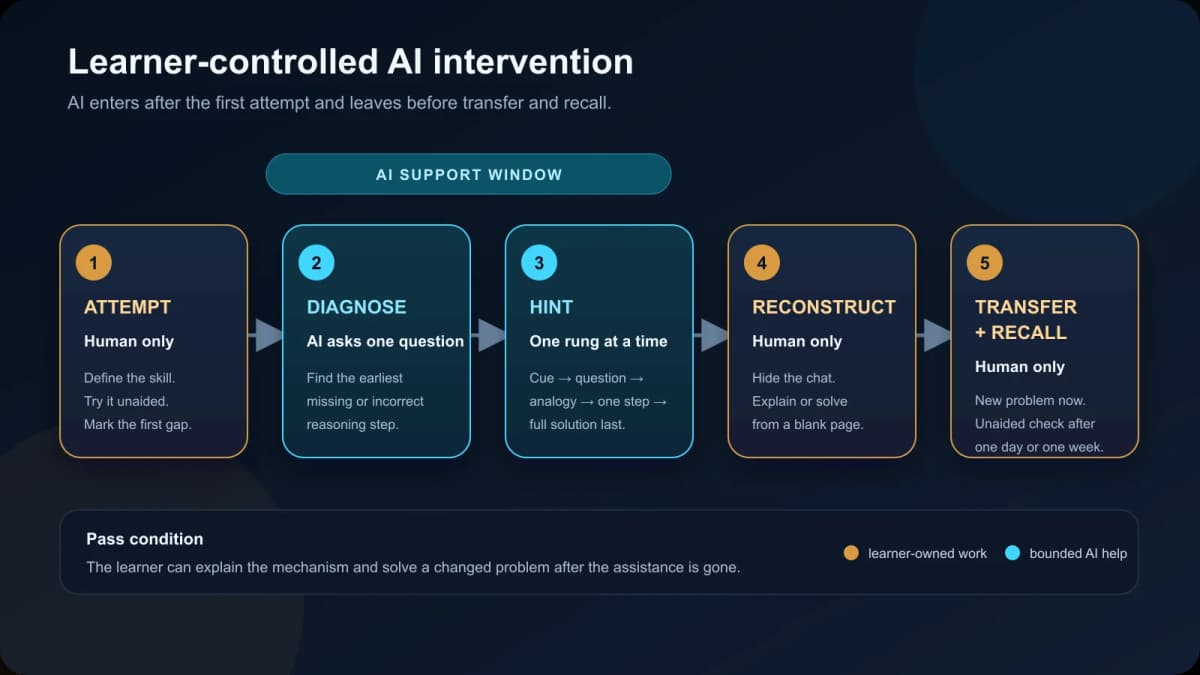
*Caption: AI enters after the first attempt and leaves before the transfer and recall checks.*
5. Run delayed recall
End the session by writing two prompts for your future self:
Answer them the next day. For material that matters, repeat after a week. Do not reopen the original AI conversation until you finish the recall attempt.
The July randomized experiment measured retention at roughly one week, but this workflow does not inherit the paper's effect size. Delayed recall is the local test: it tells you whether your understanding survived your own use of AI.
A reusable AI tutor prompt
This prompt works in a normal chat or a product study mode. Replace the bracketed fields.
Act as a tutor for [topic] at [my level].

My target skill:
[one observable outcome]

What I already know:
[short description]

My first attempt:
[paste the attempt, including where I got stuck]

Rules for this session:
1. Do not give the full solution unless I explicitly end the exercise.
2. Give one hint or one question at a time.
3. Wait for my next attempt before adding help.
4. After I solve it, ask me to explain the method in my own words.
5. Check my explanation for one factual or logical gap at a time.
6. Create one transfer problem with different surface details.
7. Do not reveal that answer until I submit mine.
8. End with two short unaided recall questions for tomorrow.

Use my source material when provided. Mark uncertainty, and do not invent a
citation or fact when the material does not support it.
A stubborn model may still reveal too much. Repeat the boundary in the next turn: “Give only the smallest hint that helps me take one more step.”
How to measure whether you learned
Do not score the session by how polished the model's explanation sounded. Record evidence that belongs to the learner.
| Check | Pass condition |
|---|---|
| --- | --- |
| First attempt | A real attempt exists before assistance |
| Hint budget | The full solution was not the first intervention |
| Explain-back | You stated the mechanism without copying |
| Error diagnosis | You can name why the original attempt failed |
| Transfer | You solved a changed problem without AI |
| Delayed recall | You reconstructed the idea after a day or week |
| Source check | Important facts match course or primary material |
Use a compact log:
Skill:
First-attempt gap:
Hints used:
Explain-back error:
Transfer result:
Next-day recall:
Source checked:
Next practice:
One failed check is not a reason to abandon AI. It identifies the next practice target. A failed transfer problem means return to the mechanism, not request five more examples with solutions attached.
What Study Mode and Guided Learning change
Current products can reduce the prompting overhead, but they do not remove the need for the workflow.
OpenAI's Study Mode documentation, checked July 28, says the mode can ask questions, explain concepts in layers, quiz the learner, use uploaded materials, and guide with a Socratic-style approach. The same page warns that Study Mode can make mistakes and may sometimes give a direct answer.
Google's Guided Learning documentation, also checked July 28, describes guided learning, visual aids, uploaded files, practice questions, feedback, hints, and optional OpenStax resources where available.
Anthropic's education page says Claude's learning mode asks questions intended to help students find answers. That is a product description, not an independent learning result.
Open-source projects are moving in the same direction. The DeepTutor repository released eight versions between June 29 and July 26. Its public history showed 146 commits and 657 newly created forks from June 28 through the July 28 check. Those figures measure engineering activity, not learning outcomes, classroom adoption, or safety.
Choose a mode for convenience, file support, privacy rules, and access. Keep the same behavioral contract:
Where this workflow can fail
The model can teach the wrong thing
An eloquent explanation can still contain a false premise, invented citation, or invalid step. Check high-stakes and course-specific claims against assigned material, official documentation, or primary sources.
A hint can leak the answer
“Think about conservation of energy” may be a useful direction. A paragraph that names the equation, substitutes the values, and leaves one arithmetic step is a solution with the label changed. Tighten the hint budget.
You can mistake recognition for recall
Reading an explanation twice creates familiarity. It does not prove reconstruction. Close the answer and write the mechanism from memory.
The transfer problem can be too similar
Changing only the numbers tests repetition. Ask the model to change context, representation, and distractors while preserving the skill.
The workflow can conflict with course rules
Follow the instructor's AI policy. An effective study method can still be prohibited for graded work, protected material, or assessments.
The evidence remains narrow
The randomized paper covers one selective undergraduate sample, three technical topics, a fixed-time lab, and about one week of retention. INT-BENCH uses simulated students and immediate transfer. The algebra-hint study used an older model and 77 participants. None provides a universal effect size for “AI tutoring.”
The safe conclusion is narrower: AI can support learning, especially when it helps the learner inspect and practice their own reasoning. Independent transfer and delayed recall should decide whether the session worked.
Claim checks
| Claim | Evidence-based wording |
|---|---|
| --- | --- |
| “AI improves learning by 0.27 standard deviations.” | One randomized undergraduate experiment reported a 0.27-SD immediate test effect and a 0.27-SD effect about one week later under its design. |
| “Augmentation is proven better than automation.” | The study randomized AI access, not use style. Augmentation and automation subgroup differences are associative and partly imprecise. |
| “AI tutors intervene too early.” | Four LLM teachers did so in INT-BENCH with a simulated student; the result is not a universal measurement of every tutor or learner. |
| “AI hints do not work.” | Too broad. An older algebra study found positive gains in both conditions, but only human-hint gains were significant and 70% of generated hints passed review. |
| “This five-step workflow is a new pedagogy.” | It is a practical synthesis that extends the TACO framework with a hint ladder, transfer problem, and delayed recall check. |
| “Study modes solve the problem.” | Vendor documentation describes question, hint, and quiz features. It also acknowledges mistakes and direct-answer leakage. |
| “A correct assisted answer proves learning.” | It proves task success for the combined process. Transfer and delayed recall require separate unaided checks. |