How do room acoustics influence mic placement strategies when recording acoustic guitars?
Recording acoustic guitars is an art that requires precision, finesse and, most importantly, an understanding of microphone placement. The way a microphone captures the sound of your guitar significantly affects the final audio quality. Proper mic placement can produce clear, natural and vibrant acoustic guitar tracks, while a poor setup can lead to a myriad of audio issues. In this article, we will explore several microphone placement techniques instrumental in securing an excellent recording from your acoustic guitar.
Understanding Your Microphone: Directionality
Before starting with an acoustic guitar recording, understanding the concept of microphone directionality is essential. In simple terms, directionality refers to the areas in which a microphone picks up sound best. The primary types of directionality include cardioid, supercardioid, omnidirectional, and bidirectional. Choose the most appropriate type for the desired sound and ambience you want to capture.
Cardioid microphones
A cardioid microphone is so named because its pick-up pattern is heart-shaped. It captures sound from the front and sides but rejects it from the rear. This directionality is suitable for close-miking, as it eliminates room noise, focuses on the source and provides a rich and detailed sound.
Supercardioid microphones
Supercardioid microphones capture sound from the front and have a narrow pick-up pattern to the sides. Compared to the cardioid, it is more directed and therefore captures less room noise.
Omnidirectional microphones
Omnidirectional microphones pick up sound from all directions. This type is handy if you’re trying to capture a room’s ambience or record multiple sources simultaneously. However, they can also capture unwanted noise.
Bidirectional microphones
Bidirectional microphones, also known as figure-8 microphones, capture sound from the front and rear but reject from the sides. This directionality is handy in certain recording scenarios, such as when you want to capture a duet.
Understanding the Acoustic Guitar: Sound Source Points
The sound of an acoustic guitar comes from various points. The sound-hole, the area between the sound-hole and the bridge, and the fretboard. Understanding these areas and their characteristic sounds is essential when placing your microphone.
The sound-hole
Placing a microphone directly in front of the sound hole can often generate a boomy, less defined sound due to the resonating air.
The area between the sound-hole and the bridge
This area produces a warmer, fuller sound, while simultaneously capturing some of the guitar’s bright, treble tones. Aiming the microphone here can create a balanced sound.
The fretboard
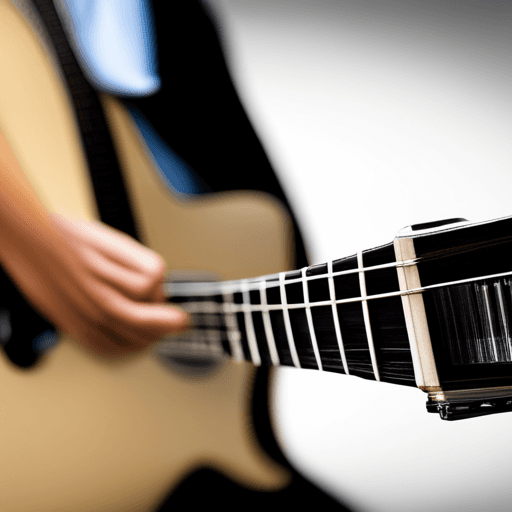
Miking the fretboard—or neck area—captures the guitar’s bright, high-frequency sounds. This technique is excellent for detailed recording, but caution must be placed not to lose the richness of the low-end frequencies.
Placement Techniques
Now that we have recognized the types of microphones and acoustic guitar sound sources, let’s delve into specific mic placement strategies.
Single Mic Placement
Using a single microphone is a common method and can yield excellent results when done correctly. Generally, a cardioid mic about 12-16 inches from the 12th fret yields a balanced sound. Some prefer pointing the mic towards the sound-hole for more bass frequencies.
Stereophonic Technique
For a stereo image, use two microphones. One can be placed at the 12th fret, and the other aimed towards the body. This technique can deliver a dynamic, full range of sounds and create a depth that isn’t achievable with a single microphone setup.
Remember that recording acoustic guitars is both a science and an art. Knowing where your sound is coming from and how your mic captures it, can significantly enhance your recording. Experiment with different placements and angles to see what works best for your unique sound.